This website works best with a newer web browser such as Chrome, Firefox, Safari or Microsoft Edge. Internet Explorer is not supported by this website.

Winter storm affecting the southern Plains to the Mid-Atlantic

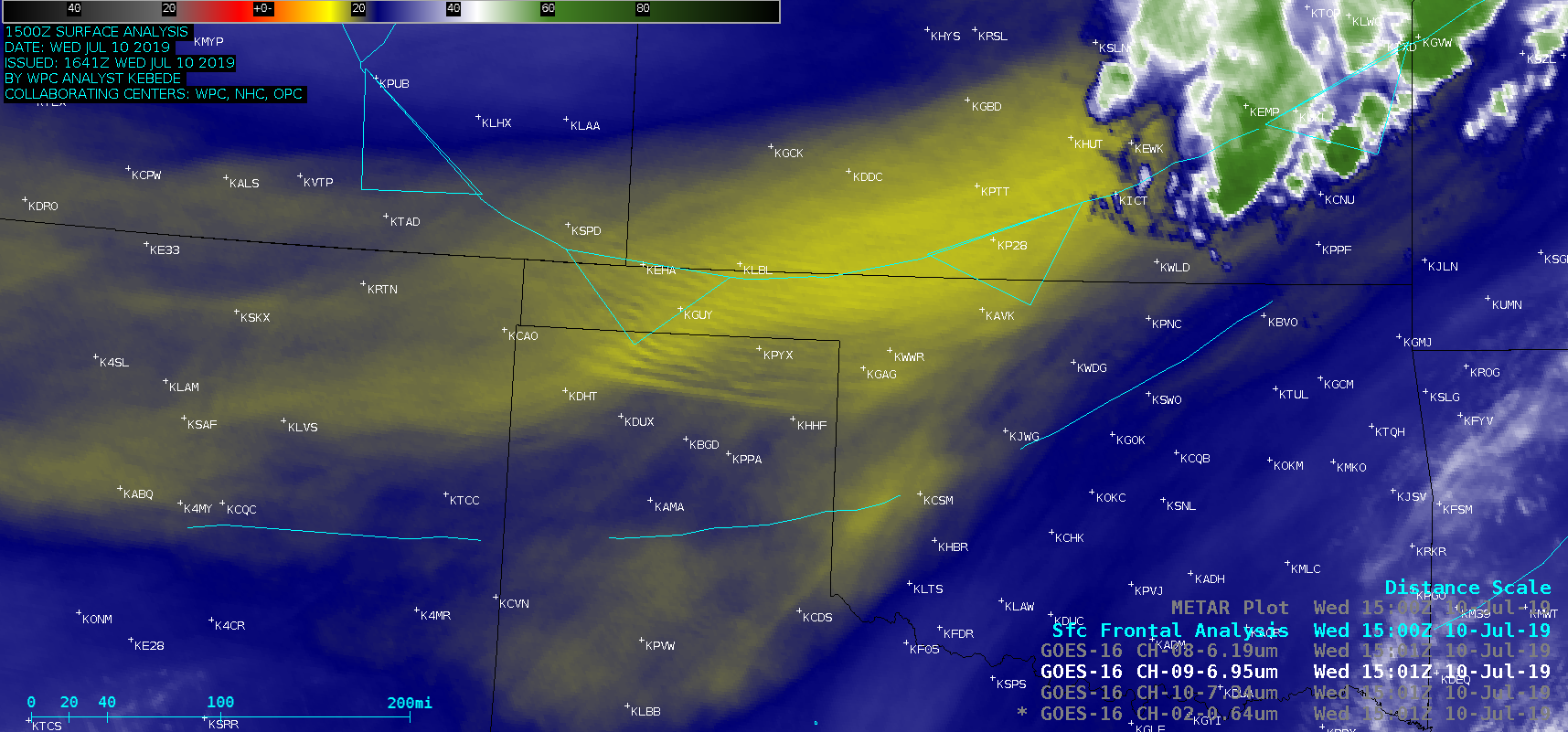
A large storm produced significant winter weather impacts from the southern Plains to the Mid-Atlantic states during the 07 December10 December 2018 period. GOES-16 (GOES-East) Mid-level Water Vapor (6.9 µm) images (above) showed the progression of the storm during that 3-day interval.As much as 10-11 inches of snow fell in the Lubbock,... Read More

GOES-16 Mid-level Water Vapor (6.9 µm) images, with hourly plots of surface weather type [click to play MP4 animation]

GOES-16 Mid-level Water Vapor (6.9 µm) images, with hourly plots of surface weather type [click to play MP4 animation]

A large storm produced significant winter weather impacts from the southern Plains to the Mid-Atlantic states during the 07 December10 December 2018 period. GOES-16 (GOES-East) Mid-level Water Vapor (6.9 µm) images (above) showed the progression of the storm during that 3-day interval.

As much as 10-11 inches of snow fell in the Lubbock, Texas area during 07-08 December. A sequence of  Suomi NPP VIIRS Visible (0.64 µm) and Near-Infrared “Snow/Ice” (1.61 µm) images (below) showed the snow cover melting from 09-10 December. Snow cover absorbs radiation at the 1.61 µm wavelength, so it appears very dark on those images.

Suomi NPP VIIRS Visible (0.64 µm) and Near-Infrared

Suomi NPP VIIRS Visible (0.64 µm) and Near-Infrared “Snow/Ice” (1.61 µm) images [click to enlarge]

Portions of northern and northeastern Arkansas received ice accrual of up to 0.5 inches due to freezing rain — those areas with snow and ice on the ground can be seen in a comparison of Suomi NPP VIIRS Visible (0.64 µm) and Near-Infrared “Snow/Ice” (1.61 µm) images (below).

Suomi NPP VIIRS Visible (0.64 µm) and Near-Infrared "Snow/Ice" (1.61 µm) images [click to enlarge]

Suomi NPP VIIRS Visible (0.64 µm) and Near-Infrared “Snow/Ice” (1.61 µm) images [click to enlarge]

Significant snowfall resulted across the central Appalachians and Mid-Atlantic, especially for so early in the winter season — 1-minute Mesoscale Domain Sector “Red” Visible (0.64 µm) images (below) revealed embedded convective elements and banding that helped to enhance snowfall rates across that region on 09 December. GLM Groups are also plotted on the images; however, there was no satellite signature of lightning associated with the convective elements until 2130 UTC in north-central North Carolina.

GOES-16

GOES-16 “Red” Visible (0.64 µm) images, with plots of hourly surface weather type in yellow and GLM Groups in red [click to play MP4 animation]


===== 11 December Update =====

GOES-16

GOES-16 “Red” Visible (0.64 µm) and Near-Infrared “Snow/Ice” (1.61 µm) images [click to play animation | MP4]

Once clouds cleared the eastern US on 11 December, the areal coverage of snow cover across the central Appalachians and Mid-Atlantic states could be seen in a comparison of GOES-16 “Red” Visible (0.64 µm) and Near-Infrared “Snow/Ice” (1.61 µm) images (above). Note the darker areas seen on 1.61 µm imagery over parts of eastern Kentucky and also from north-central North Carolina into south-central Virginia: those are areas where the snow cover also received a thin glaze of ice from a period of freezing drizzle/rain.

View only this post Read Less

Mesoscale vortices in Oregon and Idaho

?Cool vortex in the stratus/fog between Burns Junction and Jordan Valley, Oregon this afternoon. Another one was also visible in a higher cloud deck near the Owyhee Mountains #orwx #idwx pic.twitter.com/sL0GfqBUdp — NWS Boise (@NWSBoise) December 8, 2018 * GOES-17 images shown here are preliminary and non-operational *As noted by NWS Boise,... Read More

* GOES-17 images shown here are preliminary and non-operational *

As noted by NWS Boise, a pair of mesoscale vortices were apparent over far southeastern Oregon and far southwestern Idaho on 07 December 2018. A comparison of GOES-17 and GOES-16 (GOES-East) “Red” Visible (0.64 µm) images (below) showed that even with the larger GOES-16 viewing angle (or satellite zenith angle), the features could still be seen rather well.

GOES-17 and GOES-16

GOES-17 and GOES-16 “Red” Visible (0.64 µm) images [click to play animation | MP4]

Topography in feet [click to enlarge]

Topography in feet [click to enlarge]

A look at the local topography (above) indicated that the low altitude quasi-stationary Oregon vortex was located within the Owyhee River valley, just northeast of the Rome airport KREO. With high pressure centered over the Idaho/Montana border (surface analyses), the low-level southerly/southeasterly flow seen in a plot of 12 UTC rawinsonde data from Boise, Idaho (below) was being channeled between the higher terrain surrounding the valley; interactions with that terrain likely caused the Oregon vortex to form. The Idaho vortex was moving toward the northeast — Boise rawindsonde data showed southwest winds at 727 hPa or an altitude of 2700 feet. The 2 vortices wre quite small, having a diameter of only

12 UTC rawinsonde data from Boise, Idaho [click to enlarge]

12 UTC rawinsonde data from Boise, Idaho [click to enlarge]

The pair of vortices likely formed just before or right around sunrise, since there was no signature seen in earlier nighttime MODIS or VIIRS “Fog/stratus” infrared Brightness Temperature Difference (BTD) images {below).

MODIS and VIIRS

MODIS and VIIRS “Fog/stratus” infrared BTD images [click to enlarge]

View only this post Read Less

Industrial and ship plumes in supercooled clouds

A sequence of nighttime MODIS and VIIRS “Fog/stratus” infrared Brightness Temperature Difference (BTD) images (above) revealed long plumes (darker shades of red) streaming southwestward for over 200 miles from their industrial point sources in the Mesabi Range of northeastern Minnesota on 03 December 2018.During the subsequent daytime hours, a comparison of GOES-16 (GOES-East)... Read More

MODIS and VIIRS

MODIS and VIIRS “Fog/stratus” BTD images [click to enlarge]

A sequence of nighttime MODIS and VIIRS “Fog/stratus” infrared Brightness Temperature Difference (BTD) images (above) revealed long plumes (darker shades of red) streaming southwestward for over 200 miles from their industrial point sources in the Mesabi Range of northeastern Minnesota on 03 December 2018.

During the subsequent daytime hours, a comparison of GOES-16 (GOES-East) “Red” Visible (0.64 µm), Near-Infrared “Snow/Ice” (1.61 µm), Near-Infrared “Cloud Particle Size” (2.24 µm) and Shortwave Infrared (3.9 µm) images (below) showed signatures of these Mesabi Range plumes along with others emanating from industrial or power plant sources. A few ship tracks were also apparent across Lake Superior.

Particles emitted from the exhaust stacks at power plants and industrial sites (as well as ships) can act as efficient cloud condensation nuclei, which causes the formation of large numbers of supercooled water droplets having a smaller diameter than those found within the adjacent unperturbed supercooled clouds — and these smaller supercooled cloud droplets are better reflectors of incoming solar radiation, thereby appearing brighter in the Near-Infrared and warmer (darker gray) in the Shortwave Infrared images.

GOES-16

GOES-16 “Red” Visible (0.64 µm), Near-Infrared “Snow/Ice” (1.61 µm), Near-Infrared “Cloud Particle Size” (2.24 µm) and Shortwave Infrared (3.9 µm) images [click to play animation | MP4]

On the following night, another sequence of MODIS and VIIRS “Fog/stratus” infrared Brightness Temperature Difference (BTD) images (below) highlighted a number of industrial and power plant plumes across Minnesota, northern Wisconsin and the Upper Peninsula of Michigan. The curved shape of many of these plumes resulted from boundary layer winds shifting from northerly to westerly as the night progressed.

MODIS and VIIRS "Fog/stratus" BTD images [click to enlarge]

MODIS and VIIRS “Fog/stratus” BTD images [click to enlarge]

During the following daytime hours on 04 December, a comparison of VIIRS Visible (0.64 µm), Near-Infrared “Snow/Ice” (1.61 µm), Shortwave Infrared (3.74 µm) and Infrared Window (11.45 µm) images (below) showed 2 plume types across eastern Nebraska. There were several of the brighter/warmer plumes similar to those noted on the previous day across Minnesota/Wisconsin/Michigan — but one large plume originating from industrial sites just east of Norfolk (KOFK) had the effect of eroding the supercooled cloud deck via glaciation (initiated by the emission of particles that acted as efficient ice nuclei) and subsequent snowfall. This is similar to the process that creates aircraft “distrails” or “fall streak clouds” as documented here, here and here.

VIIRS Visible (0.64 µm), Near-Infrared

VIIRS Visible (0.64 µm), Near-Infrared “Snow/Ice” (1.61 µm), Shortwave Infrared (3.74 µm) and Infrared Window (11.45 µm) images [click to enlarge]


Farther to the east over Ohio and Pennsylvania, another example of the 2 plume types was seen (below) — one plume originating from an industrial site near Cleveland was glaciating/eroding the supercooled cloud and producing snowfall, while another bright/warm supercooled droplet plume was moving southeastward from a point source located west of Indiana County Airport KIDI.

The Cleveland plume was captured by an overpass of the Landsat-8 satellite, with a False Color Red-Green-Blue (RGB) image viewed using RealEarth providing great detail with 30-meter resolution (below). A small “overshooting top” can even be seen above the industrial site southeast of Cleveland, with the swath of glaciated and eroding cloud extending downwind (to the southeast) from that point.

Landsat-8 False Color RGB image [click to enlarge]

Landsat-8 False Color RGB image [click to enlarge]

Coincidentally, Landsat-8 also captured another example of a glaciating cloud plume downwind of the Flint Hills Oil Refinery south of St. Paul, Minnesota on 03 December (below). The erosion/glaciation of supercooled cloud extended as far south as Albert Lea, Minnesota. Similar to the Cleveland example, a small “overshooting top” was seen directly over the plume point source.

Landsat-8 False Color RGB image [click to enlarge]

Landsat-8 False Color RGB image [click to enlarge]

===== 08 December Update =====

The effect of this industrial plume glaciating and eroding the supercooled water droplet clouds over northern Indiana was also seen in a comparison of Terra MODIS Visible (0.65 µm), Near-Infrared “Snow/Ice” (1.61 µm) and Infrared Window (11.0 µm) images (below).

Terra MODIS Visible (0.65 µm), Near-Infrared

Terra MODIS Visible (0.65 µm), Near-Infrared “Snow/Ice” (1.61 µm) and Infrared Window (11.0 µm) images [click to enlarge]

===== 09 December Update =====


During the following daytime hours, GOES-16 “Red” Visible (0.64 µm), Near-Infrared “Snow/Ice” (1.61 µm), Near-Infrared “Cloud Particle Size” (2.24 µm), Shortwave Infrared (3.9 µm) and “Clean” Infrared Window (10.3 µm) images (below) showed a number of plumes from industrial sites (many of which were likely refineries) streaming southeastward and eastward over the Gulf of Mexico on 09 December. Note the lack of a plume signature in the 10.3 µm imagery.
GOES-16 "Red" Visible (0.64 µm), Near-Infrared "Snow/Ice" (1.61 µm), Near-Infrared "Cloud Particle Size" (2.24 µm), Shortwave Infrared (3.9 µm) and "Clean" Infrared Window (10.3 µm) images [click to play MP4 animation]

GOES-16 “Red” Visible (0.64 µm), Near-Infrared “Snow/Ice” (1.61 µm), Near-Infrared “Cloud Particle Size” (2.24 µm), Shortwave Infrared (3.9 µm) and “Clean” Infrared Window (10.3 µm) images [click to play MP4 animation]

View only this post Read Less

SpaceX launch of Spaceflight SSO-A

* GOES-17 images shown here are preliminary and non-operational *SpaceX launched a Spaceflight SSO-A mission from Vandenberg Air Force Base (KVBG) in California at 1834 UTC on 03 December 2018. GOES-17 Upper-level (6.2 µm), Mid-level (6.9 µm) and Low-level (7.3 µm) Water Vapor images in addition to Near-Infrared “Snow/Ice” (1.61 µm), Near-Infrared “Cloud Particle Size” (2.24 µm)... Read More

GOES-17 Upper-level (6.2 µm), Mid-level (6.9 µm) and Low-level (7.3 µm) Water Vapor, plus Near-Infrared

GOES-17 Upper-level (6.2 µm), Mid-level (6.9 µm) and Low-level (7.3 µm) Water Vapor, plus Near-Infrared “Snow/Ice” (1.61 µm), Near-Infrared “Cloud Particle Size” (2.24 µm) and Shortwave Infrared (3.9 µm) images [click to enlarge]

* GOES-17 images shown here are preliminary and non-operational *

SpaceX launched a Spaceflight SSO-A mission from Vandenberg Air Force Base (KVBG) in California at 1834 UTC on 03 December 2018. GOES-17 Upper-level (6.2 µm), Mid-level (6.9 µm) and Low-level (7.3 µm) Water Vapor images in addition to Near-Infrared “Snow/Ice” (1.61 µm), Near-Infrared “Cloud Particle Size” (2.24 µm) and Shortwave Infrared (3.9 µm) images (above) showed the hot thermal signature of superheated air from the booster rocket engines, along with a brief cold thermal signature of the booster engine condensation cloud on Water Vapor images. A second hot thermal signature was seen over the adjacent waters of the Pacific Ocean at 1840 UTC as the first stage rocket fired its entry burn to land on a drone ship. Since a GOES-17 Mesoscale Domain Sector was positioned over that region, images were available at 1-minute intervals.

View only this post Read Less