This website works best with a newer web browser such as Chrome, Firefox, Safari or Microsoft Edge. Internet Explorer is not supported by this website.

Day Cloud Phase Distinction RGB and Lake Effect Snow

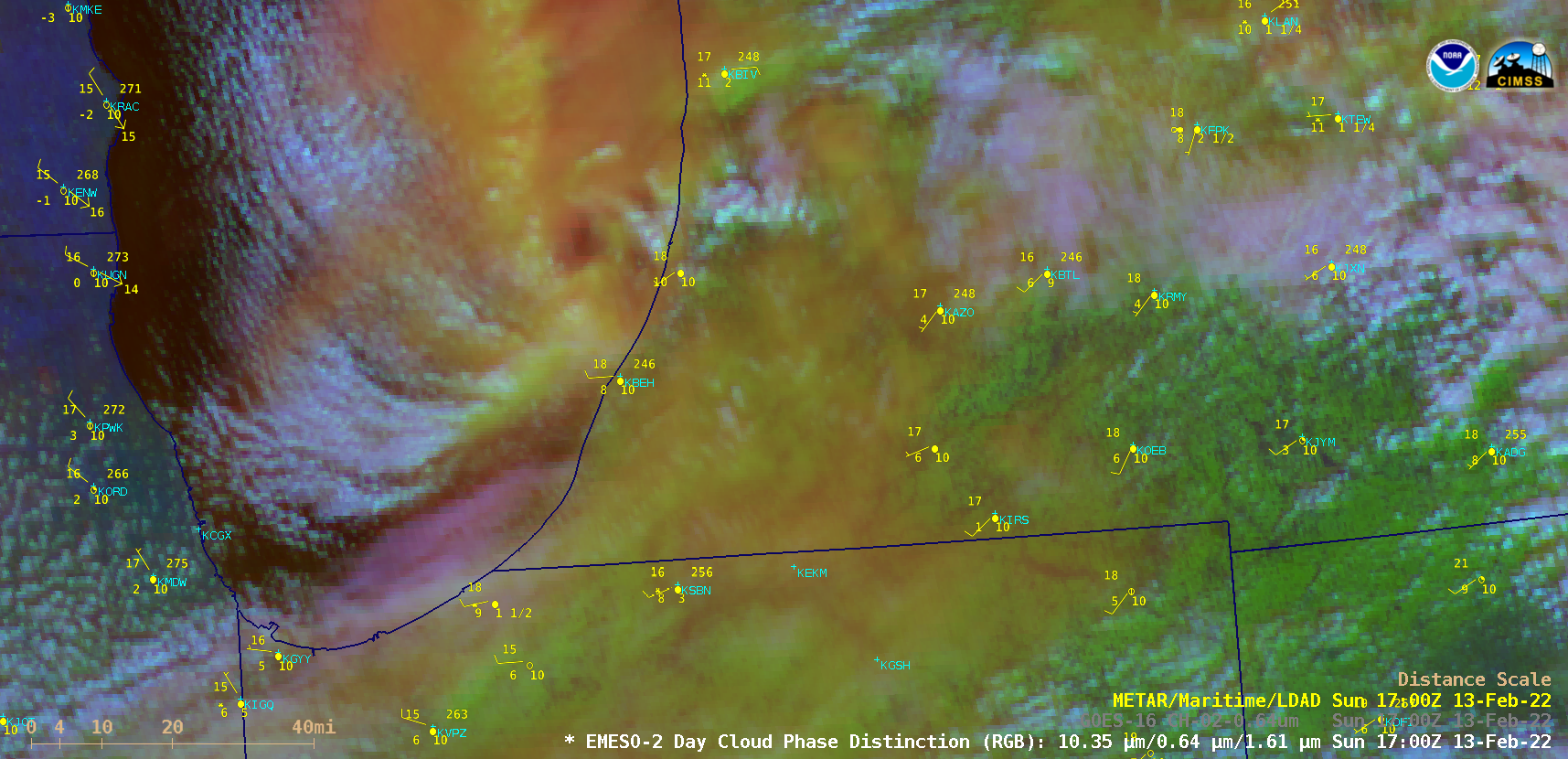
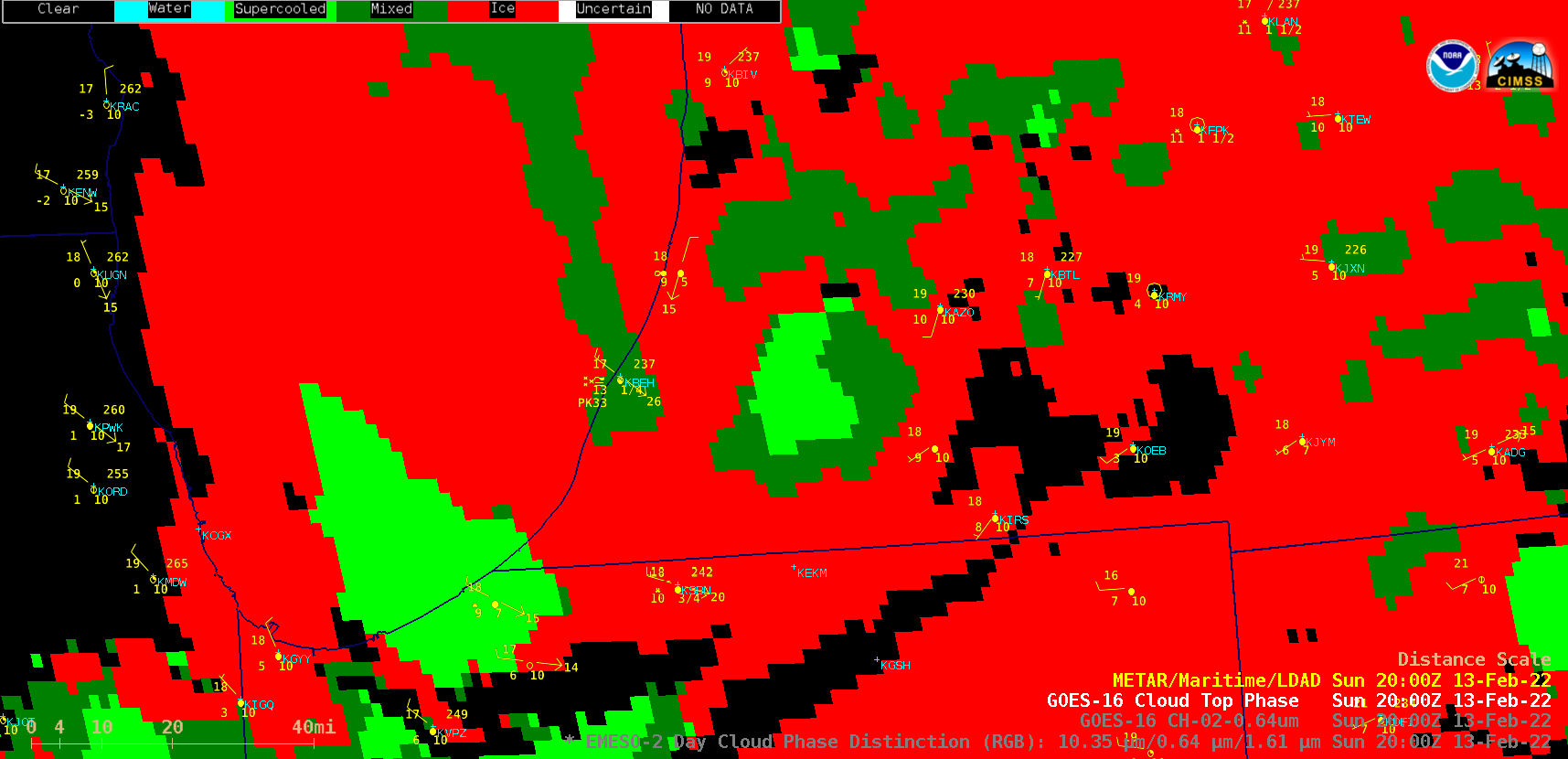
The toggle above shows NEXRAD radar (source) inset during lake-effect precipitation with two versions of the GOES-16 Day Cloud Phase Distinction RGB, one with default values, and one with ‘Green’ (ABI Band 2 Visible imagery at 0.64 ?m) and ‘Blue’ (ABI Band 5 at 1.61 ?m) reduced from default values, from 79% to 60% for Band 2, and from 59%... Read More

GOES-16 Day Cloud Phase Distinction (see text for details) at 1331 UTC and NEXRAD Reflectivity at 1333 UTC, both on 15 November 2021 (Click to enlarge)

The toggle above shows NEXRAD radar (source) inset during lake-effect precipitation with two versions of the GOES-16 Day Cloud Phase Distinction RGB, one with default values, and one with ‘Green’ (ABI Band 2 Visible imagery at 0.64 ?m) and ‘Blue’ (ABI Band 5 at 1.61 ?m) reduced from default values, from 79% to 60% for Band 2, and from 59% to 50% for Band 5 (by using the composite option feature in AWIPS). It can be advantageous to alter the bounds on some RGBs during periods of low light (i.e., sunrise and sunset) to accentuate features. However, make certain at some point to reload with the default value! As the sun rises higher into the sky, features will start to look unfamiliar if the modified RGB menu remains.

The radar/satellite comparison bears comment. First, note that the location of circled features is not quite the same, due to parallax (discussed here and here): The effect of parallax is that clouds are shifted away from the sub-satellite point in AWIPS. The effect is most pronounced for towering summertime thunderstorms, but even clouds producing lake-effect snow, clouds that are far more shallow, will be shifted.

The Day Cloud Phase Distinction RGB will show clouds with more of a yellow tint when those clouds glaciate, as might be expected in more intense lake-effect snow-producing clouds. As clouds glaciate, the ‘blue’ part of this particular RGB is reduced: ice crystals within the cloud absorb (rather than reflect) solar energy at 1.61 ?m. In the toggle above, clouds with a modest yellow enhancement in the RGB align well in three circled regions where radar suggests vigorous precipitation might be falling. This is a seasonal reminder, then, to use the Day Cloud Phase Distinction to highlight regions — during the day — where lake-effect might be most impactful.


NEXRAD Reflectivity (left) and GOES-16 Day Cloud Phase Distinction RGB (right), 1551 UTC on 16 November 2021 (Click to enlarge)

A similar example is shown above from 16 November. NEXRAD Radar (on the right) shows a single band with strongest returns stretching east-southeastward from just north of Rochester. Note the distinct color change to the cloud band in the RGB that overlays the strongest radar returns. Similar colors in the RGB are also present east of eastern Lake Ontario, where radar returns are also present.

View only this post Read Less

Severe thunderstorms across the Northeast US

1-minute Mesoscale Domain Sector GOES-16 (GOES-East) “Red” Visible (0.64 µm) images (above) include time-matched plots of SPC Storm Reports — and showed severe thunderstorms moving eastward across parts of New Jersey, New York, Connecticut, Rhode Island and Massachusetts on 13 November 2021. These storms developed along and just ahead of a cold front (surface analyses), the position of which was highlighted by an “arc cloud”... Read More

GOES-16 “Red” Visible (0.64 µm) images, with SPC Storm Reports plotted in red [click to play animated GIF | MP4]

1-minute Mesoscale Domain Sector GOES-16 (GOES-East) “Red” Visible (0.64 µm) images (above) include time-matched plots of SPC Storm Reports — and showed severe thunderstorms moving eastward across parts of New Jersey, New York, Connecticut, Rhode Island and Massachusetts on 13 November 2021. These storms developed along and just ahead of a cold front (surface analyses), the position of which was highlighted by an “arc cloud” extending southward across the Atlantic Ocean.

The corresponding 1-minute GOES-16 “Clean” Infrared Window (10.35 µm) images (below) extended past sunset into the early evening hours; the low-topped convection only displayed coldest cloud-top infrared brightness temperatures in the -40 to -50ºC range (green to yellow enhancement).

GOES-16 “Clean” Infrared Window (10.35 µm) images, with SPC Storm Reports plotted in red [click to play animated GIF | MP4]

View only this post Read Less

Mesoscale Convective Vortex in Brazil

GOES-16 (GOES-East) “Clean” Infrared Window (10.35 µm) and “Red” Visible (0.64 µm) images (above) showed a line of deep convection which moved northwestward across the Brazil / Bolivia border during 11-12 November 2021 — and in its wake, the circulation of a remnant Mesoscale Convective Vortex (MCV) was seen moving south-southeastward across Brazil, back toward the... Read More

GOES-16 “Clean” Infrared Window (10.35 µm) and “Red” Visible (0.64 µm) images [click to play animated GIF | MP4]

GOES-16 (GOES-East) “Clean” Infrared Window (10.35 µm) and “Red” Visible (0.64 µm) images (above) showed a line of deep convection which moved northwestward across the Brazil / Bolivia border during 11-12 November 2021 — and in its wake, the circulation of a remnant Mesoscale Convective Vortex (MCV) was seen moving south-southeastward across Brazil, back toward the Boliva border.

GOES-16 Visible images combined with the clear-sky Total Precipitable Water product (below) revealed TPW values in the 2.2 to 2.5 inch range in the vicinity of the MCV. This environment of high moisture likely aided the development of new convection as the MCV approached. Nearby 12 UTC soundings from Porto Velho (SBPV) and Vilhena (SBVH) showed minimal instability across far southwestern Brazil, but the sounding TPW values (2.0 to 2.3 inches) were in good agreement with the TPW values derived from GOES-16.

GOES-16 “Red” Visible (0.64 µm) images, combined with the clear-sky Total Precipitable Water product [click to play animated GIF | MP4]

GOES-16 Visible images at 1200 UTC and 1800 UTC with plots of GFS wind barbs at 850 hPa and 500 hPa (below) indicated that the MCV was moving through an environment of relatively low wind shear — this helped the MCV to maintain its circulation for the remainder of the daytime hours on 12 November.

GOES-16 “Red” Visible (0.64 µm) images at 1200 UTC and 1800 UTC, with plots of GFS wind barbs at 850 hPa and 500 hPa [click to enlarge]

View only this post Read Less

Antecedent lake-effect snow conditions over the Great Lakes

Clear skies in the early morning of 10 November 2021 allowed mapping of lake surface temperatures (LSTs) over the Great Lakes using the Advanced Clear-Sky Processor for Oceans (ACSPO) algorithm with VIIRS data acquired at the direct broadcast site at CIMSS. Surface values over Lake Superior, for example, were in... Read More

ACSPO SSTs from NOAA-20 VIIRS Imagery, 0739 UTC on 10 November 2021 (Click to enlarge)

Clear skies in the early morning of 10 November 2021 allowed mapping of lake surface temperatures (LSTs) over the Great Lakes using the Advanced Clear-Sky Processor for Oceans (ACSPO) algorithm with VIIRS data acquired at the direct broadcast site at CIMSS. Surface values over Lake Superior, for example, were in the mid-40s (º Fahrenheit; the color bar ranges from 41º F to 59º F — 5º to 15º C); much of central Lake Erie is in the upper-50s! What do temperatures in the airmass poised to move over the Lakes look like?

QuickLook software (from this site, with use described in this blog post) can be used with Direct Broadcast output of NUCAPS EDR data (in this directory, for example) to produce 852-mb temperature fields, as shown below. (You can routinely view fields of dewpoint, relative humidity and mixing ratio at 247, 496, 753 and 904 mb here, for example, as well). Minimum 850-mb temperatures as diagnosed by NUCAPS are around -10º to -13º C. A common-cited minimum temperature difference threshold between lake and 850 mb is 13º (Celsius) (as noted here and in many other places); certainly that is satisfied based on the ACSPO SSTs and the NUCAPS temperatures!

852-mb temperature from NUCAPS EDRs, 0847 UTC on 12 November 2021 (Click to enlarge)

A similar image, below (produced about 90 minutes after the NOAA-20 overpass) also shows the cold air ready to overspread the Great Lakes.

852-mb temperature from NUCAPS EDRs, 1827 UTC on 12 November 2021 (Click to enlarge)

Gridded NUCAPS fields at 850 mb are also available at this site maintained by NASA SPoRT. The toggle below shows temperature at 850 mb and Quality Control Flags (yellow corresponds to regions where the infrared retrieval did not converge to a solution — but the microwave retrieval did) from the same afternoon overpass from NOAA-20 as shown above.

850-mb Temperatures and NUCAPS Quality Control, 1824 UTC on 12 November 2021 (Click to enlarge)

AWIPS-ready ACSPO SST fields are available to National Weather Service offices via LDM. Contact the blog author for details.

View only this post Read Less