
This website works best with a newer web browser such as Chrome, Firefox, Safari or Microsoft Edge. Internet Explorer is not supported by this website.

Sheared Tropical Storm Peter

Suomi NPP Day Night imagery, in a toggle above with infrared imagery from GOES-16, (both displayed in RealEarth) depicts a classic sheared Tropical Cyclone structure to the east-northeast of the Caribbean Sea. The low-level circulation (very apparent in the nighttime visible imagery under the illumination of a near-full moon) is... Read More

Suomi NPP Day Night Band visible (0.7 µm) imagery and GOES-16 infrared (10.3 µm) imagery, 0620 UTC on 20 September 2021 (Click to enlarge)

Suomi NPP Day Night imagery, in a toggle above with infrared imagery from GOES-16, (both displayed in RealEarth) depicts a classic sheared Tropical Cyclone structure to the east-northeast of the Caribbean Sea. The low-level circulation (very apparent in the nighttime visible imagery under the illumination of a near-full moon) is displaced to the west of the deep convection near the edge of this Suomi NPP scan. Indeed, the low-level circulation is difficult to discern in the single enhanced infrared image (animation better reveals its structure however). An earlier (0527 UTC) overpass from NOAA-20, below (VIIRS imagery courtesy William Straka, CIMSS), also shows the circulation to the west of the main convection. It would be a challenge to locate correctly the storm center based solely on the VIIRS infrared imagery!

NOAA-20 VIIRS I05 (11.5 µm) and Day Night Band Visible (0.7 µm) imagery at 0527 UTC on 20 September 2021 (Click to enlarge)

The shear that is disrupting TS Peter’s structure is shown below (imagery from the SSEC Tropical website), overlain on top of 1-km visible imagery at 1300 UTC.

GOES-16 Visible (0.64 µm) Imagery, 1300 UTC, along with an analysis of 200-850 mb wind shear (Click to enlarge)

For more information on struggling Tropical Storm Peter, visit the website of the National Hurricane Center.

View only this post Read Less
Local Noon imagery near the Equinox

SSEC/CIMSS scientists (notably Rick Kohrs) create daily imagery that blends vertical strips of true-color imagery at local Noon, starting near the dateline and proceeding westward. A year-long animation of this product is available here, and was discussed on this blog previously here (and here). Recent images are available at this website... Read More

Multi-satellite True-Color imagery at local noon, 19 September 2021 (Click to enlarge)

SSEC/CIMSS scientists (notably Rick Kohrs) create daily imagery that blends vertical strips of true-color imagery at local Noon, starting near the dateline and proceeding westward. A year-long animation of this product is available here, and was discussed on this blog previously here (and here). Recent images are available at this website — the imagery there, like that above, has a size of 1440×720 pixels. Full-size imagery (9200×4600 pixels) are available for purchase at the website.

The image above, from shortly before the (Northern Hemisphere) Autumnal Equinox shows illumination at both Poles. Careful inspection of the imagery does reveal difference between imagery created from Himawari-8 Imagery over eastern Asia and imagery created from Meteosat imagery over central Asia. There is a more subtle difference between Meteosat imagery and GOES-16 imagery, chiefly because that seam is over the eastern Atlantic Ocean. Such differences arise from spectral differences between the satellites.


This web page with web apps allows anyone to investigate how solar energy varies with the season.

View only this post Read Less
Eruption of the Cumbre Vieja volcano on La Palma in the Canary Islands

GOES-16 (GOES-East) True Color RGB images created using Geo2Grid (above) showed the southward expansion of a volcanic cloud following an eruption of Cumbre Vieja in the Canary Islands at 1410 UTC (advisories) on 19 September 2021. The eruption caused some evacuations on the island of La Palma. The ash loading was relatively light, as... Read More

GOES-16 True Color RGB images [click to play animation | MP4]

GOES-16 (GOES-East) True Color RGB images created using Geo2Grid (above) showed the southward expansion of a volcanic cloud following an eruption of Cumbre Vieja in the Canary Islands at 1410 UTC (advisories) on 19 September 2021. The eruption caused some evacuations on the island of La Palma. The ash loading was relatively light, as no distinct ash signature (shades of pink to magenta) was seen the corresponding GOES-16 Ash RGB  images (animated GIF | MP4) — however, pale shades of green in those RGB images did suggest the presence of SO2 within the volcanic cloud (below). Lower-altitude winds transported some of the volcanic cloud material southwestward, while higher-altitude winds carried SO2-rich parts of the volcanic cloud toward the southeast (Tenerife, Canary Islands sounding).

GOES-16 True Color RGB and Ash RGB images at 1700 UTC [click to enlarge]

A distinct thermal anomaly (cluster of hot pixels, yellow to red enhancement) was seen at the eruption site on GOES-16 Shortwave Infrared (3.9 µm) images (below) — this thermal signature briefly subsided about 2 hours after the eruption, but then resumed for several additional hours. The bulk of any significant volcanic ash remained aloft, with no restrictions to surface visibility reported at La Palma or Tenerife.

GOES-16 Shortwave Infrared (3.9 µm) images [click to play animation | MP4]

View only this post Read Less
VIIRS Imagery Viewer is online at CIMSS

The VIIRS Imagery Viewer hosts 7 days’ worth of imagery over North America — refreshed daily — for all 22 VIIRS channels. Five of these channels are imaging-resolution bands (I-Bands) with a resolution of 375 m, and sixteen are moderate-resolution bands (M-Bands) with a resolution of... Read More

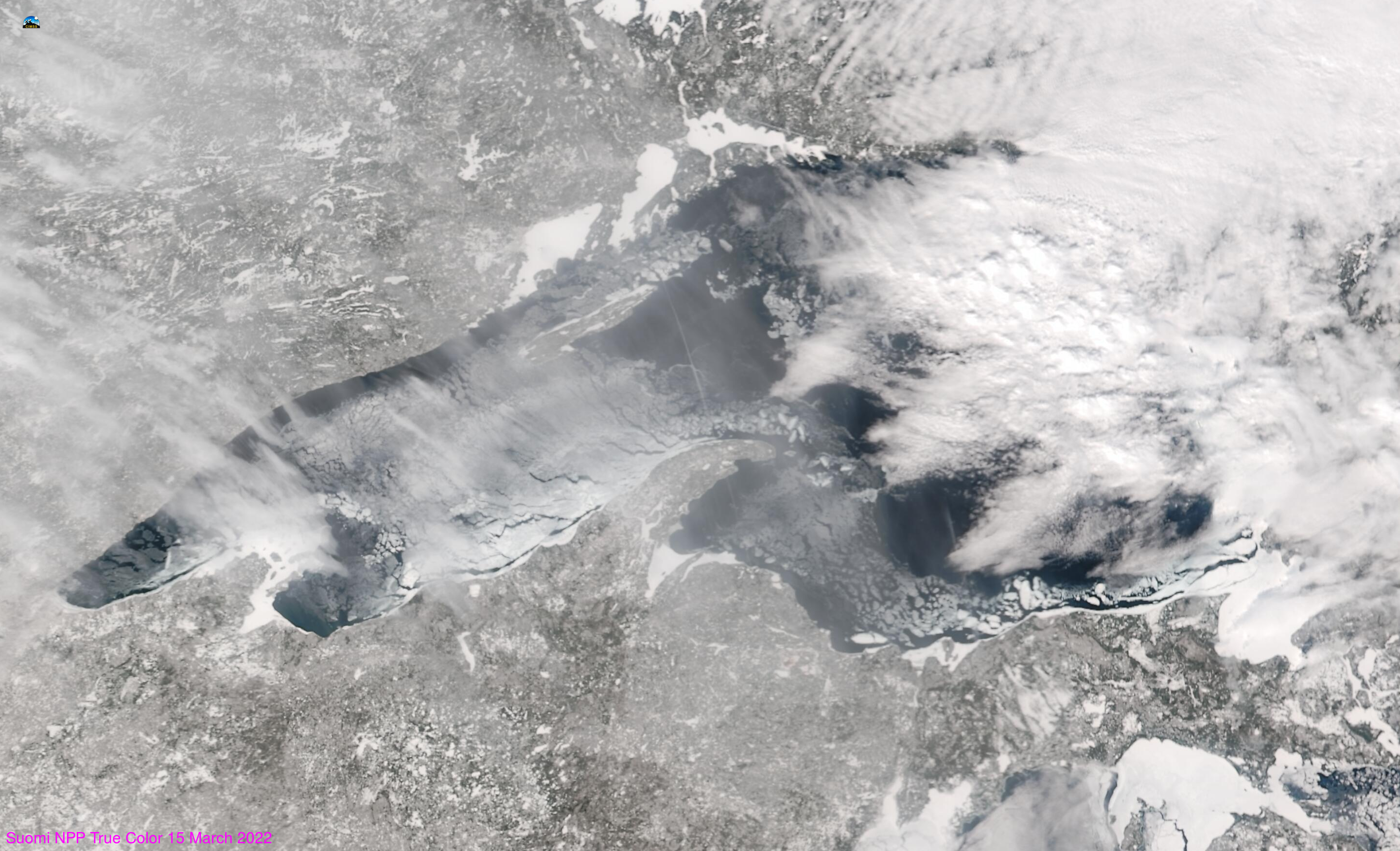
VIIRS imagery over the eastern United States and Canada from 13 September 2021

The VIIRS Imagery Viewer hosts 7 days’ worth of imagery over North America — refreshed daily — for all 22 VIIRS channels. Five of these channels are imaging-resolution bands (I-Bands) with a resolution of 375 m, and sixteen are moderate-resolution bands (M-Bands) with a resolution of 750 m. The viewer also hosts Day Night Band (DNB) images that provide unique nighttime perspectives. CIMSS acquires the data from the Suomi-NPP and NOAA-20 polar-orbiting satellites via Direct Broadcast antennas.  As new images become available from the Visible Infrared Imaging Radiometer Suite (VIIRS), they are processed via CSPP software and presented in a thumbnail directory, usually within 60 minutes of acquisition onboard the spacecraft. The thumbnails link to high resolution full overpass images. In addition to the individual bands, the VIIRS Imagery Viewer features multiple Level-2 products. The most popular are True and False Color images.  

CIMSS Direct Broadcast is one of the few places to access images in all 22 bands collected by VIIRS. Previously (and still) available via ftp (at https://ftp.ssec.wisc.edu/pub/eosdb/), the VIIRS Imagery Viewer makes it easier for students and citizen scientists to access the data, especially students participating in the JPSS Virtual Science Fair.  

Visit the VIIRS Imagery Viewer at https://cimss.ssec.wisc.edu/viirs/imagery-viewer/

View only this post Read Less