This website works best with a newer web browser such as Chrome, Firefox, Safari or Microsoft Edge. Internet Explorer is not supported by this website.

Satellite views of a Spacecraft Freighter Launch from Tanegashima Island in Japan

NOAA-20 has viewed the launch from Tanegashima Island of a Japanese Spacecraft (NASA Blog Coverage; YouTube video, launch is at minute 35 in the video). Brandon Aydlett, NWS Guam, noted the appearance of a very bright spot in the Day Night Band imagery from NOAA-20 at 1602 UTC on 24 September (and a... Read More

NOAA-20 Day Night Band visible (0.7 µm) imagery at 1602 UTC on 24 September 2019 (Click to enlarge) (Image courtesy Mike Ziobro and Brandon Aydlett, WFO Guam)

NOAA-20 has viewed the launch from Tanegashima Island of a Japanese Spacecraft (NASA Blog Coverage; YouTube video, launch is at minute 35 in the video). Brandon Aydlett, NWS Guam, noted the appearance of a very bright spot in the Day Night Band imagery from NOAA-20 at 1602 UTC on 24 September (and a hot spot as well in the infrared imagery shown below). (NOAA-20 and Suomi-NPP data in this blog post were downloaded at the Direct Broadcast Antenna at the Forecast Office in Guam). NOAA-20 Orbital passes (from this site) show an overpass near the island at 1605 UTC; Suomi NPP had a more direct overpass over the island around 1657 UTC. Compare the NOAA-20 image, above, timestamped 1602 UTC, to the Suomi NPP image, below, timestamped at 1654 UTC. The bright signal over Tanegashima at 1602 UTC is missing from the 1654 UTC Suomi NPP imagery.

Suomi-NPP Day Night Band visible imagery (0.7 µm) at 1654 UTC on 24 September 2019 (Click to enlarge) (Image courtesy Mike Ziobro and Brandon Aydlett, WFO Guam)

Infrared Imagery captured the thermal signature of this launch as well. The hot spots in VIIRS imagery are obvious at 1602 UTC from NOAA-20, but not at 1654 UTC from Suomi NPP, at both 3.74 and 11.45, as shown below.

VIIRS shortwave infrared (3.74 µm) imagery at 1654 UTC (left) and at 1602 UTC (center, right, with two different color enhancements). Blown-up versions of the warm pixels are shown (Click to enlarge) (Image courtesy Mike Ziobro and Brandon Aydlett, WFO Guam)

VIIRS infrared (11.45 µm) imagery at 1654 UTC (left) and at 1602 UTC (right, same color enhancements). Blown-up versions of the warm pixels are shown (Click to enlarge) (Image courtesy Mike Ziobro and Brandon Aydlett, WFO Guam)


Himawari-8 shortwave infrared imagery also captured the launch, with a hot spot in a Japan Sector image at 1605 UTC on 24 September 2019, below.

Himawari-8 shortwave infrared (3.9 µm) imagery from 1600-1610 UTC on 24 September 2019 (Click to enlarge). Himawari data courtesy of JMA.

There is a considerable parallax shift in the NOAA-20 imagery, as the VIIRS instrument is scanning at the limb in the image, and the rocket at the time was very high in the atmosphere. The parallax shift in the Himawari-8 imagery is less noticeable.

View only this post Read Less

Severe thunderstorms in Arizona

1-minute Mesoscale Domain Sector GOES-17 (GOES-West) “Red” Visible (0.64 µm) and “Clean” Infrared Window (10.35 µm) images (above) showed the development of severe thunderstorms over southern/central Arizona from 1600-1900 UTC on 23 September 2019. The far western storm exhibited a well-defined Above-Anvil Cirrus Plume (AACP) that extended northeastward from the cold overshooting top (whose coldest infrared brightness temperature... Read More

GOES-17 “Red” Visible (0.64 µm) and “Clean” Infrared Window (10.35 µm) images, with surface reports plotted in cyan [click to play animation | MP4]

GOES-17 “Red” Visible (0.64 µm) and “Clean” Infrared Window (10.35 µm) images, with surface reports plotted in cyan [click to play animation | MP4]

1-minute Mesoscale Domain Sector GOES-17 (GOES-West) “Red” Visible (0.64 µm) and “Clean” Infrared Window (10.35 µm) images (above) showed the development of severe thunderstorms over southern/central Arizona from 1600-1900 UTC on 23 September 2019. The far western storm exhibited a well-defined Above-Anvil Cirrus Plume (AACP) that extended northeastward from the cold overshooting top (whose coldest infrared brightness temperature was -74ºC); note that the AACP feature appeared colder (shades of yellow to orange) on the Infrared images (for example, at 1817 UTC).

As the western storm began to weaken somewhat, a new storm just to the east (located about 20-30 miles north-northeast of the Phoenix metro area) began to intensify, prompting the issuance of a Tornado Warning at 1914 UTC (the last tornado warning issued by NWS Phoenix was 21 January 2010) — a brief EF0 tornado was documented (NWS Phoenix summary).

GOES-17 “Clean” Infrared Window (10.35 µm) images, with surface reports plotted in cyan [click to play animation | MP4]

GOES-17 “Clean” Infrared Window (10.35 µm) images, with surface reports plotted in cyan [click to play animation | MP4]

Much of the moisture helping to fuel the development of this severe convection was from the remnants of Tropical Storm Lorena in the East Pacific Ocean — the northward transport of this moisture could be seen using the hourly MIMIC Total Precipitable Water product (below).

MIMIC Total Precipitable Water product [click to play animation | MP4]

MIMIC Total Precipitable Water product [click to play animation | MP4]


GOES-17 ABI Band 13 (10.35 µm) Clean Window Imagery and Derived Convective Available Potential Energy, 1501 – 1856 UTC on 23 September 2019 (Click to animate)


Stability parameters from GOES-16 showed that the reigon of thunderstorm development was just east of a strong gradient in Convective Available Potential Energy.  The animation above shows the GOES-17 Clean Window;  in regions of clear sky, the baseline Derived Stability Index CAPE is shown.  CAPE values are zero over much of California (except for the southeasternmost corner) but they increase rapidly over Arizona to values approaching 1000 J/kg.

On 23 September, skies were clear enough that an instability signal was obvious in the clear-sky baseline CAPE. An ‘All-Sky’ product has been developed that can be used on days with more widespread cloudiness; it is available at this link. Values of All-Sky CAPE at 1156 and 1556 UTC on 23 September are shown below, and they also show a sharp gradient in the instability, and the link down to moisture from Lorena’s remants.

‘All-Sky’ values of Convective Available Potential Energy (CAPE) at 1156 and 1556 UTC on 23 September 2019 (Click to enlarge)

NOAA/CIMSS ProbSevere is a product designed to indicate the likelihood that a given object will produce severe weather within the next 60 minutes. An animation of the product at 5-minute intervals, below, shows that the right-moving radar cell (also associated, as noted above, with an AACP) that developed over far southwestern Arizona (becoming a warned storm at 1647 UTC) was very likely to produce severe weather.

NOAA/CIMSS ProbSevere from 16:30 UTC to 18:00 UTC. Contours surrounding radar objects are color-coded such that pink/magenta contours are the highest probability.  Warning polygons (yellow for severe thunderstorm) are also shown (Click to enlarge)

Parameters that are used to determine the probability can be revealed at the ProbSevere site by mousing over the colored object contours.  The values for the warned storm over SW Arizona are shown below at 1650 UTC, 3 minutes after the warning was issued.  This image shows the 1710 UTC readout with the highest ProbWind value (76%); this image shows the 1725 UTC readout with the highest ‘ProbHail’ value (99%); ProbTor values on this day were not exceptionally large — for the later tornado-warned storm farther east, they were 28% at 1915 UTC and 30% at 1920 UTC.

NOAA/CIMSS ProbSevere display from 1650 UTC on 23 September 2019; parameters used in the probability computation, and Severe Thunderstorm Warning polygon parameters are also shown (Click to enlarge)

CIMSS is developing a machine-learning tool that combines ABI and GLM imagery (that is, only satellite data) to identify regions where supercellular thunderstorms capable of producing severe weather might be occurring. An mp4 animation for this event (courtesy John Cintineo, CIMSS) is shown below.  (This experimental product was also shown in this blog post)

View only this post Read Less

30-year anniversary of the landfall of Hurricane Hugo

GOES-7 Infrared Window (11.25 µm) images (above) showed Hurricane Hugo as it made landfall as a Category 4 storm around 04 UTC on 22 September 1989. This GOES-7 data was accessed from the SSEC Satellite Data Services archive.A GOES-7 Visible animation from 21 September and a longer Infrared animation spanning the period 13-22 September are... Read More

GOES-7 Infrared Window (11.25 µm) images [click to play animation | MP4]

GOES-7 Infrared Window (11.25 µm) images [click to play animation | MP4]

GOES-7 Infrared Window (11.25 µm) images (above) showed Hurricane Hugo as it made landfall as a Category 4 storm around 04 UTC on 22 September 1989. This GOES-7 data was accessed from the SSEC Satellite Data Services archive.

A GOES-7 Visible animation from 21 September and a longer Infrared animation spanning the period 13-22 September are shown below (courtesy of Tim Schmit, NOAA/NESDIS).

GOES-7 Visible (0.65 µm) images [click to play MP4 animation]

GOES-7 Visible (0.65 µm) images [click to play MP4 animation]

GOES-7 Infrared Window (11.25 µm) images [click to play MP4 animation]

GOES-7 Infrared Window (11.25 µm) images [click to play MP4 animation]

More information on Hugo is available from NWS Charleston and NWS Wilmington.

View only this post Read Less

Saharan Air Layer plume over the Atlantic Ocean

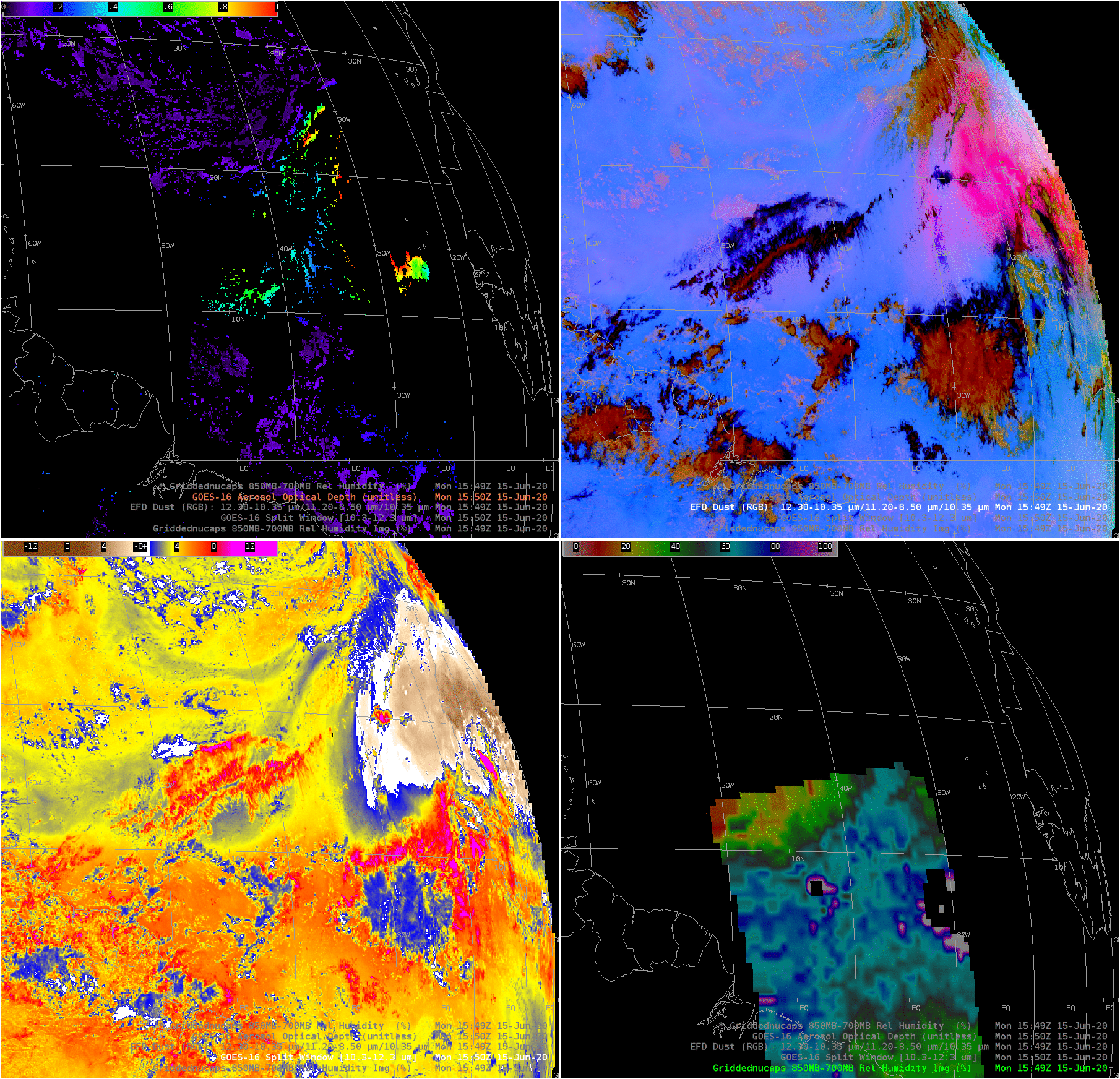
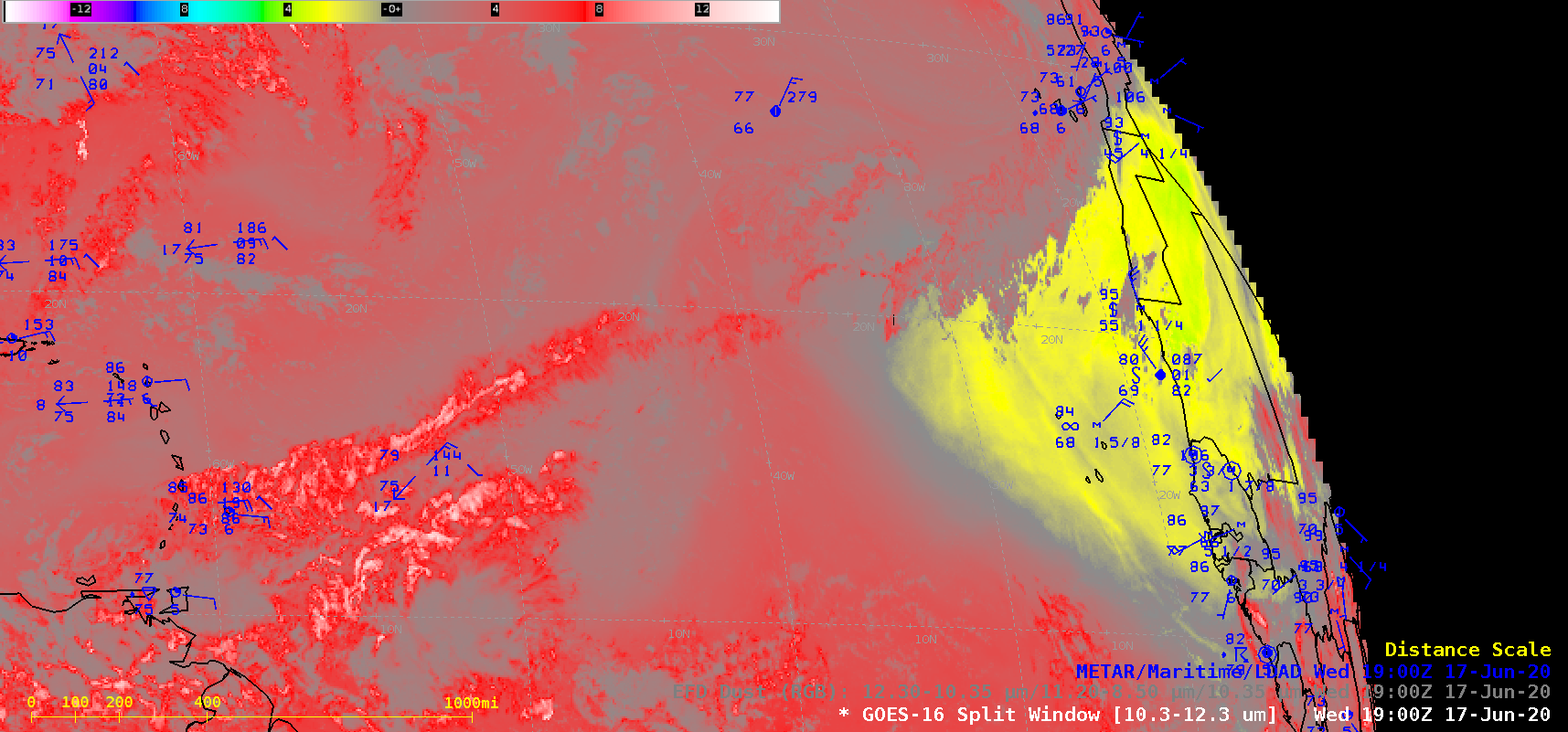
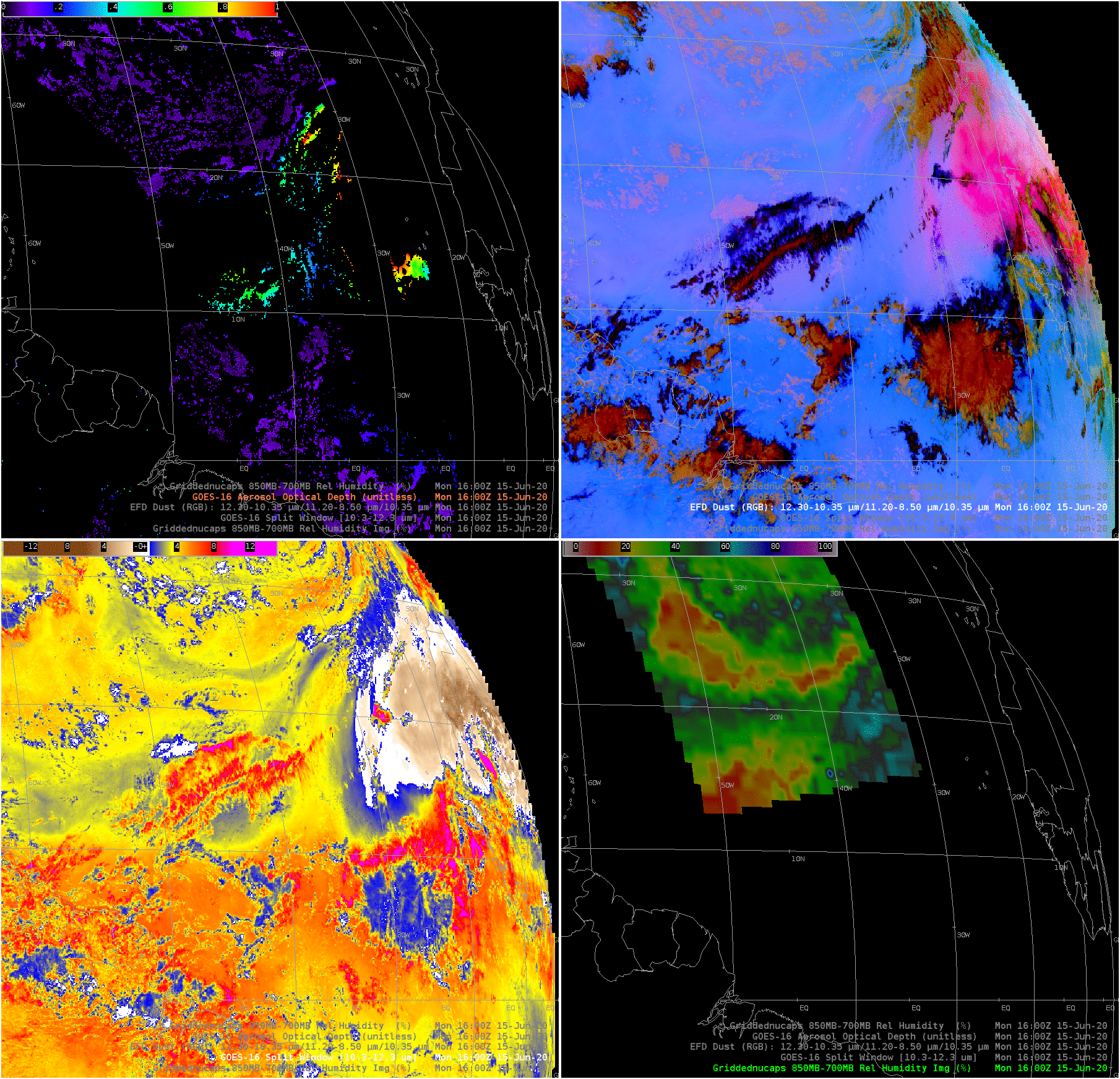
GOES-16 (GOES-East) Split Window images (above) showed a large plume of the Saharan Air Layer (SAL) that moved westward off the coast of Africa then westward and northwestward across the eastern and central Atlantic Ocean during the 15-20 September 2019 period.On 20 September, the hazy SAL plume could be easily seen... Read More

Saharan Air Layer product [click to play animation | MP4]

GOES-16 “Split Window” Saharan Air Layer product [click to play animation | MP4]

GOES-16 (GOES-East) Split Window images (above) showed a large plume of the Saharan Air Layer (SAL) that moved westward off the coast of Africa then westward and northwestward across the eastern and central Atlantic Ocean during the 15-20 September 2019 period.

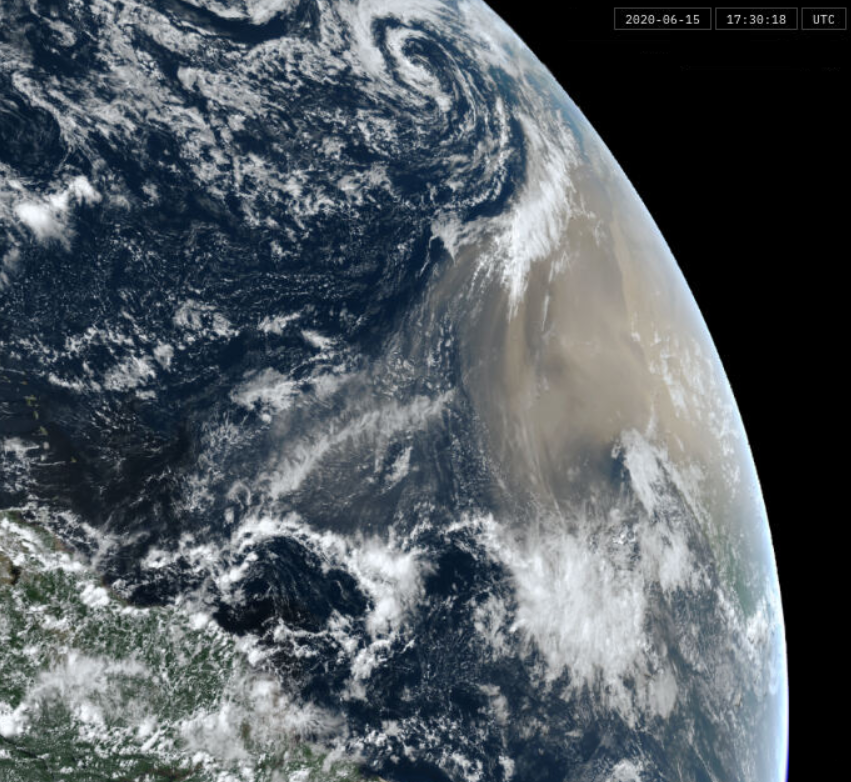
On 20 September, the hazy SAL plume could be easily seen in Full Disk GOES-16 True Color Red-Green-Blue (RGB) images from the AOS site (below).

GOES-16 True Color images [click to play animation | MP4]

GOES-16 True Color RGB images [click to play animation | MP4]

The SAL plume was also apparent in True Color RGB images from Suomi NPP and NOAA-20 as viewed using RealEarth (below).

VIIRS True Color RGB images from Suomi NPP and NOAA-20 [click to enlarge]

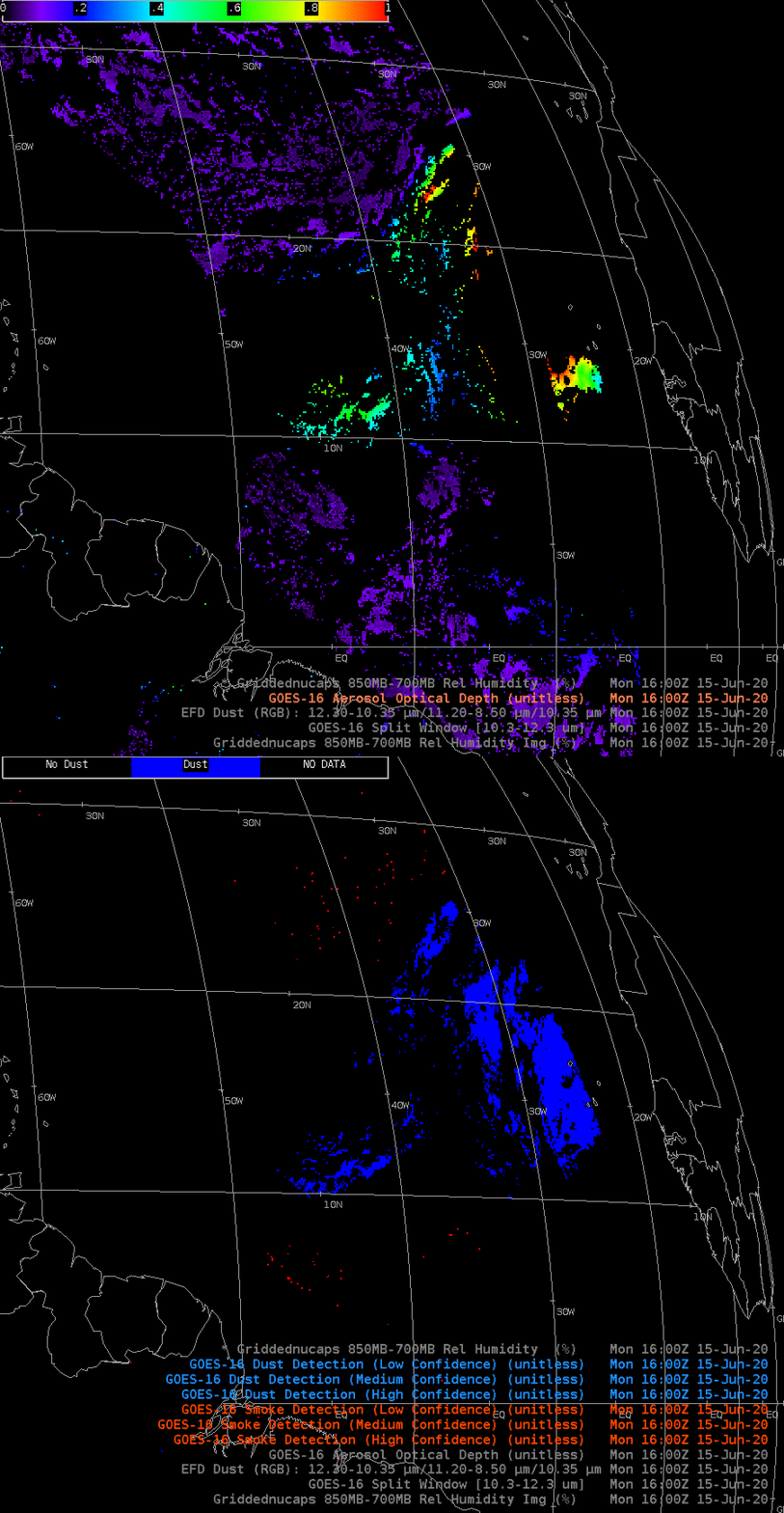
A comparison of GOES-16 CIMSS Natural Color RGB, Aerosol Optical Depth and Dust Detection product images from 1500-1900 UTC on 20 September (below) revealed AOD values as high as 0.5 within the hazy dust-laden SAL plume; the Dust Detection product indicated large areas of Low- to Medium-Confidence dust (with isolated pockets of High Confidence).

GOES-16 CIMSS Natural Color RGB, Aerosol Optical Depth, and Dust Detection product [click to play animation | MP4]

GOES-16 CIMSS Natural Color RGB, Aerosol Optical Depth, and Dust Detection product [click to play animation | MP4]


On a side note, the Full Disk True Color shown above images revealed 3 different types of solar backscatter: a small spot of very bright sun glint off the water of the Amazon River and its tributaries, which moved from east to west — similar to this example from October 2018  (below)

GOES-16

GOES-16 “Red” Visible (0.64 µm) images [click to play animation | MP4]

along with 2 separate (and larger) areas of more diffuse solar backscatter, which propagated from west to east: the first (possibly a 180º-42º=138º or “rainbow” backscatter) appeared about midway between the Equator and the southern tip of South America — and the second  (a 180º backscatter) appeared farther north, closer to the Equator, slightly later in time (this type of solar backscatter was previously discussed here). These 3 solar backscatter features can also be seen in a rocking animation below.

GOES-16 True Color RGB images [click to play animation | MP4]

GOES-16 True Color RGB images [click to play animation | MP4]

Thanks to Fred Wu (NOAA/NESDIS) and Steve Miller (CIRA) for providing further insight regarding the nature of the 2 larger types of solar backscatter.

View only this post Read Less