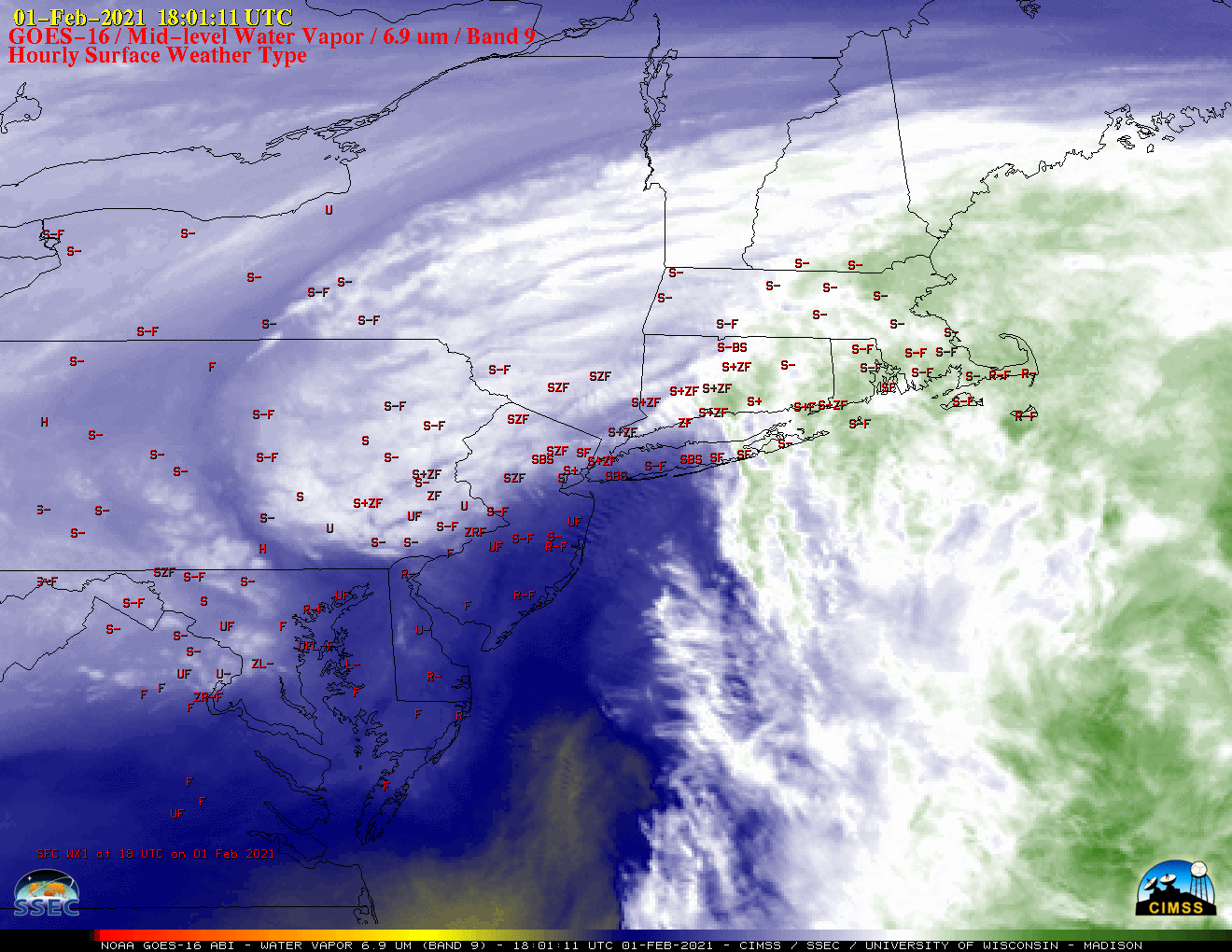
GOES-16 (GOES-East) Mid-level Water Vapor (6.9 µm) images with plots of hourly surface weather type (above) showed the formation of a well-defined cold conveyor belt that moved westward across parts of the Northeast US during the 01 February – 02 February 2021 period. This moist airstream helped to enhance snowfall rates, with 2-4 inches... Read More
![GOES-16 Mid-level Water Vapor (6.9 µm) images, with plots of hourly surface weather type [click to play animation | MP4]](https://cimss.ssec.wisc.edu/satellite-blog/images/2021/02/G16_WV_WX1_NEUS_WINTER_STORM_01FEB2021_B9_2021032_180611_GOES-16_0001PANEL_FRAME0000110.GIF)
GOES-16 Mid-level Water Vapor (6.9 µm) images, with hourly surface weather type plotted in red [click to play animation | MP4]
GOES-16
(GOES-East) Mid-level Water Vapor (
6.9 µm) images with plots of hourly surface weather type
(above) showed the formation of a well-defined cold conveyor belt that moved westward across parts of the Northeast US during the
01 February –
02 February 2021 period. This moist airstream helped to enhance snowfall rates, with 2-4 inches per hour occurring at some locations.
Storm total snowfall accumulations were as high as 36.1″ in Pennsylvania, 35.5″ in New Jersey, 25.6″ in New York, 24.0″ in Massachusetts, and 19.0″ in Connecticut.
Another feature that played an important role in enhancing/prolonging heavy snowfall rates was a TROWAL — appearing as a tongue of higher Equivalent Potential Temperature within the 850-700 hPa layer, just north of the surface occluded front — moving inland and feeding moisture into the southern edge of the cold conveyor belt seen on GOES-16 Water Vapor imagery (below).
![GOES-16 Mid-level Water Vapor (6.9 µm) images, with contours of 850-700 hPa layer Equivalent Potential Temperature (red) and Surface Fronts (purple) [click to play animation | MP4]](https://cimss.ssec.wisc.edu/satellite-blog/images/2021/02/neus_trowal-20210201_180111.png)
GOES-16 Mid-level Water Vapor (6.9 µm) images, with contours of 850-700 hPa layer Equivalent Potential Temperature (red) and Surface Frontal Analysis (purple) [click to play animation | MP4]
1-minute
Mesoscale Domain Sector GOES-16 “Red” Visible (
0.64 µm) images with 5-minute plots of
Derived Motion Winds (below) revealed a mesoscale circulation just south-southwest of the analyzed location of the surface low — the majority of these wind vectors had height assignments within the 900-990 hPa range, indicating that the circulation was located above the surface. The highest DMW speed was 36 knots.
![GOES-16 "Red" Visible (0.6 µm) images, with plots of Derived Motion Winds [click to play animation | MP4]](https://cimss.ssec.wisc.edu/satellite-blog/images/2021/02/neus_dmw_vis-20210202_141021.png)
GOES-16 “Red” Visible (0.6 µm) images, with plots of Derived Motion Winds [click to play animation | MP4]
View only this post
Read Less


![Suomi NPP VIIRS Infrared Window (11.45 µm) images [click to enlarge]](https://cimss.ssec.wisc.edu/satellite-blog/images/2021/02/210204_suomiNPP_viirs_infrared_AK_anim.gif)
![GOES-17 "Clean" Infrared Window (10.35 µm) images [click to enlarge]](https://cimss.ssec.wisc.edu/satellite-blog/images/2021/02/210204_goes17_infrared_AK_anim.gif)
![Infrared Window images from Suomi NPP VIIRS and GOES-17 (10.35 µm) at 1223 UTC [click to enlarge]](https://cimss.ssec.wisc.edu/satellite-blog/images/2021/02/210204_suomiNPP_goes17_infrared_AK_anim.gif)

![GOES-16 Mid-level Water Vapor (6.9 µm) images, with plots of hourly surface weather type [click to play animation | MP4]](https://cimss.ssec.wisc.edu/satellite-blog/images/2021/02/210201_goes16_waterVapor_precipType_Northeast_US_anim.gif)
![GOES-16 Mid-level Water Vapor (6.9 µm) images, with contours of 850-700 hPa layer Equivalent Potential Temperature (red) and Surface Fronts (purple) [click to play animation | MP4]](https://cimss.ssec.wisc.edu/satellite-blog/images/2021/02/210201_goes16_waterVapor_trowal_Northeast_US_anim.gif)
![GOES-16 "Red" Visible (0.6 µm) images, with plots of Derived Motion Winds [click to play animation | MP4]](https://cimss.ssec.wisc.edu/satellite-blog/images/2021/02/210202_goes16_visible_derivedMotionWinds_NortheastUS_low_anim.gif)
![GOES-16 True Color RGB images [click to play animation | MP4]](https://cimss.ssec.wisc.edu/satellite-blog/images/2021/01/210130_goes16_trueColorRGB_NM_TX_anim.gif)
![GOES-16 Dust RGB and Split Window Difference (10.3 µm – 12.3 µm) images [click to play animation | MP4]](https://cimss.ssec.wisc.edu/satellite-blog/images/2021/01/210130_goes16_dustRGB_splitWindowDifference_NM_TX_blowing_dust_anim.gif)