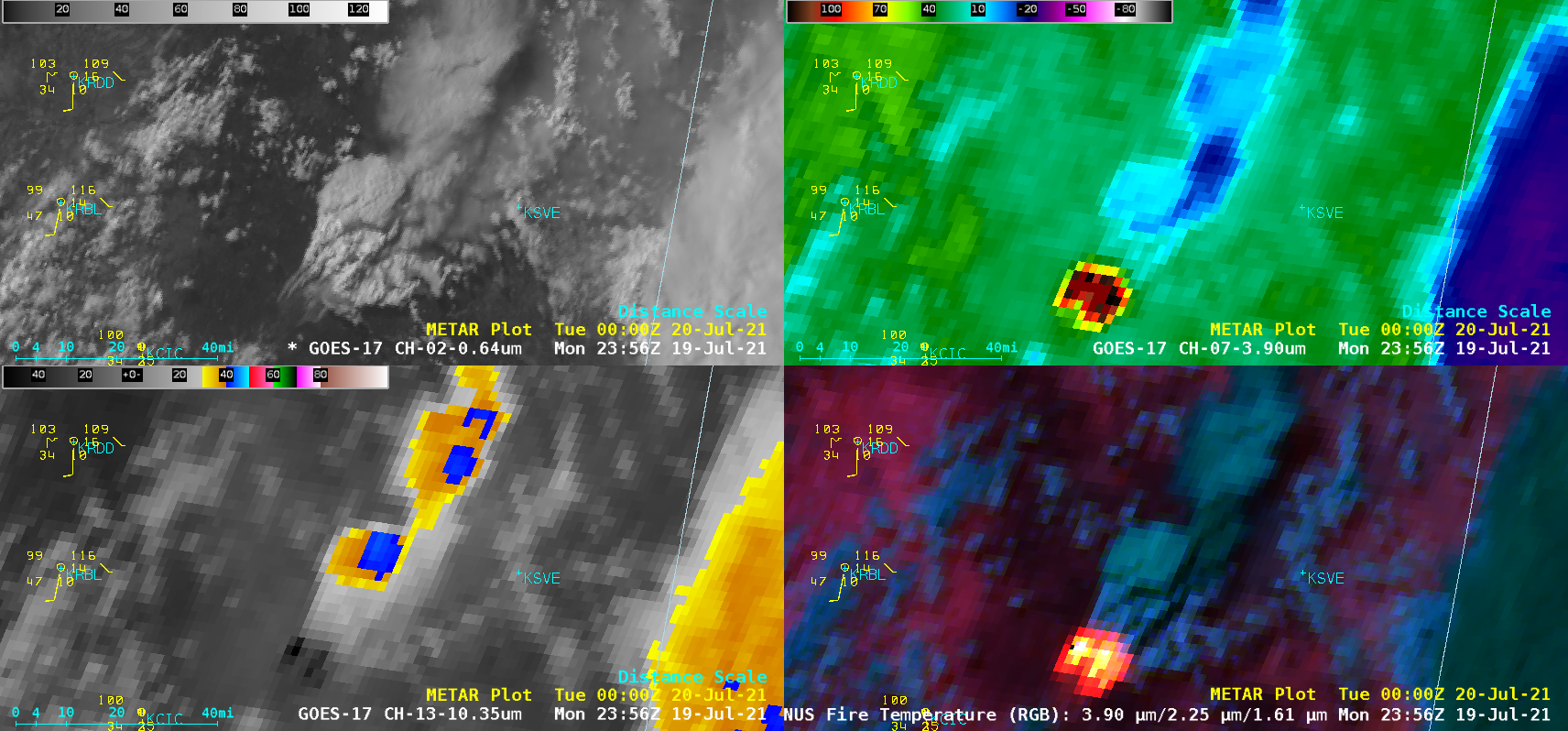

GOES-17 “Red” Visible (0.64 µm) images [click to play animation | MP4]
View only this post Read Less
With the help of a relatively low sun angle, 1-minute Mesoscale Domain Sector GOES-17 (GOES-West) “Red” Visible (0.64 µm) images (above) revealed long shadows cast by peaks of the Alaska Range — especially that of Denali, located in the lower center of the satellite scene — upon the tops of stratus clouds to... Read More

GOES-17 “Red” Visible (0.64 µm) images [click to play animation | MP4]
View only this post Read Less
Himawari-8 “Target” infrared imagery at 10.41 µm (above) and 7.35 µm (below) (courtesy JMA, the Japanese Meteorological Agency) show Typhoon Vamco as it crossed the South China Sea on 13 November, approaching Vietnam. Strong convection develops frequently in the region surrounding the not-quite-circular eye (click here for an mp4 animation), and dry air is far... Read More

Himawari-8 Infrared Imagery (10.41 µm, Band 13) from 0702 to 1942 UTC on 13 November (Click to animate)
Himawari-8 “Target” infrared imagery at 10.41 µm (above) and 7.35 µm (below) (courtesy JMA, the Japanese Meteorological Agency) show Typhoon Vamco as it crossed the South China Sea on 13 November, approaching Vietnam. Strong convection develops frequently in the region surrounding the not-quite-circular eye (click here for an mp4 animation), and dry air is far removed from the center, based on the low-level water vapor imagery below (click here for an mp4 animation), although it is wrapping around the southern half of the storm by the end of the animation. (Click here for more information on Vamco from JMA).

Himawari-8 Infrared Imagery (7.35 µm, Band 10) from 0702 to 1947 UTC on 13 November (Click to animate)
MIMIC Total Precipitable Water fields (from this site), below, show that Vamco is preceded by relatively dry air that appears to be wrapping closer and closer to the storm (The storm is however followed by abundant moisture). Dry air and relatively cool sea-surface temperatures (from this site) may be the reason that weakening is forecast before landfall. Shear values remain low but are forecast to become less favorable.

MIMIC Total Precipitable Water for the 24 hours ending 2000 UTC on 13 November 2020 (Click to enlarge)
For more information on Vamco, refer the SSEC Tropical Page, the JTWC or to JMA.
View only this post Read Less
GOES-16 (GOES-East) “Red” Visible (0.64 µm), Near-Infrared “Snow/Ice” (1.61 µm) and Day Snow-Fog Red-Green-Blue (RGB) images (above) showed a broad swath of fresh snow cover across parts of Nebraska, South Dakota, Iowa, Minnesota, Wisconsin and Upper Michigan on 11 November 2020. The band of heavy snow developed northwest of an intensifying midlatitude cyclone on the... Read More

GOES-16 “Red” Visible (0.64 µm), Near-Infrared “Snow/Ice” (1.61 µm) and Day Snow-Fog RGB images [click to play animation | MP4]
![GOES-16 “Red” Visible (0.64 µm), Near-Infrared "Snow/Ice" (1.61 µm) and Day Snow-Fog RGB images at 1501 UTC [click to enlarge]](https://cimss.ssec.wisc.edu/satellite-blog/images/2020/11/201111_1501utc_goes16_visible_snowIce_daySnowFogRGB_Upper_Midwest_snow_cover_anim.gif)
GOES-16 “Red” Visible (0.64 µm), Near-Infrared “Snow/Ice” (1.61 µm) and Day Snow-Fog RGB images at 1501 UTC [click to enlarge]
![Plots of Spectral Response Function for ABI Bands 1-5 [click to enlarge]](https://cimss.ssec.wisc.edu/satellite-blog/wp-content/uploads/sites/5/2019/01/ABI_Bands1-5_SRF.jpg)
Plots of Spectral Response Function for ABI Bands 1-5 (credit: Mat Gunshor, CIMSS) [click to enlarge]
View only this post Read Less
A toggle between Suomi NPP VIIRS Infrared Window (11.45 µm) and Day/Night Band (0.7 µm) images at 0734 UTC (above) showed Tropical Storm Eta over the Gulf of Mexico (northwest of Cuba) on 10 November 2020. A large convective burst was seen southeast of the storm center, with concentric cloud-top... Read More
![Suomi NPP VIIRS Infrared Window (11.45 µm) and Day/Night Band (0.7 µm) images at 0734 UTC [click to enlarge]](https://cimss.ssec.wisc.edu/satellite-blog/images/2020/11/201110_0734utc_suomiNPP_viirs_infraredWindow_dayNightBand_TS_Eta_anim.gif)
Suomi NPP VIIRS Infrared Window (11.45 µm) and Day/Night Band (0.7 µm) images at 0734 UTC [click to enlarge]
1-minute Mesoscale Domain Sector GOES-16 (GOES-East) “Clean” Infrared Window (10.35 µm), GLM Flash Extent Density and “Red” Visible (0.64 µm) images (below) showed Tropical Storm Eta from sunrise to sunset, as it continued a slow northward movement — pulsing overshooting tops occasionally exhibited infrared brightness temperatures of -90ºC and colder (yellow pixels embedded within darker shades of purple), and lightning activity persisted for much of the day.
![GOES-16 “Clean” Infrared Window (10.35 µm) images (with and without an overlay of GLM Flash Extent Density) and “Red” Visible (0.64 µm) images [click to play MP4 animation]](https://cimss.ssec.wisc.edu/satellite-blog/images/2020/11/eta_glm-20201110_200250.png)
GOES-16 “Clean” Infrared Window (10.35 µm) images (with and without an overlay of GLM Flash Extent Density) and “Red” Visible (0.64 µm) images [click to play MP4 animation]
===== 11 November Update =====
![GOES-16 “Red” Visible (0.64 µm) images [click to play animation | MP4]](https://cimss.ssec.wisc.edu/satellite-blog/images/2020/11/eta_vis-20201111_150350.png)
GOES-16 “Red” Visible (0.64 µm) images [click to play animation | MP4]
View only this post Read Less