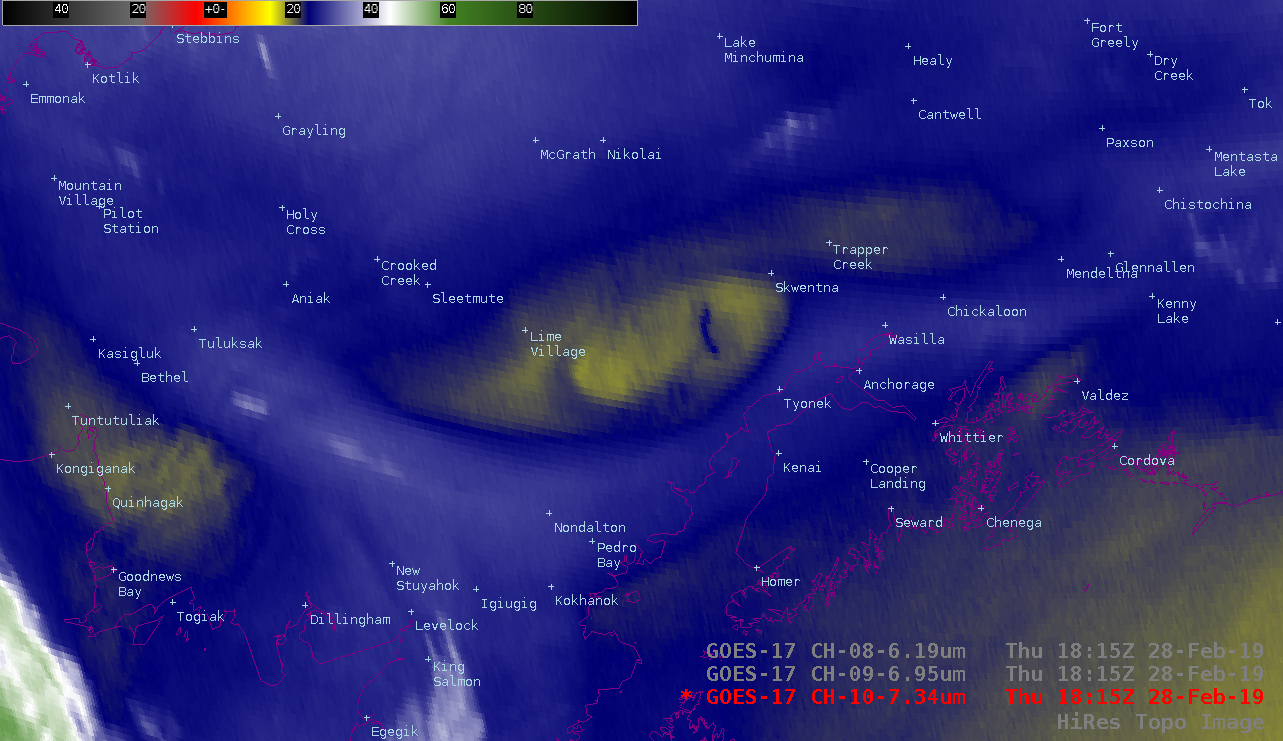
GOES-17 (GOES-West) Low-level (7.3 µm), Mid-level (6.9 µm) and Upper-level (6.2 µm) Water Vapor images (above) displayed subtle thermal signatures of some of the highest-elevation western and central portions of the Alaska Range on 28 February 2019.Plots of GOES-17 Water Vapor weighting functions, calculated using 12 UTC rawinsonde data from Anchorage, are shown below. Even with a very... Read More
![GOES-17 Low-level (7.3 µm), Mid-level (6.9 µm) and Upper-level (6.2 µm) Water Vapor images, with topography [click to play animation | MP4]](https://cimss.ssec.wisc.edu/satellite-blog/wp-content/uploads/sites/5/2019/02/ak_wv10-20190228_181538.png)
GOES-17 Low-level (7.3 µm), Mid-level (6.9 µm) and Upper-level (6.2 µm) Water Vapor images, with topography [click to play animation | MP4]
GOES-17
(GOES-West) Low-level (
7.3 µm), Mid-level (
6.9 µm) and Upper-level (
6.2 µm) Water Vapor images
(above) displayed subtle thermal signatures of some of the highest-elevation western and central portions of the
Alaska Range on 28 February 2019.
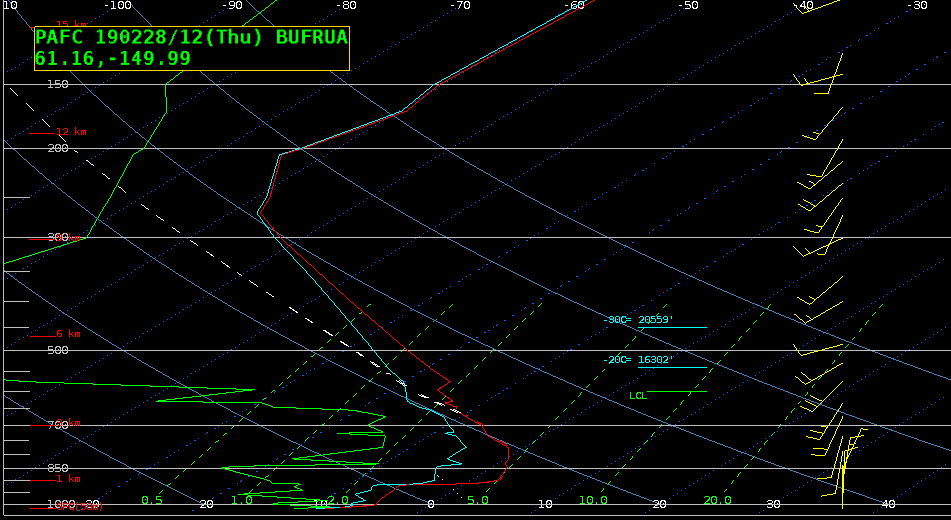
Plots of GOES-17 Water Vapor weighting functions, calculated using 12 UTC rawinsonde data from Anchorage, are shown below. Even with a very large satellite viewing angle (or zenith angle) of 70.1 degrees — which would tend to shift the Water Vapor weighting functions to higher altitudes — the presence of dry air within the entire mid-upper troposphere brought the weighting function peaks downward to pressure levels corresponding to those of the higher elevations of the Alaska Range.
![GOES-17 Water Vapor weighting functions, calculated using 12 UTC rawinsonde data from Anchorage [click to enlarge]](https://cimss.ssec.wisc.edu/satellite-blog/wp-content/uploads/sites/5/2019/02/190228_12utc_panc_wv_wf.png)
GOES-17 Water Vapor weighting functions, calculated using 12 UTC rawinsonde data from Anchorage [click to enlarge]
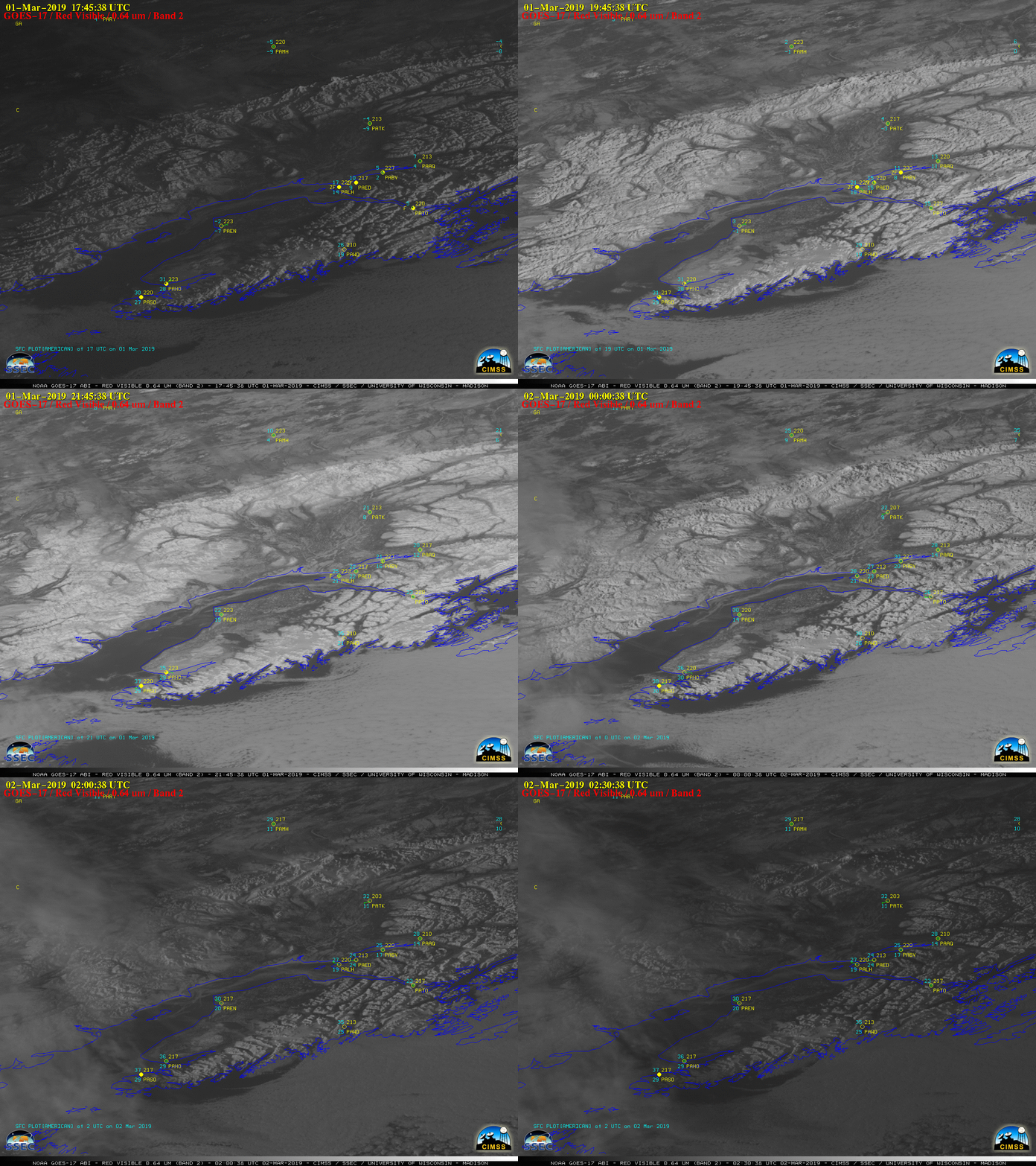
The dry air aloft helped to provide a remarkably cloud-free day over much of south-central Alaska, as seen in GOES-17 “Red” Visible (
0.64 µm) images
(below). In addition, an example of the transient spikes in daytime solar reflectance seen during this time of year was evident in the Visible imagery — note the brief brightening of a few of the images centered at 2115 UTC. Additional details about this effect are available
here.
![GOES-17 "Red" Visible (0.64 µm) images [click to play animation | MP4]](https://cimss.ssec.wisc.edu/satellite-blog/wp-content/uploads/sites/5/2019/02/ak_vis-20190228_203038.png)
GOES-17 “Red” Visible (0.64 µm) images [click to play animation | MP4]
Just for fun, a closer look at the GOES-17 Visible imagery
(below) revealed the tidal ebb and flow of drift ice within Cook Inlet and Turnagain Arm in the Anchorage area — and a similar diurnal flow of ice was also seen on the following day (
animated GIF |
MP4).
![GOES-17 "Red" Visible (0.64 µm) images [click to play animation | MP4]](https://cimss.ssec.wisc.edu/satellite-blog/wp-content/uploads/sites/5/2019/02/G17_VIS_ANC_28FEB2019_2019059_234538_GOES-17_0001PANEL.GIF)
GOES-17 “Red” Visible (0.64 µm) images [click to play animation | MP4]
===== 01 March Update =====
![GOES-17 Low-level (7.3 µm), Mid-level (6.9 µm) and Upper-level (6.2 µm) Water Vapor images, with topography [click to play animation | MP4]](https://cimss.ssec.wisc.edu/satellite-blog/wp-content/uploads/sites/5/2019/03/ak_wv9-20190301_180038.png)
GOES-17 Low-level (7.3 µm), Mid-level (6.9 µm) and Upper-level (6.2 µm) Water Vapor images, with topography [click to play animation | MP4]
With a similar scenario to the previous day (but farther to the east), dry air aloft allowed thermal signatures of the highest summits of the eastern Alaska Range and the Wrangell Mountains to be apparent in GOES-17 Water Vapor imagery — even the Upper-level 6.2 µm band
(above).
However, in this case the Water Vapor weighting functions derived using rawinsonde data from nearby Anchorage were not representative of the pocket of dry air farther east over the mountains. An increase in the moisture profile — especially within the mid/upper troposphere — shifted the weighting functions to higher altitudes, due absorption and re-emission by that higher-altitude (and colder) moisture. Note how the weighting function contributions centered around the 300 hPa pressure level increased during the 24 hours from 12 UTC on 28 February to 12 UTC on 01 March, while the relative contributions decreased within the 500-700 layer (below).
![GOES-17 Water Vapor weighting functions, calculated using rawinsonde data from Anchorage on 28 February (12 UTC) and 01 March (00 and 12 UTC) [click to enllarge]](https://cimss.ssec.wisc.edu/satellite-blog/wp-content/uploads/sites/5/2019/03/190228_190301_panc_wv_wf_anim.gif)
GOES-17 Water Vapor weighting functions, calculated using rawinsonde data from Anchorage on 28 February (12 UTC) and 01 March (00 and 12 UTC) [click to enllarge]
An overpass of the Suomi NPP satellite provided a number of
NUCAPS sounding profiles across this region
(below).
![GOES-17 Upper-level Water Vapor (6.2 µm) image at 2045 UTC, with NUCAPS sounding points at 2049 UTC plotted in green [click to enlarge]](https://cimss.ssec.wisc.edu/satellite-blog/wp-content/uploads/sites/5/2019/03/ak_wv8_nucaps-20190301_204538_M_D.png)
GOES-17 Upper-level Water Vapor (6.2 µm) image at 2045 UTC, with NUCAPS sounding points plotted in green [click to enlarge]
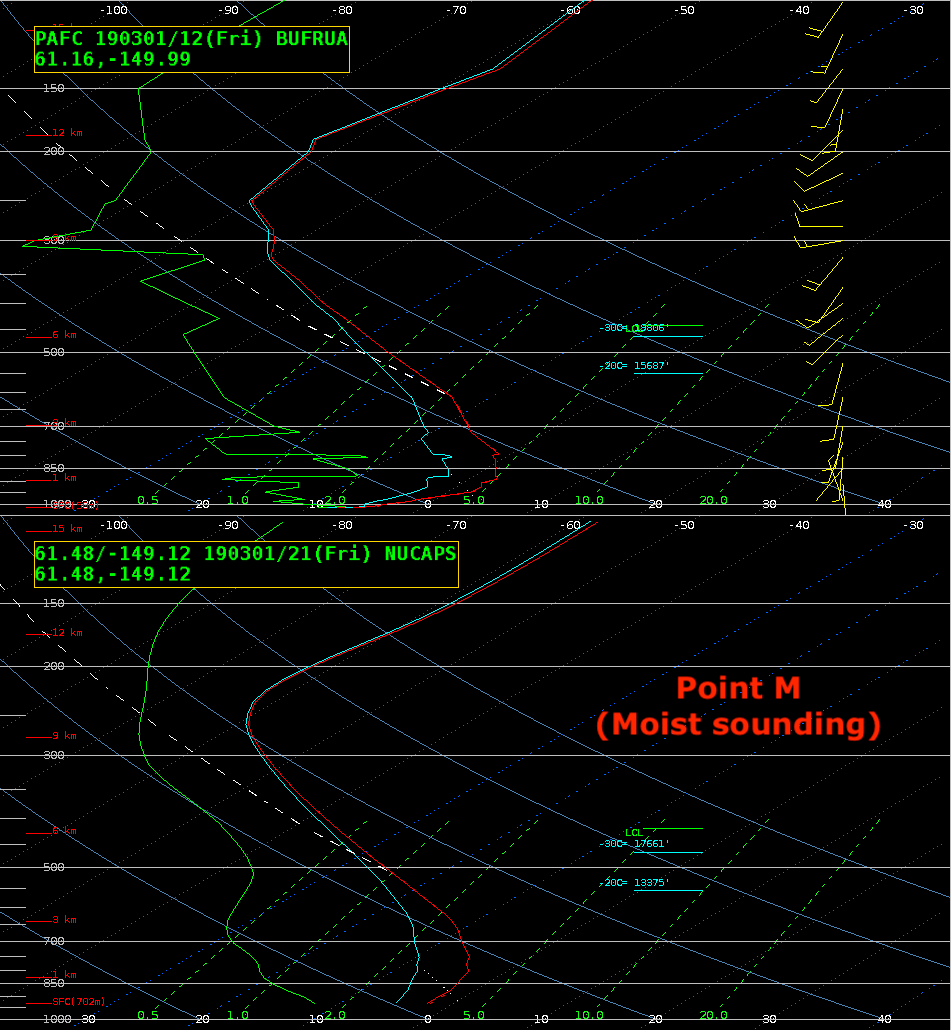
A comparison of a
dry NUCAPS sounding over the mountains (Point D) with a
moist sounding near Anchorage (Point M) is shown below. As shown
here, the moisture profile of the NUCAPS Point M sounding was similar to that of the 12 UTC Anchorage sounding.
![Comparison of a dry NUCAPS sounding over the mountains (Point D) with a moist sounding near Anchorage (Point M) [click to enlarge]](https://cimss.ssec.wisc.edu/satellite-blog/wp-content/uploads/sites/5/2019/03/20190301_nucaps_Point_M_Point_D_anim.gif)
Comparison of a dry NUCAPS sounding over the mountains (Point D) with a moist NUCAPS sounding near Anchorage (Point M) [click to enlarge]
View only this post
Read Less


![Sequence of 3 consecutive VIIRS Infrared Window (11.45 µm) images from NOAA-20 and Suomi NPP [click to enlarge]](https://cimss.ssec.wisc.edu/satellite-blog/wp-content/uploads/sites/5/2019/03/190303_viirs_infrared_MT_anim.gif)
![GOES-16 "Clean" Infrared Window (10.3 µm) images, with observed minimum aurface air temperatures [click to play animation | MP4]](https://cimss.ssec.wisc.edu/satellite-blog/wp-content/uploads/sites/5/2019/03/190304_goes16_infrared_MT_anim.gif)
![Sequence of 3 consecutive VIIRS Infrared Window (11.45 µm) images from NOAA-20 and Suomi NPP [click to enlarge]](https://cimss.ssec.wisc.edu/satellite-blog/wp-content/uploads/sites/5/2019/03/190304_viirs_infrared_Montana_anim.gif)
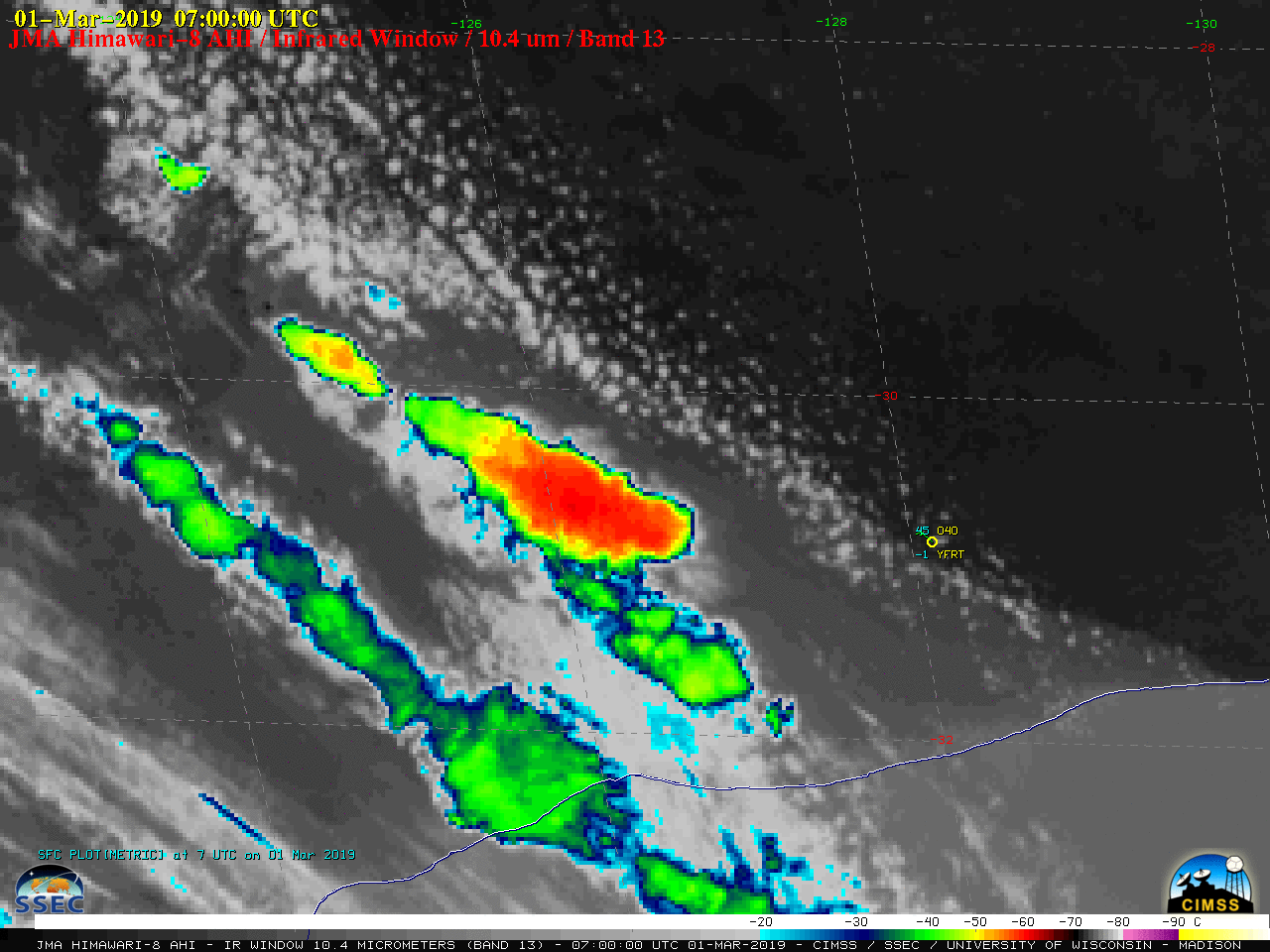
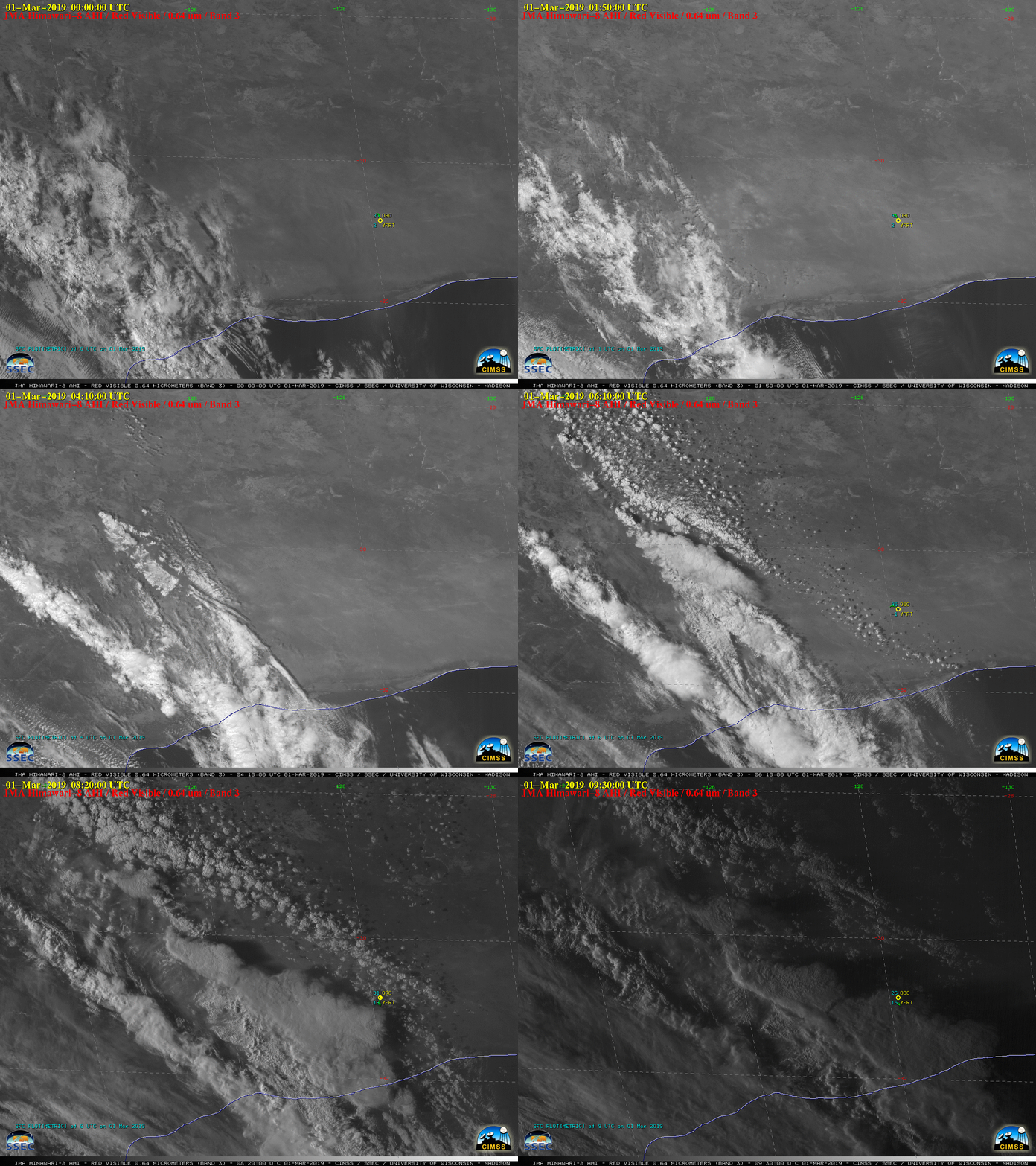
![Himawari-8 "Clean" Infrared Window (10.4 µm) images [click to play animation | MP4]](https://cimss.ssec.wisc.edu/satellite-blog/wp-content/uploads/sites/5/2019/03/190301_himawari8_infraredWindow_Australia_pyroCb_anim.gif)
![Suomi NPP VIIRS True Color RGB and Infrared Window (11.45 µm) images at 0537 UTC [click to enlarge]](https://cimss.ssec.wisc.edu/satellite-blog/wp-content/uploads/sites/5/2019/03/190301_0537utc_suomiNPP_viirs_truecolor_infrared_Australia_pyroCb_anim.gif)
![NOAA-20 VIIRS True Color RGB and Infrared Window (11.45 µm) images at 0628 UTC [click to enlarge]](https://cimss.ssec.wisc.edu/satellite-blog/wp-content/uploads/sites/5/2019/03/190301_0628utc_noaa20_viirs_truecolor_infrared_Australia_pyroCb_anim.gif)
![Himawari-8 Shortwave Infrared (3.9 µm) images [click to play animation | MP4]](https://cimss.ssec.wisc.edu/satellite-blog/wp-content/uploads/sites/5/2019/03/190301_himawari8_shortwaveInfrared_Australia_pyroCb_anim.gif)
![GOES-17 Low-level (7.3 µm), Mid-level (6.9 µm) and Upper-level (6.2 µm) Water Vapor images, with topography [click to play animation | MP4]](https://cimss.ssec.wisc.edu/satellite-blog/wp-content/uploads/sites/5/2019/02/190228_goes17_waterVapor_Alaska_Range_anim.gif)
![GOES-17 "Red" Visible (0.64 µm) images [click to play animation | MP4]](https://cimss.ssec.wisc.edu/satellite-blog/wp-content/uploads/sites/5/2019/02/190228_goes17_visible_Alaska_Range_anim.gif)
![GOES-17 "Red" Visible (0.64 µm) images [click to play animation | MP4]](https://cimss.ssec.wisc.edu/satellite-blog/wp-content/uploads/sites/5/2019/02/190228_goes17_visible_Cook_Inlet_AK_ice_anim.gif)
![GOES-17 Low-level (7.3 µm), Mid-level (6.9 µm) and Upper-level (6.2 µm) Water Vapor images, with topography [click to play animation | MP4]](https://cimss.ssec.wisc.edu/satellite-blog/wp-content/uploads/sites/5/2019/03/190301_goes17_waterVapor_Wrangell_Mountains_AK_anim.gif)