This website works best with a newer web browser such as Chrome, Firefox, Safari or Microsoft Edge. Internet Explorer is not supported by this website.

Resuspended volcanic ash from Mount Aniakchak in Alaska

GOES-18 (GOES-West) Dust RGB images (above) showed a plume of resuspended volcanic ash (brighter shades of violet) from Mount Aniakchak, which was being lofted by strong SE winds — gusting as high as 45 knots at Port Heiden — and transported NW across Bristol Bay on 26 October 2023. A Volcanic Ash Advisory was issued at... Read More

GOES-18 Dust RGB images [click to play animated GIF | MP4]

GOES-18 (GOES-West) Dust RGB images (above) showed a plume of resuspended volcanic ash (brighter shades of violet) from Mount Aniakchak, which was being lofted by strong SE winds — gusting as high as 45 knots at Port Heiden — and transported NW across Bristol Bay on 26 October 2023. A Volcanic Ash Advisory was issued at 2130 UTC (below), cautioning pilots of hazardous airborne ash between the Surface and an altitude of 3000 feet.

GOES-18 Dust RGB image at 2130 UTC, with a cursor sample of the Volcanic Ash Advisory [click to enlarge]

While a subtle signature of the plume was also evident in GOES-18 Ash RGB imagery, it was a bit more obvious in the Dust RGB (below) — both RGBs use the same spectral bands and spectral band differences, but the individual RGB components are scaled differently (so an examination of both is advised, in order to determine which RGB is best to track this type of ash-related feature).

GOES-18 Dust RGB and Ash RGB images at 2130 UTC [click to enlarge]

GOES-18 True Color RGB images from the CSPP GeoSphere site (below) provided a good view of the resuspended ash plume (shades of tan) as it moved NW across the water.

GOES-18 True Color RGB images [click to play MP4 animation]

View only this post Read Less
Typhoon Lola seen from Himawari

Severe Tropical Cyclone Lola has formed in the southwest Pacific and is currently moving south west. As of 2023-10-25 at 21Z, it is located near Vanuatu at approximately 17°S, 167°E. Watch Lola move over 48 hours in RealEarth, which allows users to visualize full-disk data from geostationary satellites: GOES-East, GOES-West,... Read More

Severe Tropical Cyclone Lola has formed in the southwest Pacific and is currently moving south west. As of 2023-10-25 at 21Z, it is located near Vanuatu at approximately 17°S, 167°E. Watch Lola move over 48 hours in RealEarth, which allows users to visualize full-disk data from geostationary satellites: GOES-East, GOES-West, and Himawari. Himawari carries the Advanced Himawari Imager (AHI), which is a twin instrument to the Advanced Baseline Imager (ABI) that flies on GOES-East and West.

Cyclone Lola in the Southwest Pacific as seen from Himawari, from 2023-10-23 at 18Z to 2023-10-25 at 18Z, every hour. Daylight frames show true color imagery while nighttime frames show Band 9 water vapor imagery. Viewers can recreate this animation using RealEarth.

A previous post noted Lola’s lack of eye structure. You can see that eye clearly in the animation on 2023-10-23, but it dissipates by 2023-10-24 at 05Z. Discussion from the JWTC notes “a drastic degradation in the structure… and a lack of convection near the center… The environment is clearly hostile with high southwesterly shear, mid-level dry air and lower SSTs having finally taken their toll on the system.” Lola is predicted to arrive at New Caledonia island on 2023-10-27 at 00Z with its winds weakened significantly.

View only this post Read Less
Cat 5 Hurricane Otis from the Wisconsin Direct Broadcast site

Hurricane Otis explosively developed yesterday and made landfall near midnight on 25 October. The image below shows Day Night Band visible imagery from NOAA-20 at 0752 UTC, shortly after the storm made landfall near Acapulco, Mexico as a Category 5 storm. A clear eye is not apparent, and no lightning... Read More

Hurricane Otis explosively developed yesterday and made landfall near midnight on 25 October. The image below shows Day Night Band visible imagery from NOAA-20 at 0752 UTC, shortly after the storm made landfall near Acapulco, Mexico as a Category 5 storm. A clear eye is not apparent, and no lightning streaks are detected either. The Sensor Data Records (SDRs) for the image below were downloaded from the CIMSS Direct Broadcast website (at this temporary link; pre-made imagery is also available here), and the imagery was created using Polar2Grid (available at the CSPP download site here). Sensor Data Records for NOAA-20 can also be downloaded here.

NOAA-20 Day Night Band image, 0752 UTC on 25 October 2023 (Click to enlarge)

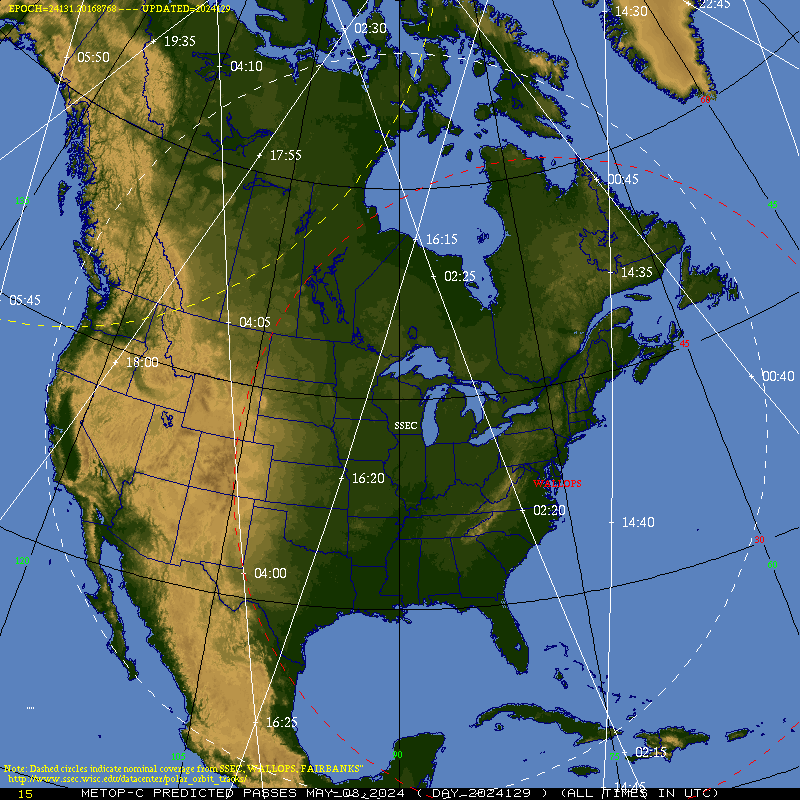
Note: The image above is time-stamped 0752 UTC, as that was when the first line of the satellite data used to create the image was received. In reality, NOAA-20 was acquiring data over Acapulco closer to 0808 UTC based on this predicted orbit path (from this site).

View only this post Read Less

Hurricane Otis rapidly intensifies to Category 5, just prior to making landfall near Acapulco, Mexico

1-minute Mesoscale Domain Sector GOES-18 (GOES-West) “Clean” Infrared Window (10.3 µm) images (above) showed Hurricane Otis as it approached the coast of Mexico, making landfall near Acapulco (Acapulco International Airport, METAR identifier MMAA, is located about 16 miles southeast of the city center) around 0625 UTC on 25 October 2023. During the 11-hour time period shown,... Read More

GOES-18 “Clean” Infrared Window (10.3 µm) images, from 2000 UTC on 24 October to 0700 UTC on 25 October [click to play animated GIF | MP4]

1-minute Mesoscale Domain Sector GOES-18 (GOES-West) “Clean” Infrared Window (10.3 µm) images (above) showed Hurricane Otis as it approached the coast of Mexico, making landfall near Acapulco (Acapulco International Airport, METAR identifier MMAA, is located about 16 miles southeast of the city center) around 0625 UTC on 25 October 2023. During the 11-hour time period shown, Otis was rapidly intensifying from a Category 2 hurricane at 2000 UTC on 24 October to Category 5 at 0300 UTC on 25 October (SATCON) — exhibiting a pinhole eye in the process. The coldest cloud-top infrared brightness temperatures were in the -80 to -90ºC range (shades of white, embedded within dark shades of black). After landfall Otis weakened quickly to a Category 2 storm by 1200 UTC on 25 October, due to interaction with the complex Sierra Madre del Sur topography.

Note that surface reports from Acapulco International Airport ceased after 0341 UTC on 25 October (presumably due to evacuation and/or power outages) — by that time, the site had already received 11 inches of rainfall (below) .

Plot of surface report data from Acapulco International Airport, from 1846 UTC on 24 October to 0341 UTC on 25 October [click to enlarge]

1-minute GOES-18 Infrared images with an overlay of GLM Flash Extent Density (below) revealed continuous lightning activity within the eyewall — which peaked in intensity at 0550 UTC, about 35 minutes prior to landfall.

GOES-18 “Clean” Infrared Window (10.3 µm) images with an overlay of GLM Flash Extent Density, from 2000 UTC on 24 October to 0700 UTC on 25 October [click to play animated GIF | MP4]

1-minute GOES-18 “Red” Visible (0.64 µm) images (below) showed a cloud-filled eye during the hours leading up to sunset, with intermittent pulses of convective overshooting tops within the eyewall (Visible/Infrared image toggle at 2246 UTC).

GOES-18 “Red” Visible (0.64 µm) images, from 2000 UTC on 24 October to 0000 UTC on 25 October [click to play animated GIF | MP4]

An image of RCM-1 Synthetic Aperture Radar (SAR) winds at 0052 UTC on 25 October (source) is shown below — the maximum satellite-derived wind speeds were in the northeast and southeast quadrants of the eyewall.

RCM-1 SAR wind speeds at 0052 UTC on 25 October [click to enlarge]


GOES-18 Water Vapor images, with contours and streamlines of deep-layer wind shear [click to enlarge]

Imagery from the CIMSS Tropical Cyclones site indicated that Otis was moving through an environment characterized by low values of deep-layer wind shear (above), and was also traversing warm water (below) — both factors that were favorable for further intensification.

Sea Surface Temperature and Ocean Heat Content on 24 October, with an overlay of the track of Otis [click to enlarge]

___________________________

GOES-18 “Clean” Infrared Window (10.3 µm) images, from 0500 UTC to 0900 UTC on 25 October [click to play animated GIF | MP4]

Around the time of landfall, Otis began to exhibit a “cloud cliff” feature that extended southward from the western edge of the eye (above). To further characterize this cloud cliff, the Cloud Top Height derived product was examined from GOES-16 (GOES-East) — using both the full-resolution (2 km) CLAVR-x version and the “legacy” 10-km resolution version that is currently distributed in AWIPS (below). It is clear that the sharp horizontal gradient associated with the cliff feature was not well resolved with the 10-km version. This unique cloud cliff feature has occasionally been seen in strong typhoons in the West Pacific — for example, Typhoon Lekima and Typhoon Neoguri

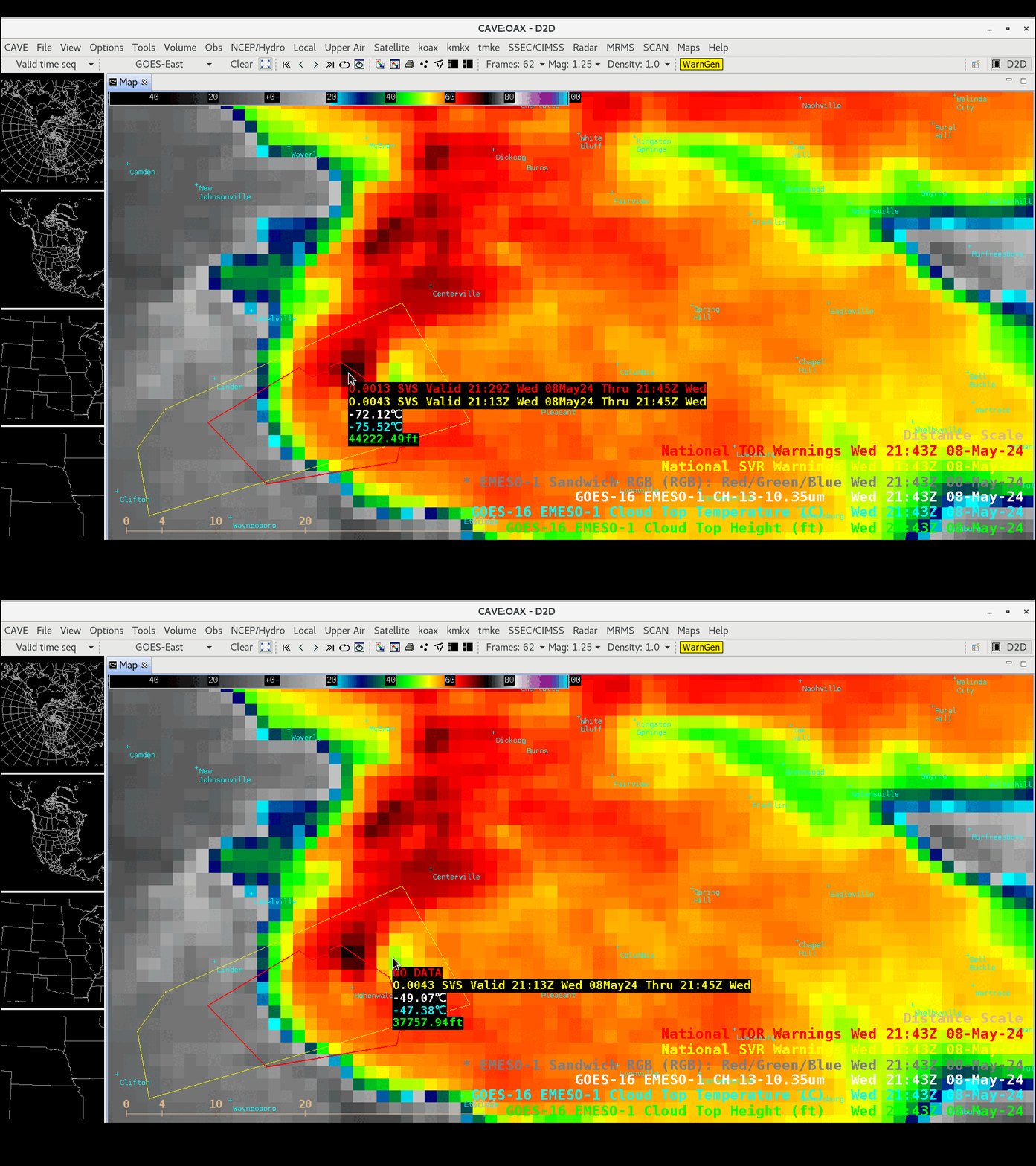
GOES-16 “Clean” Infrared Window (10.3 µm), CLAVR-x Cloud Top Height and legacy Cloud Top Height at 0636 UTC [click to enlarge]

Cursor samples of GOES-16 infrared (10.3 µm) brightness temperature, CLAVR-x Cloud Top Height and legacy Cloud Top Height across 2 portions of the cloud cliff feature (below) indicated that the “top” of the cliff was at CLAVR-x heights of 55904-56006 ft, while the adjacent downwind “trench” dropped to CLAVR-x heights of 47774-50523 ft — the height difference between the cliff top and the adjacent trench was 8210 ft and 5483 ft at the northern and southern cursor-sampled points, respectively. In addition, the CLAVR-x product cliff top heights were 4000-5000 ft higher (and the trench heights 2000-3000 ft lower) compared to the legacy product.   Thanks are extended to Joleen Feltz (CIMSS) for staging the CLAVR-x products on our local AWIPS data server, allowing this Cloud Top Height comparison to be made.  

Cursor samples of GOES-16 Infrared (10.3 µm) brightness temperature (white), CLAVR-x Cloud Top Height (blue) and legacy Cloud Top Height (red) at 0636 UTC [click to enlarge]

Due to ample illumination from the Moon (which was in the Waxing Gibbous phase, at 70% of Full), the trench feature was also evident just south of the Mexico coastline in a nocturnal NOAA-20 VIIRS Day/Night Band (0.7 µm) image valid at 0808 UTC on 25 October (below) — another version of the NOAA-20 image is available in this blog post; the corresponding GOES-18 Infrared image that showed the (warm) trench at that time can be seen here.

NOAA-20 VIIRS Day/Night Band (0.7 µm) image, valid at 0808 UTC on 25 October [click to enlarge]

View only this post Read Less