This website works best with a newer web browser such as Chrome, Firefox, Safari or Microsoft Edge. Internet Explorer is not supported by this website.

Erin…TUTT…Dean

AWIPS images of the GOES-12 water vapor channel (above) showed 3 distinct cyclonic circulation features on 17 August 2007: (1) the remnants of Tropical Storm Erin over Texas, (2) a Tropical Upper Tropospheric Trough (TUTT) over the Bahamas, and (3) rapidly intensifying Hurricane Dean over the western Atlantic Ocean (see the CIMSS Tropical Cyclones site... Read More

GOES-12 water vapor images (Animated GIF)

AWIPS images of the GOES-12 water vapor channel (above) showed 3 distinct cyclonic circulation features on 17 August 2007: (1) the remnants of Tropical Storm Erin over Texas, (2) a Tropical Upper Tropospheric Trough (TUTT) over the Bahamas, and (3) rapidly intensifying Hurricane Dean over the western Atlantic Ocean (see the CIMSS Tropical Cyclones site for the latest information on Hurricane Dean).

GOES-12 water vapor winds (Animated GIF)

Satellite-derived water vapor winds (or Atmospheric Motion Vectors) using GOES-12 imagery (above) were helpful in diagnosing the intensification of the TUTT circulation over the Bahamas during the 15-17 August period. Note that the TUTT circulation was evident in the upper-tropospheric 200 hPa wind fields, but not on the lower-tropospheric 850 hPa wind fields.

CRAS forecast imagery (Animated GIF)

Since TUTT features can sometimes inhibit tropical cyclone development by introducing greater environmental shear, we examined a series of forecast synthetic water vapor channel + IR channel satellite imagery from the CRAS model (above). The CRAS water vapor image forecast suggested that the TUTT circuation would remain over the Gulf of Mexico, far to the northwest of Hurricane Dean as it intensified and moved westward across the Caribbean Sea.

View only this post Read Less
Tropical Storm Erin

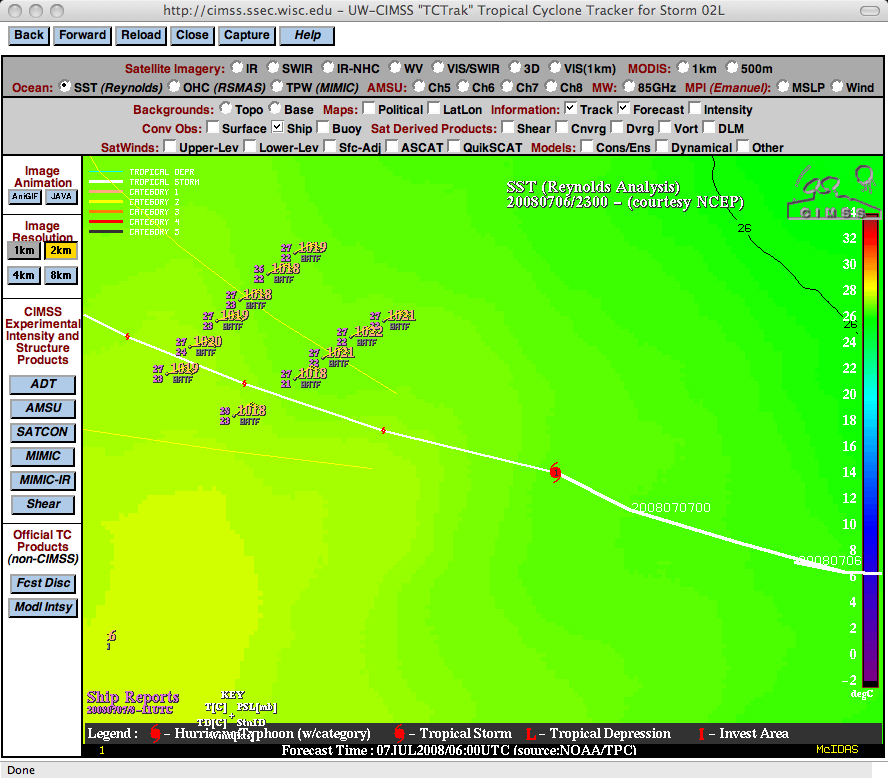
The track of Tropical Storm Erin from the CIMSS Tropical Cyclones site (above) depicts a fairly short-lived history over the Gulf of Mexico during 15 August16 August 2007. Although wind speeds only reached minimal tropical storm intensity, the more important characteristic of Erin was the high amounts of tropical moisture tapped by the system.AWIPS images of the... Read More

GOES-12 water vapor image with Erin track

The track of Tropical Storm Erin from the CIMSS Tropical Cyclones site (above) depicts a fairly short-lived history over the Gulf of Mexico during 15 August16 August 2007. Although wind speeds only reached minimal tropical storm intensity, the more important characteristic of Erin was the high amounts of tropical moisture tapped by the system.

AWIPS images of the GOES Sounder Total Precipitable Water (TPW) derived product (below; QuickTime animation) showed a large area of elevated TPW values ranging from 50-67 mm (2.0-2.6 in) over the Gulf of Mexico around the periphery of Erin, with TPW values greater than 40 mm (1.6 in) inland over much of Texas. Such copious amounts of moisture coupled with slow forward storm motion helped the remnants of Erin to produce very heavy rainfall (as much as 8.6 inches reported, with rainfall rates of 1-3 inches per hour — see radar-estimated storm total precipitation from Houston and Austin/San Antonio) which led to flooding across parts of Texas during the day on 16 August.

AWIPS GOES sounder total precipitable water

View only this post Read Less
Upper Midwest Derecho

Derechos are long-lived convectively-driven wind storms. In the upper midwest, they typically form in northwesterly flow just poleward of very warm and moist air and then surge southward. Convection overnight on 13-14 August 2007 developed into a long-lasting complex with a bow echo that propagated from north of Minneapolis to... Read More

ir_lightningmovie.gif

Derechos are long-lived convectively-driven wind storms. In the upper midwest, they typically form in northwesterly flow just poleward of very warm and moist air and then surge southward. Convection overnight on 13-14 August 2007 developed into a long-lasting complex with a bow echo that propagated from north of Minneapolis to Illinois. Although wind speeds weren’t as strong in historic events such as July 1983, numerous wind damage reports nevertheless were reported to SPC.

070813_rpts.gif

Monday August 13 was characterized by strong moisture contrasts over the upper midwest (see the 2100 UTC dewpoint plot here; the 2100 UTC temperature plot is here). Excessive heat and humidity over the high plains extended northeastward into central Minnesota where cooler and dryer air prevailed. Predictably, this was a region for the development of strong thunderstorms, and the 0000 UTC sounding for 14 August at Chanhassen (here) showed the potential for very strong convection.

The AQUA satellite carrying the MODIS instrument flew directly over the mature thunderstorm complex at 7:50 UTC 14 August, and the color-enhanced IR window channel (10.8 micrometers) is below. Plotted on top of the clouds are the 15-minute cloud to ground lightning data. Two active regions of lightning are present; one is over south-central Wisconsin, near Madison, and a second stretches as an arc along the front of a southward-propagating bow echo over western Wisconsin, immediately in front of the coldest cloud tops. The vertex of the arc corresponds to the line of wind damage reports from SPC. This correspondence is even more striking when viewing animations of lightning data and satellite data (or the combination, at the top of this blog entry), or the radar loop with lightning superposed on top that is here. Note the striking roll-up at the eastern edge of the devloping bow echo that was captured in extreme western Wisconsin — next to the St. Croix River — in the radar image at 0554 UTC (here).

The propagating thunderstorm had a predictable influence on surface pressures. Pressures rose as the first region of lightning moved through Madison just before 08z, and again as the second region of lightning associated with the weakening bow echo moved across Dane County.

rigmeteorogram.jpg

Note also the presence of a 38-knot wind gust from the southeast at 10:10 UTC as the mesolow moved through after most of the rain had fallen.

View only this post Read Less
More smoke from the Idaho/Montana fires

Large wildfires continued to burn out of control in parts of Idaho and Montana (NOAA HMS product) on 13 August 2007. GOES-13 visible imagery (above; Java animation) showed smoke (from the previous day of burning) that was trapped in the valleys during the morning hours…with a transition to rapid smoke plume growth as southwesterly boundary... Read More

GOES-13 visible images

Large wildfires continued to burn out of control in parts of Idaho and Montana (NOAA HMS product) on 13 August 2007. GOES-13 visible imagery (above; Java animation) showed smoke (from the previous day of burning) that was trapped in the valleys during the morning hours…with a transition to rapid smoke plume growth as southwesterly boundary layer winds increased and new fire activity flared up during the afternoon and evening hours.

GOES-12 visible imagery (below; Java animation) showed that smoke from previous days of burning had been transported as far eastward as Wisconsin and the western Great Lakes region on 13 August.

GOES-12 visible image

MODIS AOD product

The extent of the eastward transport of smoke was confirmed using the MODIS Aerosol Optical Depth (AOD) product (above), with the thick smoke exhibiting high AOD values of 0.7 to 1.0 (orange to red enhancement).

MODIS true color imagery (below) showed a closer view of the smoke (hazy areas) that was drifting over Wisconsin and surrounding states during the early afternoon hours — and the IDEA aerosol trajectory forecast suggested a continuation of smoke transport aloft across the the Upper Midwest and Great Lakes regions .

MODIS true color image

The thick smoke aloft was responsible for creating a colorful (albeit somewhat muted) sunset — the photo below was taken in Middleton, Wisconsin, looking west, around 7:45 PM local time.

smoky sunset in southern Wisconsin

View only this post Read Less