
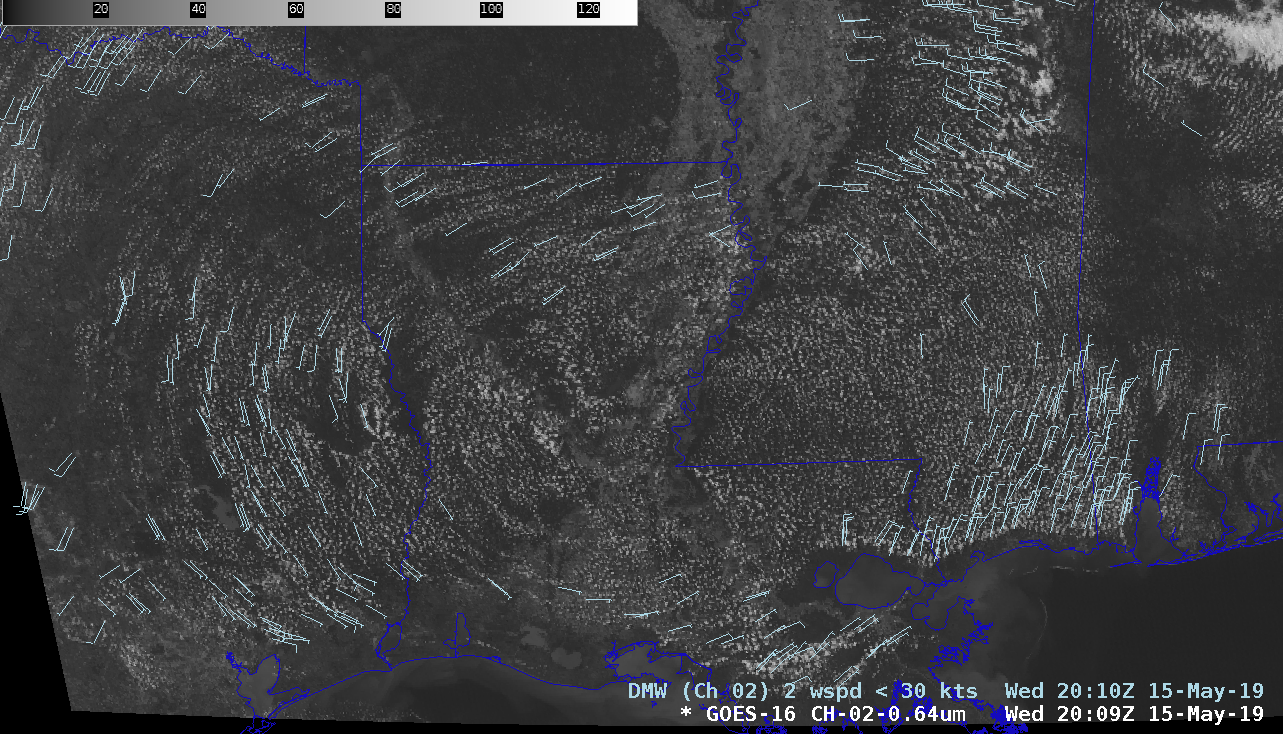
GOES-16 “Red” Visible (0.64 µm) images, with plots of Derived Motion Winds [click to play MP4 animation]
View only this post Read Less
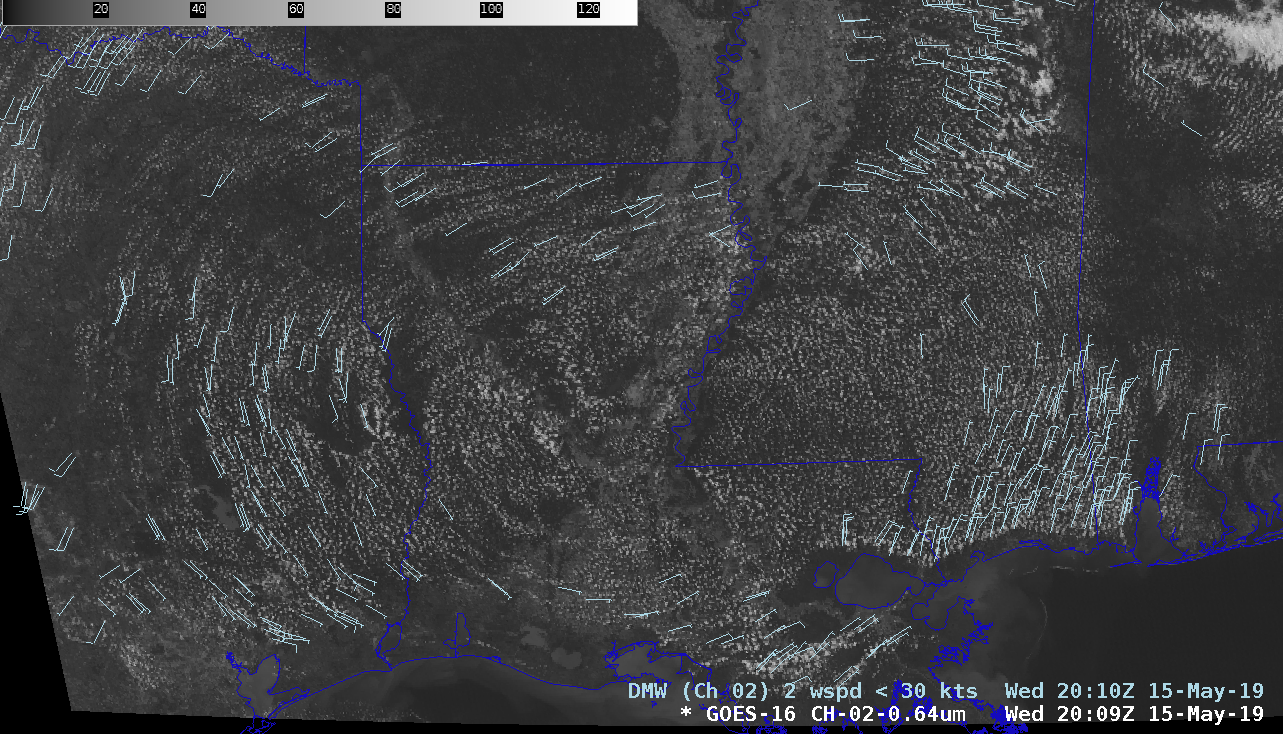
1-minute Mesoscale Domain Sector GOES-16 (GOES-East) “Red” Visible (0.64 µm) images, with 5-minute plots of Derived Motion Winds (above) revealed a cumulus cloud field that beautifully outlined the flow around an area of high pressure that was centered over Louisiana on 15 May 2019. Subsidence within the dome of high pressure prevented significant vertical development of these... Read More
GOES-16 “Red” Visible (0.64 µm) images, with plots of Derived Motion Winds [click to play MP4 animation]
View only this post Read Less
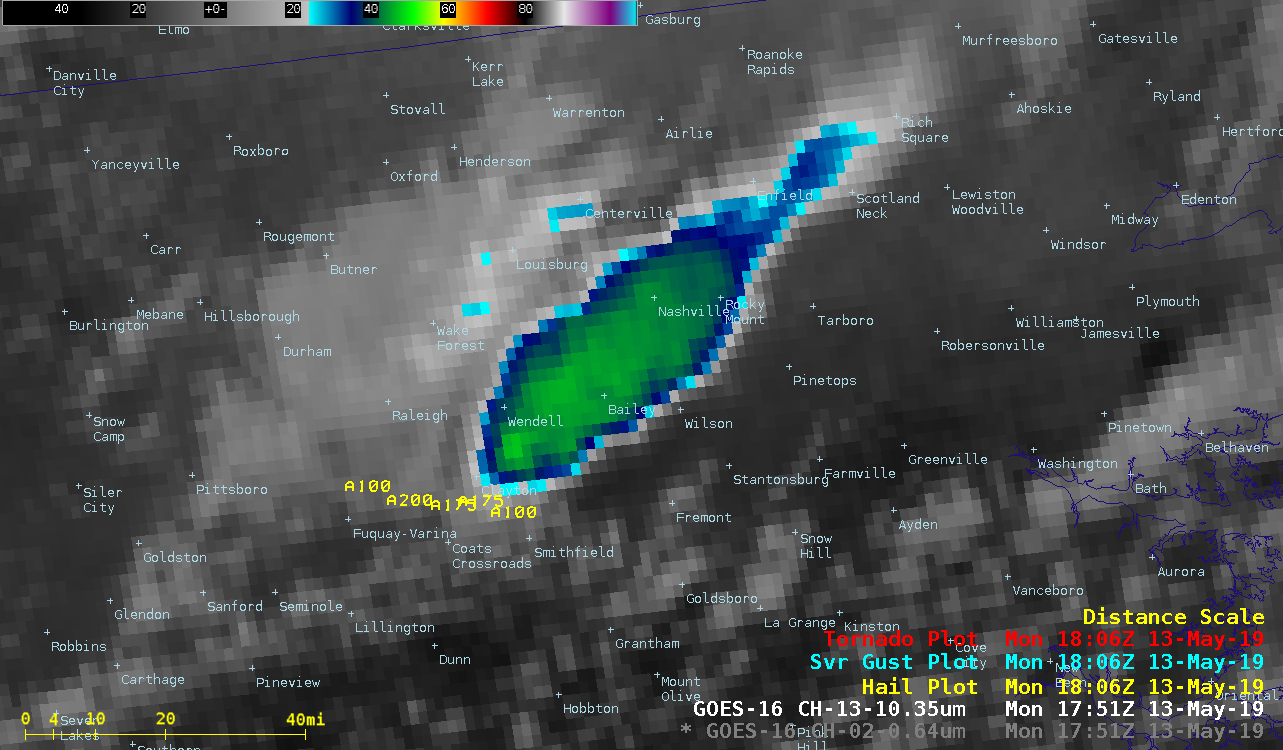
GOES-16 (GOES-East) “Red” Visible (0.64 µm) and “Clean” Infrared Window (10.3 µm) images (above) showed clusters of severe thunderstorms that produced tornadoes and large hail (SPC storm reports) across parts of central and eastern North Carolina on 13 May 2019.A west-to-east oriented quasi-stationary frontal boundary was acting as a focusing mechanism for many of these thunderstorms... Read More

GOES-16 “Red” Visible (0.64 µm) and “Clean” Infrared Window (10.3 µm) images, with plots of SPC storm reports [click to play animation | MP4]
A west-to-east oriented quasi-stationary frontal boundary was acting as a focusing mechanism for many of these thunderstorms — the Terra MODIS Total Precipitable Water product at 1525 UTC (below) showed TPW values around 28 mm or 1.1 inch (lighter green enhancement) pooled immediately south of this frontal boundary.
![Terra MODIS Total Precipitable Water product [click to enlarge]](https://cimss.ssec.wisc.edu/satellite-blog/wp-content/uploads/sites/5/2019/05/nc_modis_ir_tpw-20190513_152500.png)
Terra MODIS Total Precipitable Water product [click to enlarge]
View only this post Read Less
True Color Red-Green-Blue (RGB) images from the MODIS instrument (on the Terra satellite) and the VIIRS instrument (on the NOAA-20 and Suomii NPP satellites) as viewed using RealEarth (above) revealed a tan-colored swirl of dust that had been lofted from the surface and entrained into the circulation of a midlatitude... Read More
![True Color RGB images from MODIS (Terra) and VIIRS (NOAA-20 and Suomi NPP) [click to enlarge]](https://cimss.ssec.wisc.edu/satellite-blog/wp-content/uploads/sites/5/2019/05/190512_modis_viirs_truecolor_china_anim.gif)
True Color RGB images from MODIS (Terra) and VIIRS (NOAA-20 and Suomi NPP) [click to enlarge]
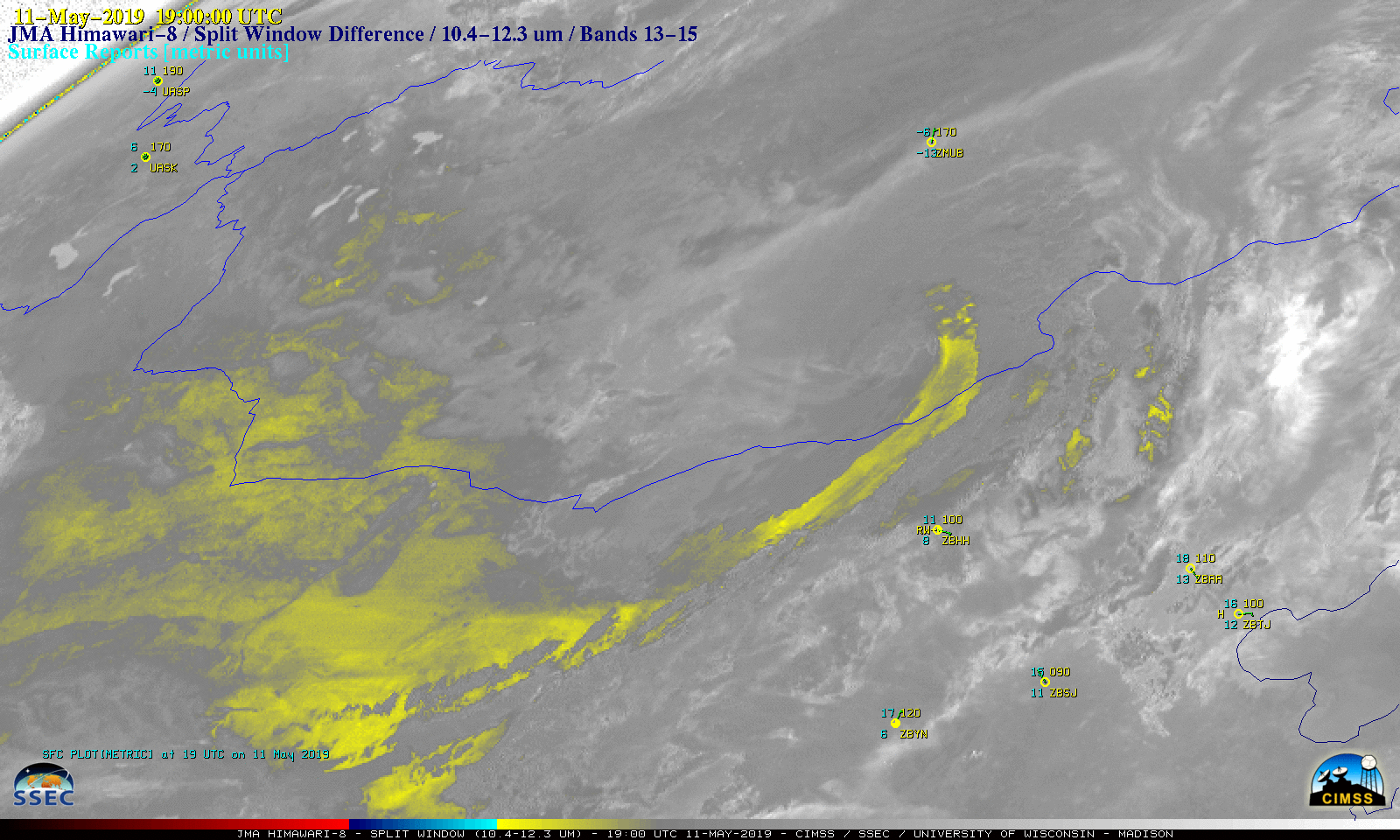
A sequence of MODIS/VIIRS True Color RGB images from Terra and Suomi NPP on 10, 11 and 12 May (below) showed the initial signature of surface-based blowing dust appearing in the Kumul and Jiuquan areas of northwestern China on 11 May, before it became wrapped into the circulation of the aforementioned midlatitude cyclone on 12 May.
![True Color RGB images from MODIS (Terra) and VIIRS (Suomi NPP) [click to enlarge]](https://cimss.ssec.wisc.edu/satellite-blog/wp-content/uploads/sites/5/2019/05/190510_190512_modis_viirs_truecolor_China_anim.gif)
True Color RGB images from MODIS (Terra) and VIIRS (Suomi NPP) [click to enlarge]
![Surface analyses at 3-hour intervals from 12 UTC on 11 May to 00 UTC on 13 May [click to enlarge]](https://cimss.ssec.wisc.edu/satellite-blog/wp-content/uploads/sites/5/2019/05/190511_190513_surface_analyses_asia_anim.gif)
Surface analyses at 3-hour intervals from 12 UTC on 11 May to 00 UTC on 13 May [click to enlarge]
![Himawari-8 Split Window Difference (10.4-12.3 µm) iimages [click to play animation |MP4]](https://cimss.ssec.wisc.edu/satellite-blog/wp-content/uploads/sites/5/2019/05/190511_190512_himawari8_splitWindowDifference_China_blowing_dust_anim.gif)
Himawari-8 Split Window Difference (10.4-12.3 µm) images [click to play animation | MP4]
View only this post Read Less
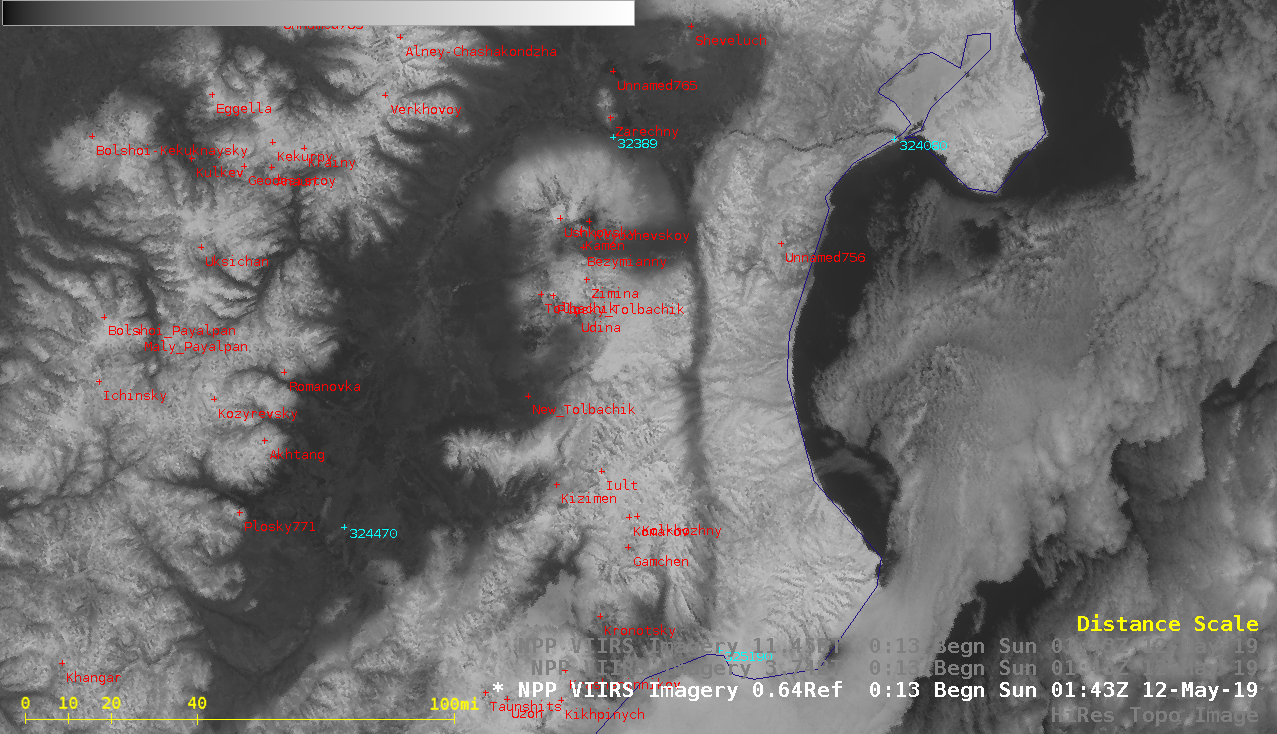
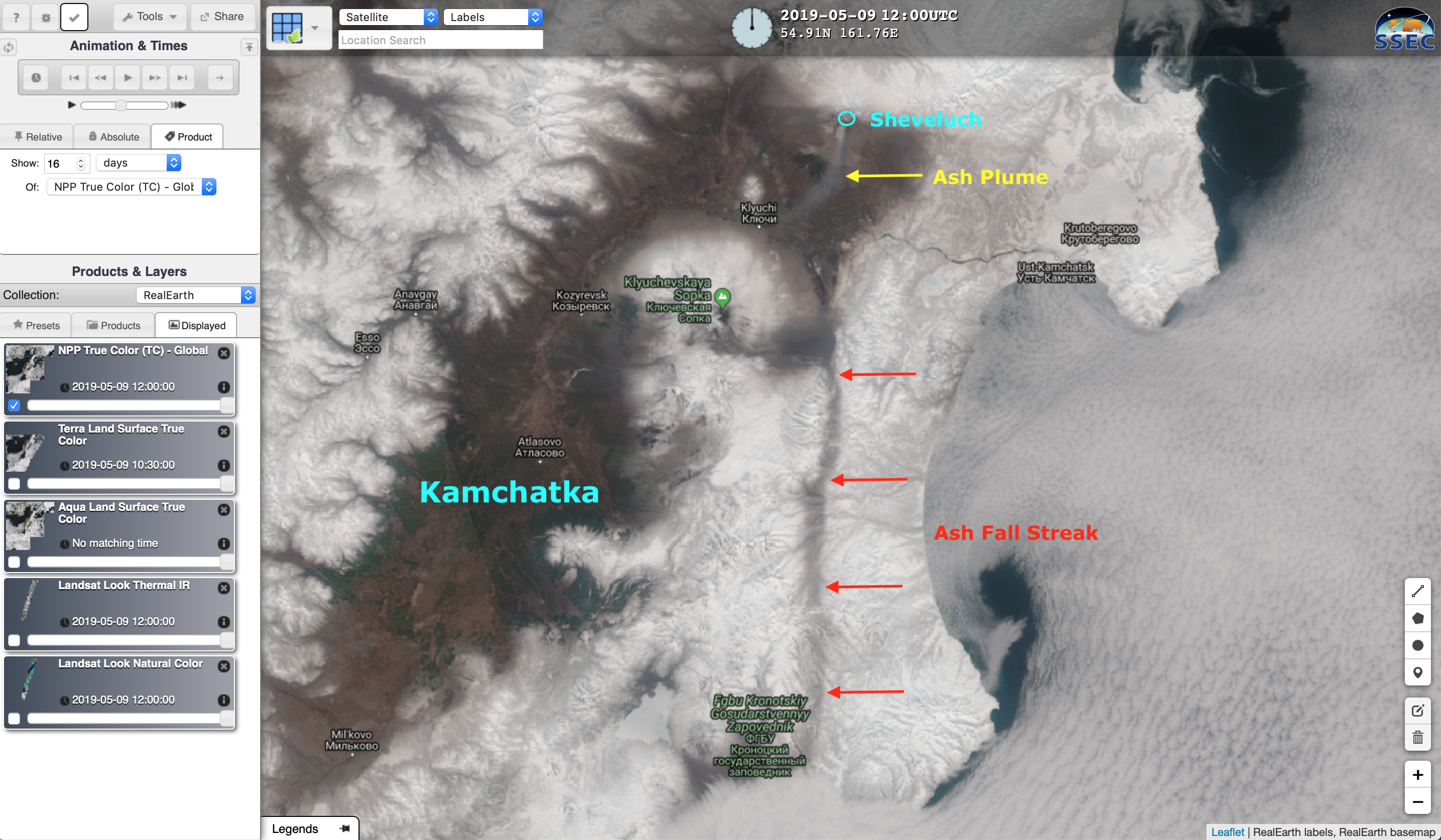
In a comparison of Suomi NPP VIIRS Visible (0.64 µm), Shortwave Infrared (3.74 µm) and Infrared Window (11.45 µm) images on 12 May 2019 (above), a dark volcanic ash fall streak was evident in the Visible image, which extended over 100 miles southward from the Sheveluch volcano on the Kamchatka... Read More
![Suomi NPP VIIRS Visible (0.64 µm), Shortwave Infrared (3.74 µm) and Infrared Window (11.45 µm) images, with topography [click to enlarge]](https://cimss.ssec.wisc.edu/satellite-blog/wp-content/uploads/sites/5/2019/05/190512_0143utc_suomiNPP_viirs_visible_shortwaveInfrared_infraredWindow_Kamchatka_ash_fall_plume_anim.gif)
Suomi NPP VIIRS Visible (0.64 µm), Shortwave Infrared (3.74 µm) and Infrared Window (11.45 µm) images, with topography [click to enlarge]
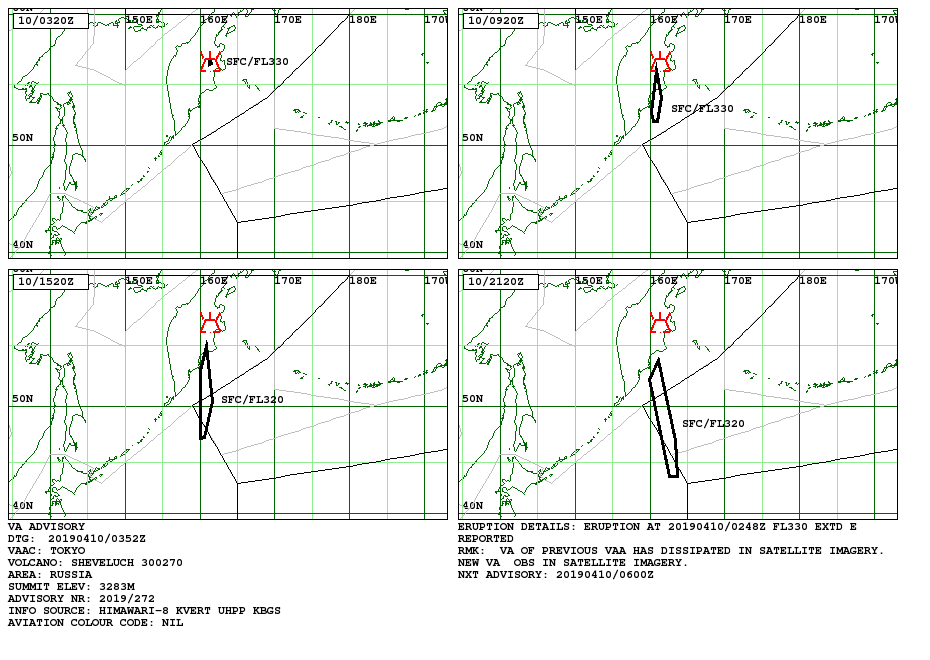
This ash fall streak was a result of an explosive eruption of the volcano over a month earlier, on 10 April — the volcanic ash plume could be seen moving southward in Himawari-8 Visible (0.64 µm) images (below).
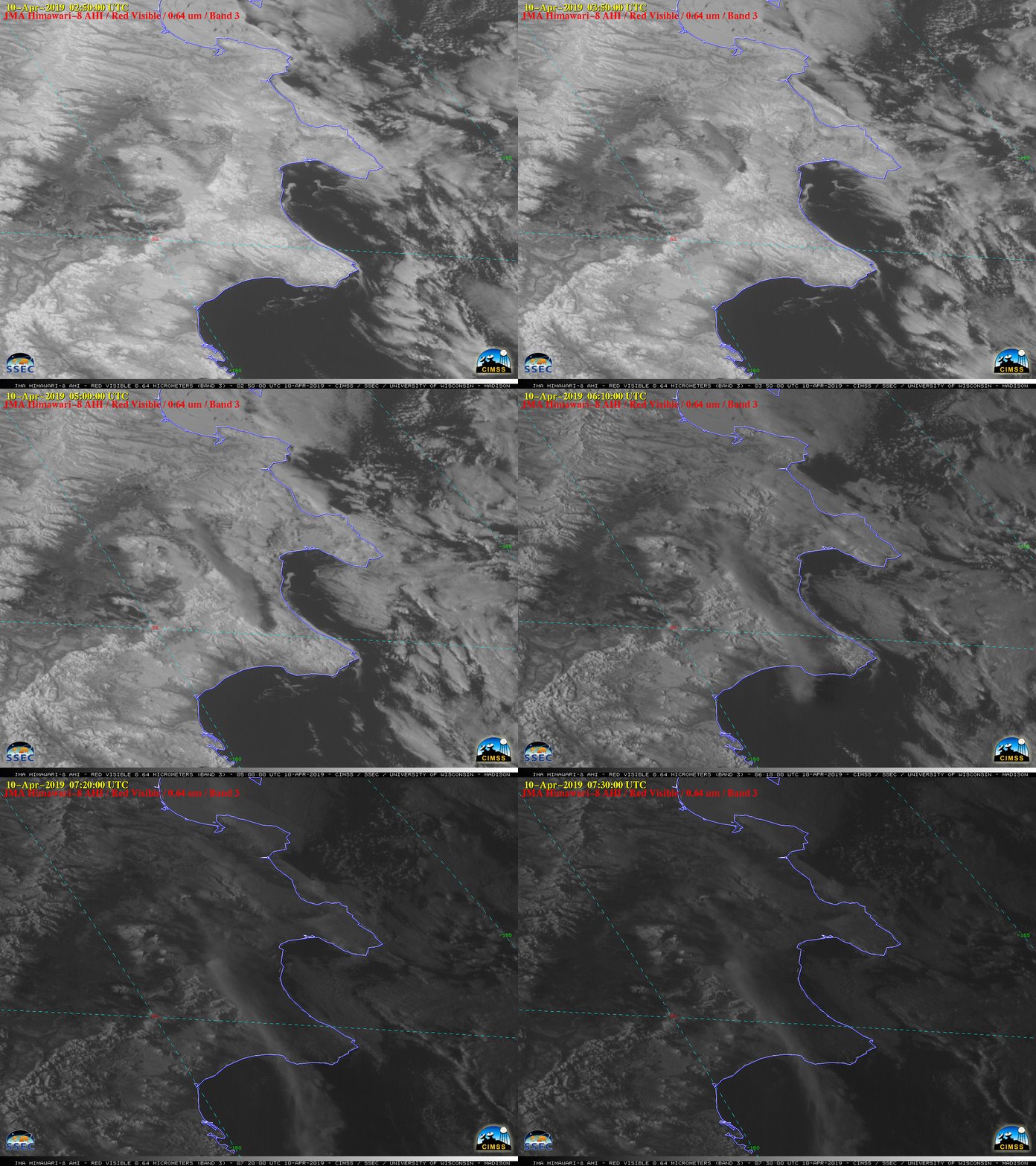
Himawari-8 “Red” Visible (0.64 µm) images [click to play animation | MP4]
![Suomi NPP VIIRS True Color RGB images, 06-12 May 2019 [click to play animation | MP4]](https://cimss.ssec.wisc.edu/satellite-blog/wp-content/uploads/sites/5/2019/05/190506_190512_suomiNPP_viirs_truecolor_Kamchatka_ash_fall_plume_anim.gif)
Suomi NPP VIIRS True Color RGB images, 06-12 May 2019 [click to play animation | MP4]
![Suomi NPP False Color, Ash Probability, Height, Loading and Effective Radius [click to enlarge]](https://cimss.ssec.wisc.edu/satellite-blog/wp-content/uploads/sites/5/2019/05/190509_0100utc_suomiNPP_falsecolor_ash_probability_height_loading_radius_Shiveluch_anim.gif)
Suomi NPP False Color, Ash Probability, Height, Loading and Effective Radius [click to enlarge]
Thanks go out to Santiago Gassó for bringing this interesting feature to our attention.
In #Kamchatka today, this feature caught my attention. A long dark streak , it is not atmospheric, it appears lack of snow on the ground, it is there the previous days. I am not super familiar with the topo but I do not recall seeing it before. Any guess? some ground heating? pic.twitter.com/ShVbWCPJhF
— Santiago Gassó (@SanGasso) May 12, 2019
View only this post Read Less