The animation above shows GOES-16 Band 4 (1.38 µm, “Cirrus Channel) Imagery along with GOES-16 Derived Motion Wind vectors and Turbulence observations. Significant and widespread turbulence occurred. Of particular interest is a arced feature that appears in the GOES-16 imagery from northern Mississippi through western Tennessee and into south-central Kentucky. ... Read More
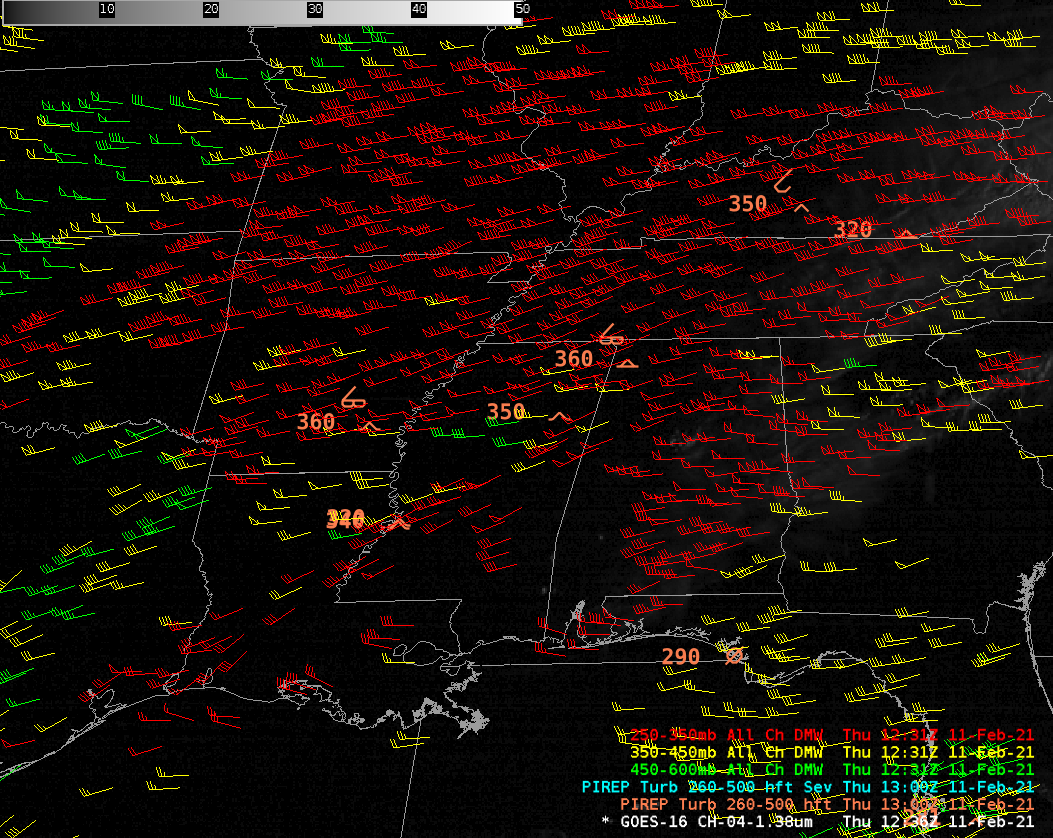
GOES-16 Band 4 (1.38 µm) “Cirrus Channel” imagery, along with Derived Motion Wind Vectors at 250-350 mb (red), 350-450 mb (yellow) and 450-600 mb *green). Pilot Reports of Turbulence are also plotted (Click to play animated gif)
The animation above shows GOES-16 Band 4 (1.38 µm, “Cirrus Channel) Imagery along with GOES-16 Derived Motion Wind vectors and Turbulence observations. Significant and widespread turbulence occurred. Of particular interest is a arced feature that appears in the GOES-16 imagery from northern Mississippi through western Tennessee and into south-central Kentucky. Turbulence occurs along this feature, where strong downward motion is likely present. Note this raw PIREP, for example, showing a very large vertical change!
UUA /OV RQZ/TM 1801/FL 410/TP C25M/TB SEV CAT/RM + OR - 1000 FT AND +60 KNOTS NO INJURIES NO DAMAGE
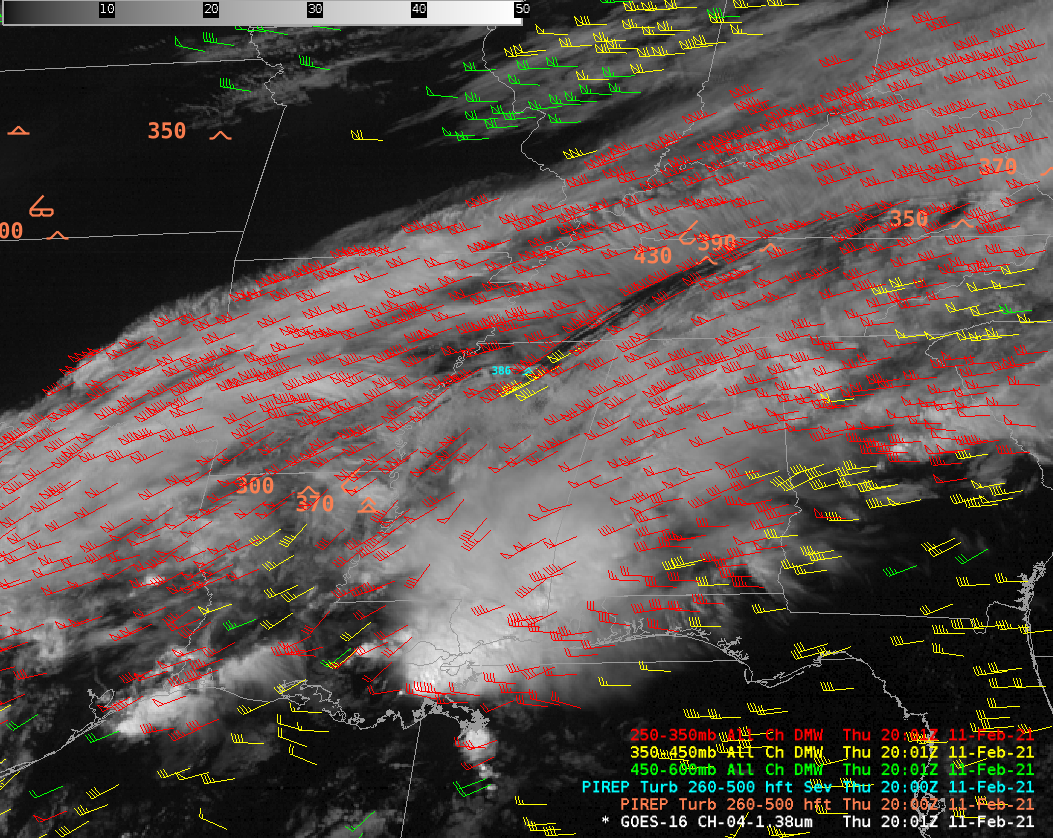
GOES-16 “Cirrus” Channel (Band 4, 1.38 µm) imagery, along with Derived Motion Winds and Pilot Reports (PIREPs) of turbulence, 2001 UTC on 11 February 2021 (Click to enlarge)
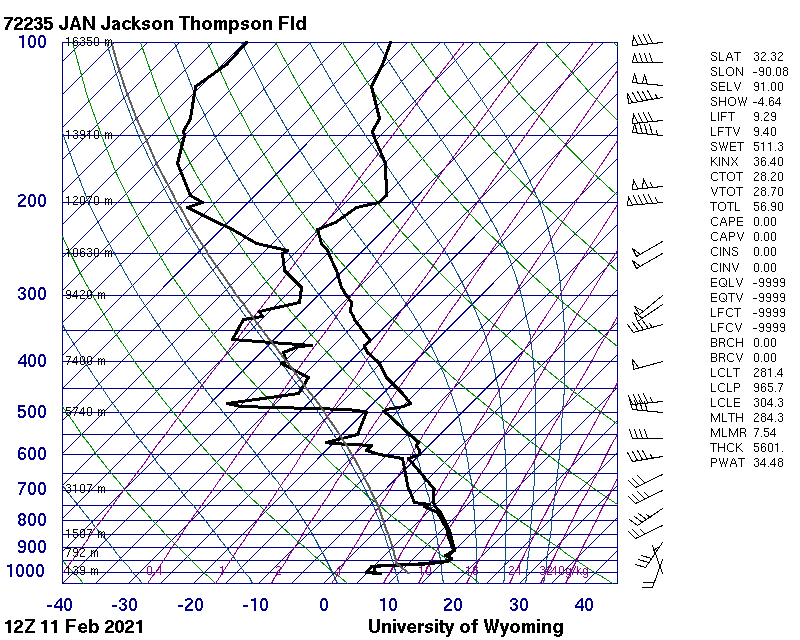
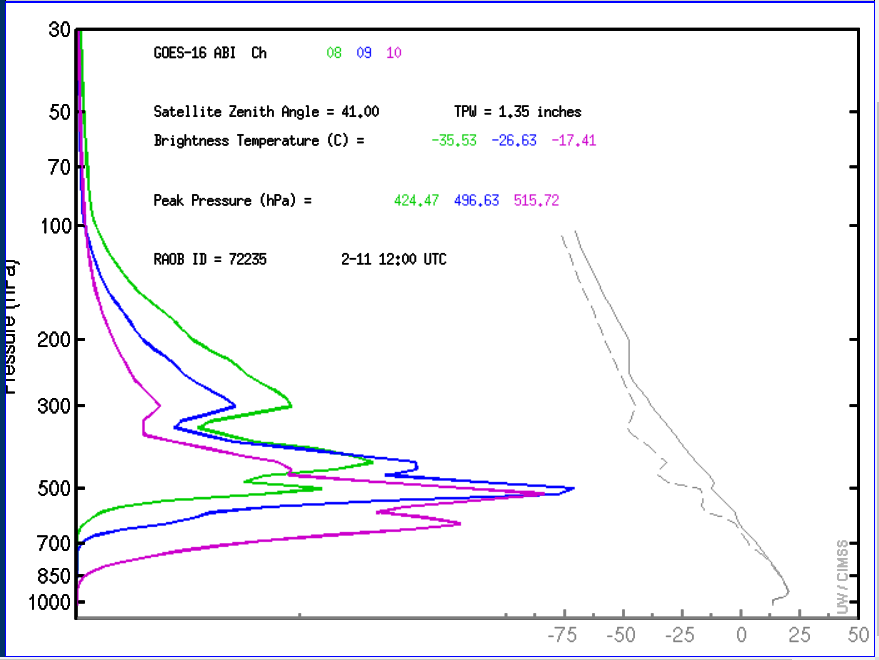
The curved structure is also prominent in the GOES-16 Band 8 (6.19 µm, Upper Level Water Vapor) infrared imagery shown below in a rocking animation. It emerges out of convection along the Gulf Coast and subsequently races to the northeast. The feature is less obvious in the Band 10 animation, suggesting that it is fairly high in the atmosphere. The 1200 UTC sounding from Jackson MS (link, from this website) shows a strong inversion at 500 mb; this might be the vertical boundary under which this feature is trapped. The weighting function for the Jackson sounding (here, from this site), shows peak values for all three water vapor channels very close to 500 mb.
Note that the arcing feature is apparent first in the upper-level water vapor imagery, then in the lower-level water vapor and cirrus channel imagery.
The mp4 animations below are also available as animated gifs: 6.19 µm, 7.34 µm and 1.38 µm)
GOES-16 6.19 µm (Band 8, “Upper-Level Water Vapor”) Infrared Imagery, 1236 UTC 11 February – 0001 UTC 12 February 2021 (Click to play mp4 animation)
GOES-16 7.34 µm (Band 10, “Low-Level Water Vapor”) Infrared Imagery, 1236 UTC 11 February – 0001 UTC 12 February 2021 (Click to play mp4 animation)
GOES-16 1.38 µm (Band 4, “Cirrus Channel”) near-infrared Imagery, 1401 UTC – 2201 UTC 11 February 2021 (Click to play mp4 animation)
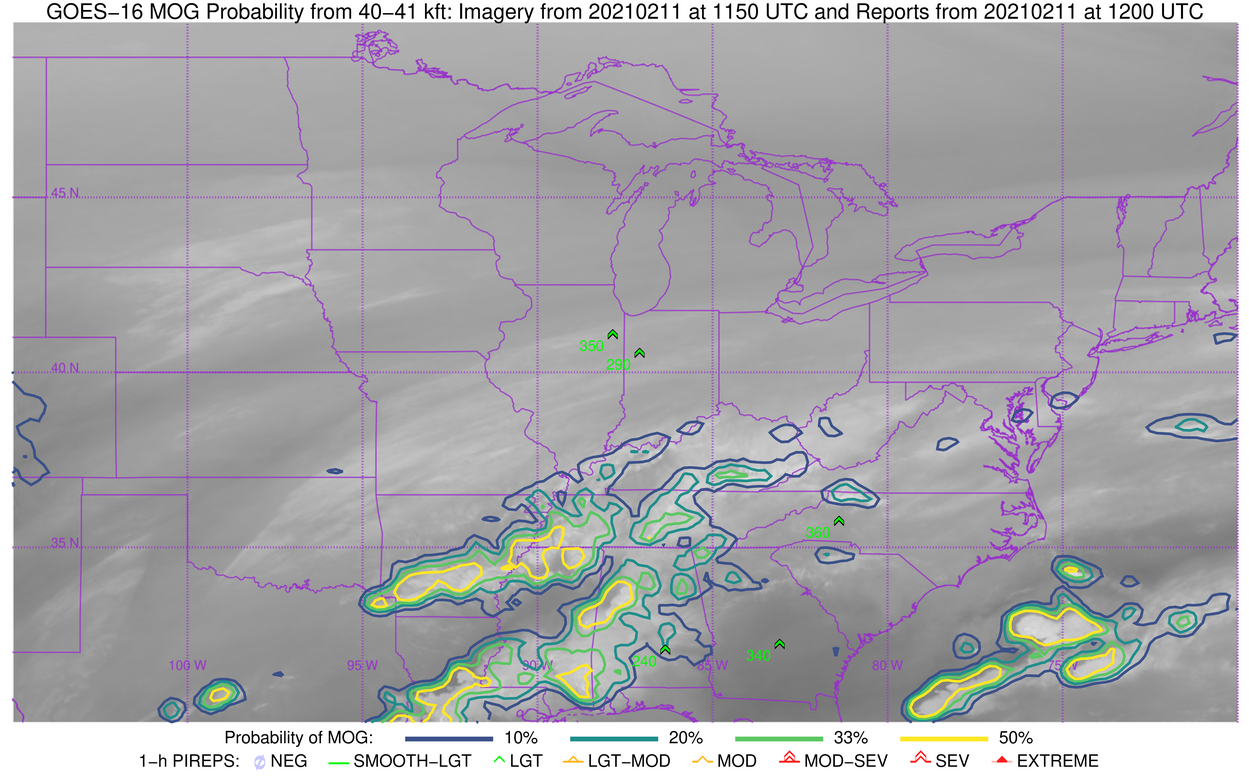
CIMSS scientists have recently upgraded a turbulence detection product that was developed using machine learning, combining Satellite Data, principally GOES-R Band 8 (6.19 µm, a “water vapor” band on GOES-R) and Band 13 (the Clean Window infrared, 10.3 µm) and trained on observations of EDR (Eddy Dissipation Rate). These mappings of Probabilities of Moderate or Greater (MOG) turbulence are available online at this website. How did this product fare on this day of active turbulence.
Animations below show predictions of MOG from 1200 to 2350 UTC on 11 February 2021. Predictions of MOG at 30000-31000 feet, 36000-37000 feet and 40000-41000 feet are shown. The probability contours are shown on top of a grey-scaled 6.19 µm water vapor image, and observations of turbulence are included.
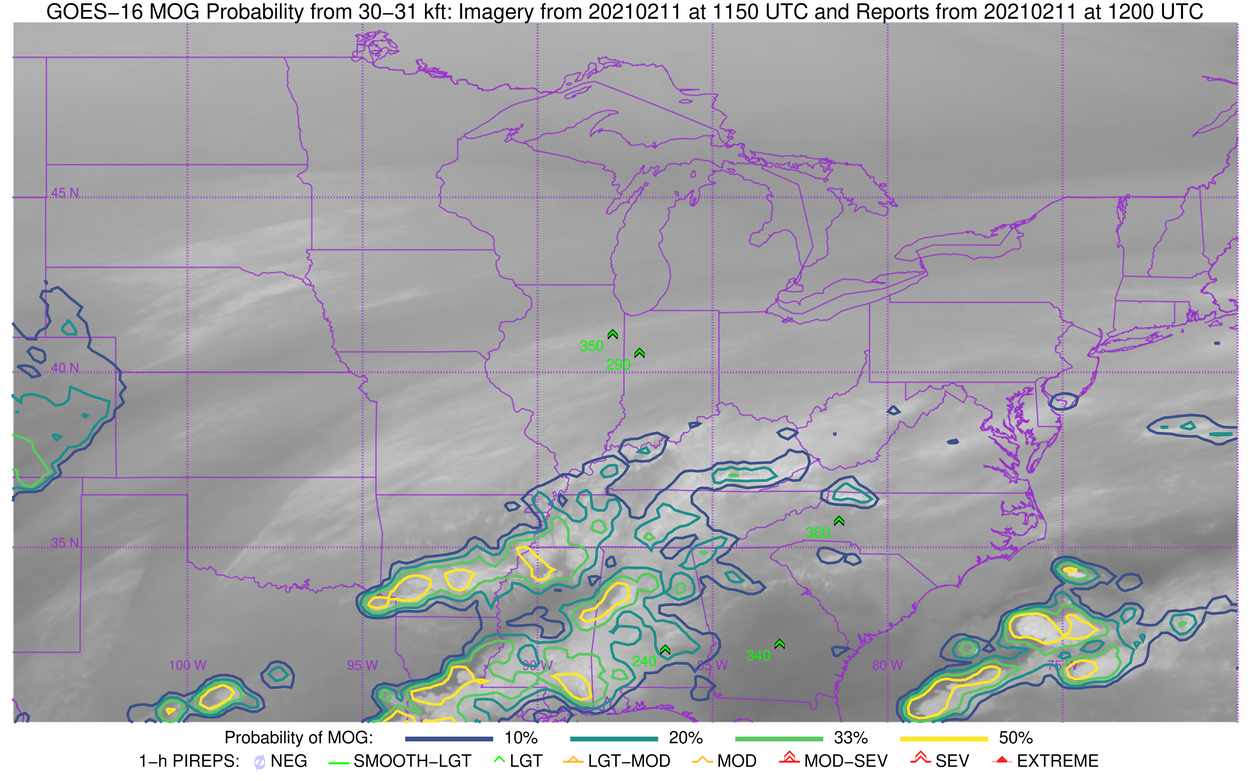
Probabilities of Moderate or Greater (MOG) turbulence at 30000-31000 feet, from 1200 – 2350 UTC on 11 February 2021 (Click to animate)
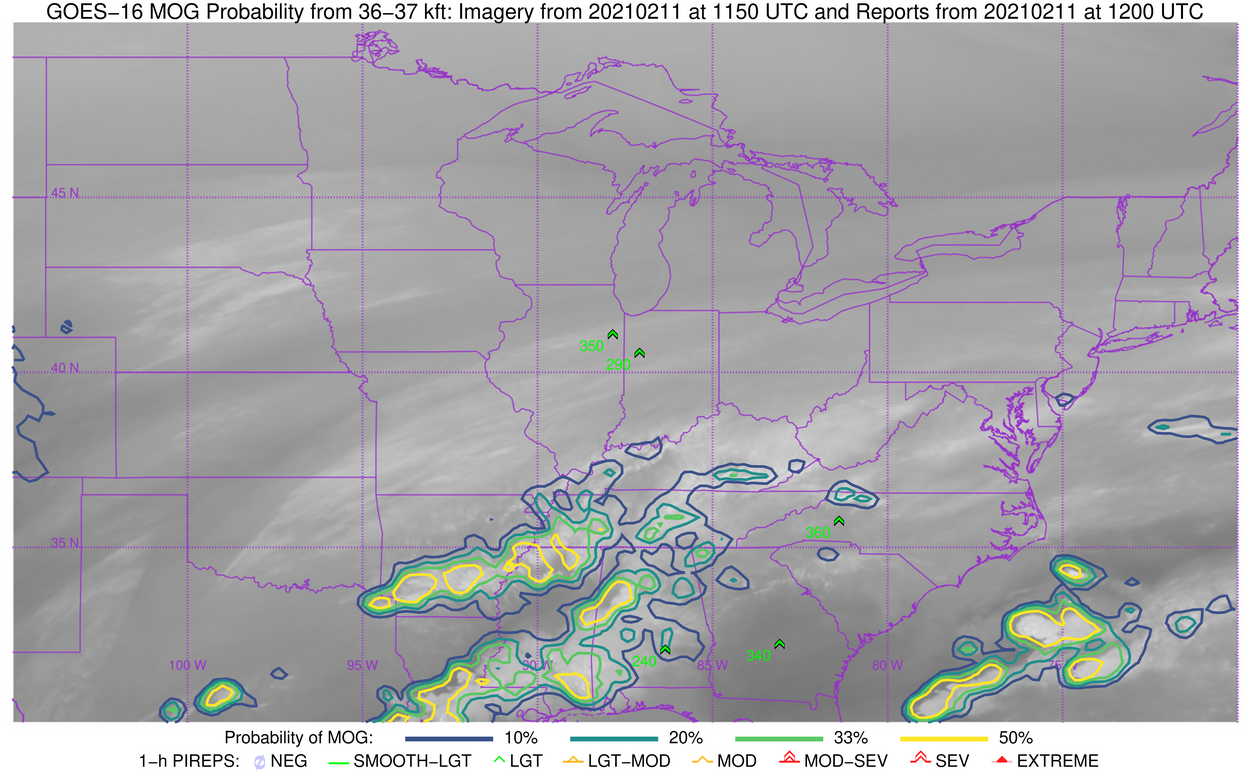
Probabilities of Moderate or Greater (MOG) turbulence at 36000-37000 feet, from 1200 – 2350 UTC on 11 February 2021 (Click to animate)
Probabilities of Moderate or Greater (MOG) turbulence at 40000-41000 feet, from 1200 – 2350 UTC on 11 February 2021 (Click to animate)
View only this post
Read Less



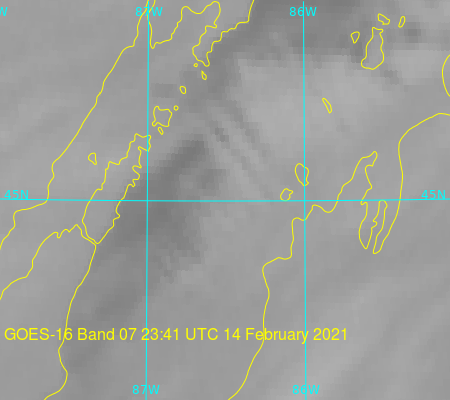
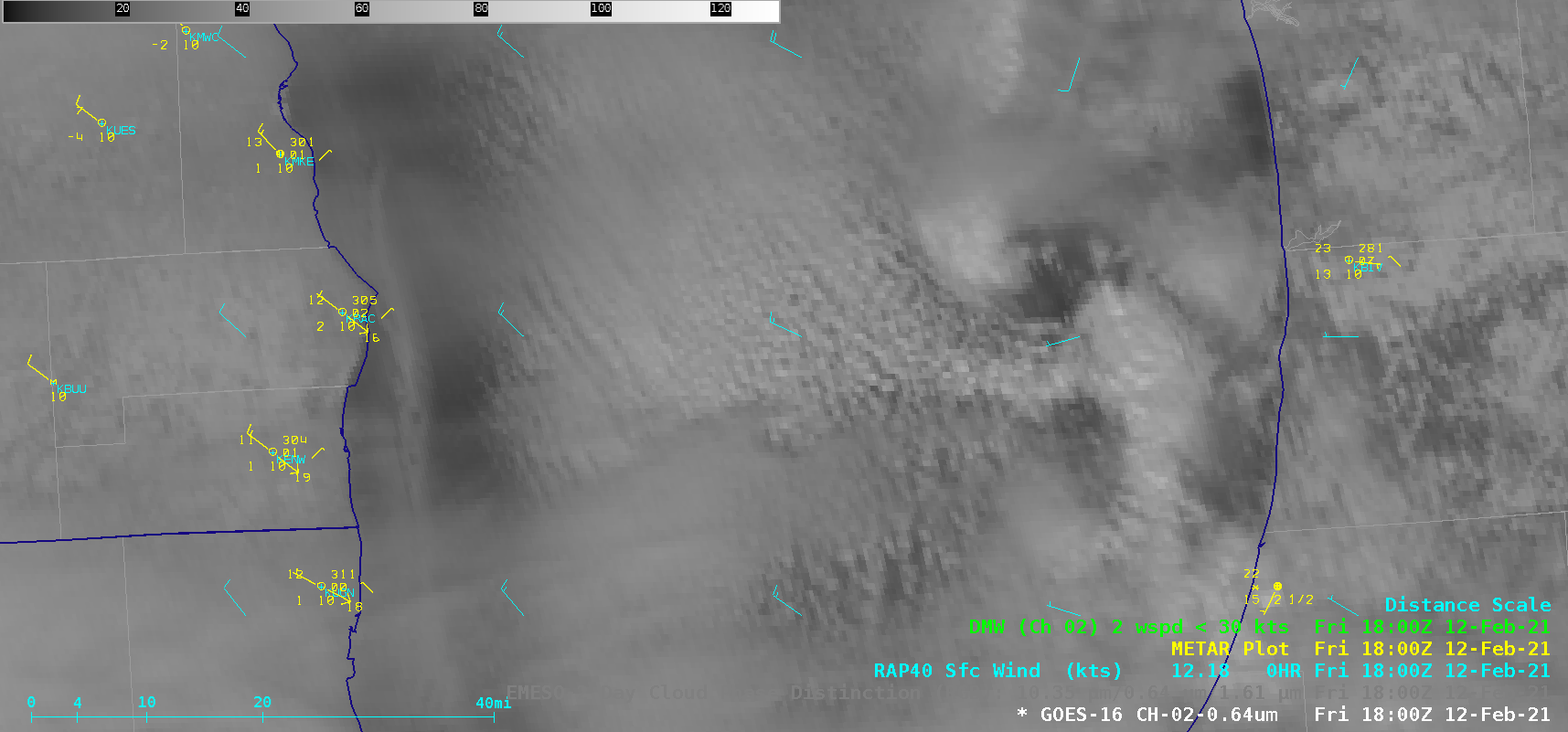

![GOES-16 "Red" Visible (0.64 µm) and Day Cloud Phase Discrimination RGB images at 1800 UTC [click to enlarge]](https://cimss.ssec.wisc.edu/satellite-blog/images/2021/02/210212_1800utc_visible_dayCloudPhaseDiscriminationRGB_Lake_Michigan_mesovortex_anim.gif)

![Water Vapor images from GOES-17 (6.9 µm, left) and GOES-15 (6.5 µm, right) [click to play animation | MP4]](https://cimss.ssec.wisc.edu/satellite-blog/images/2021/02/210210_goes17_goes15_waterVapor_WY_CO_mountain_waves_anim.gif)
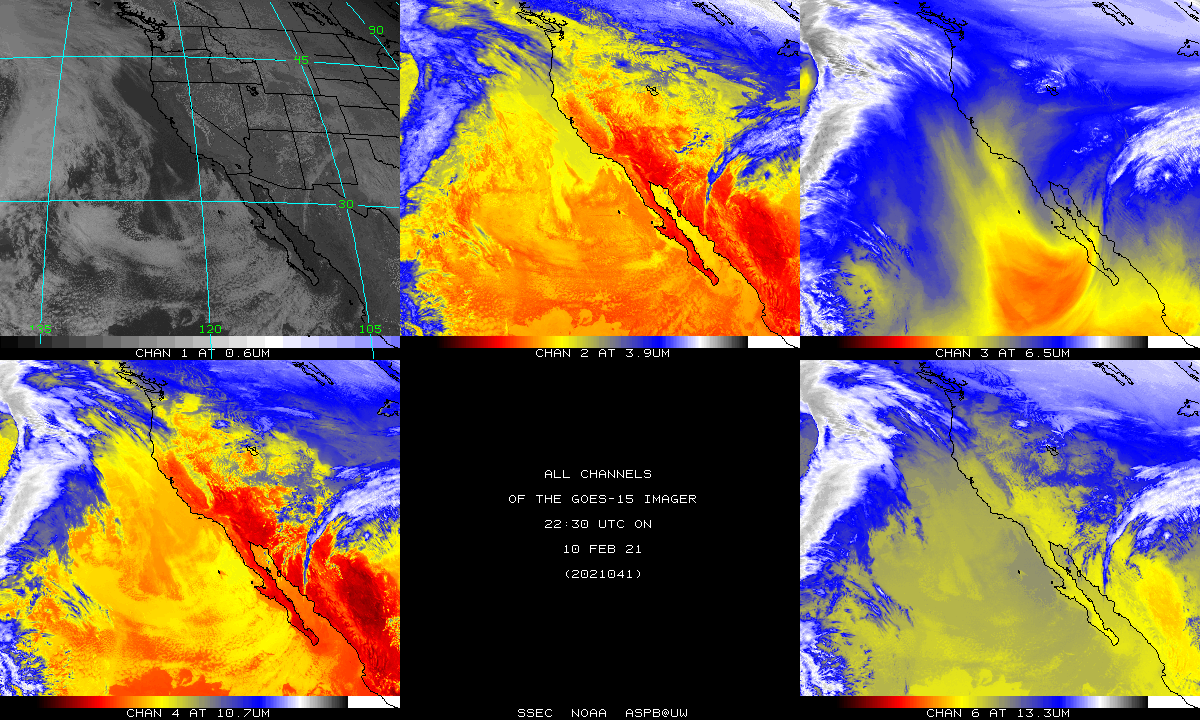
![GOES-15 Imager spectral bands [click to play animation | MP4]](https://cimss.ssec.wisc.edu/satellite-blog/images/2021/02/210210_goes15_imager_bands_anim.gif)
![GOES-15 Sounder spectral bands [click to play animation | MP4]](https://cimss.ssec.wisc.edu/satellite-blog/images/2021/02/210210_goes15_sounder_bands_anim.gif)