
Blowing dust in the Four Corners region of the US

April 16th, 2013
GOES-13 0.63 µm visible channel images (click image to play animation)

GOES-13 0.63 µm visible channel images (click image to play animation)

Strong southwesterly winds ahead of an advancing cold front caused large areas of blowing dust across parts of the “Four Corners” region of the western US on 16 April 2013. Wind gusts were as high as 68 mph at Winslow, Arizona — and Interstate 40 was closed between Winslow and Winona, as visibility was reduced to 50 feet at times in some areas. McIDAS images of 1-km resolution GOES-13 0.63 µm visible channel data (above; click image to play animation) showed the growth of large plumes of blowing dust during the day, with primary source regions appearing in northeastern Arizona and northwestern New Mexico.

A comparison of AWIPS images of 1-km resolution MODIS 0.65 µm visible channel and 11-12 µm IR brightness temperature difference (BTD) data at 19:49 UTC  (below) revealed the hazy signature (on the visible image) and large BTD values of -3 to -5 C (orange to red color enhancement) associated with the most dense plumes of blowing dust that were moving northeastward. In southwestern Colorado, surface visibility was reduced to 1 mile at Cortez (station identifier KCEZ), and winds gusted to 75 mph at Wolf Creek Pass (station identifier KCPW).

MODIS 0.65 µm visible image and 11-12 µm IR brightness temperature difference product

MODIS 0.65 µm visible image and 11-12 µm IR brightness temperature difference product

A 250-meter resolution MODIS true-color Red/Green/Blue (RGB) image from the SSEC MODIS Today site (below) showed the lighter tan-colored plumes of blowing dust in great detail.

MODIS true-color Red/Green/Blue (RGB) image (displayed using Google Earth)

MODIS true-color Red/Green/Blue (RGB) image (displayed using Google Earth)

Later in the day, there were public reports of “dirty rain” at Grand Junction, Colorado, as well as “dirty snow” in the Denver area.

Photo of dust sediment in melted snow water

Photo of dust sediment in melted snow water

In the Fort Collins, Colorado area, two photos (courtesy of Louis Grasso and Dan Bikos, CIRA)  showed (1) blowing dust sediment in a container of melted snow water collected on 17 April (above), and (2) dust residue on a vehicle after the snow had melted on 18 April (below).

Dust residue on a vehicle after the snow had melted

Dust residue on a vehicle after the snow had melted

Historic blizzard affects parts of Texas, Oklahoma, and Kansas

February 26th, 2013
GOES-13 6.5 µm water vapor channel images (click image to play animation)

GOES-13 6.5 µm water vapor channel images (click image to play animation)

A powerful winter storm brought historic snowfall amounts and widespread blizzard conditions to parts of Texas, Oklahoma, and Kansas during the 25 February26 February 2013 period (see additional information from the NWS forecast offices at Amarillo TX, Norman OK, Dodge City KS, Wichita KS, and Topeka KS). AWIPS images of 4-km resolution GOES-13 6.5 µm water vapor channel images (above; click image to play animation) showed the evolution of the storm system on 25 February, which included the development of well-defined dry slot and comma head signatures.

A comparison of 1-km resolution MODIS 0.65 µm visible channel, 11.0 µm IR channel, and 6.7 µm water vapor channel images (below) revealed a snapshot of the storm at 20:00 UTC or 3 PM local time on 25 February. A line of deep convection exhibiting cold cloud top temperatures extended from the Gulf of Mexico northward into Missouri, which produced large hail, damaging winds, and a tornado (SPC storm reports).

MODIS 0.65 µm visible, 11.0 µm IR, and 6.7 µm water vapor channel images

MODIS 0.65 µm visible, 11.0 µm IR, and 6.7 µm water vapor channel images

Very strong winds were associated with this storm, which created a large area of blowing dust across southwest Texas and southeastern New Mexico on 24 February — and GOES-13 0.63 µm visible channel images (below; click image to play animation) revealed additional areas of blowing dust across drought-stricken areas of southern Texas on 25 February, where winds gusted as high as 56 mph and visibilities were reduced to 1 mile or less in some locations (see NWS Brownsville TX summary).

GOES-13 0.63 µm visible channel images (click image to play animation)

GOES-13 0.63 µm visible channel images (click image to play animation)

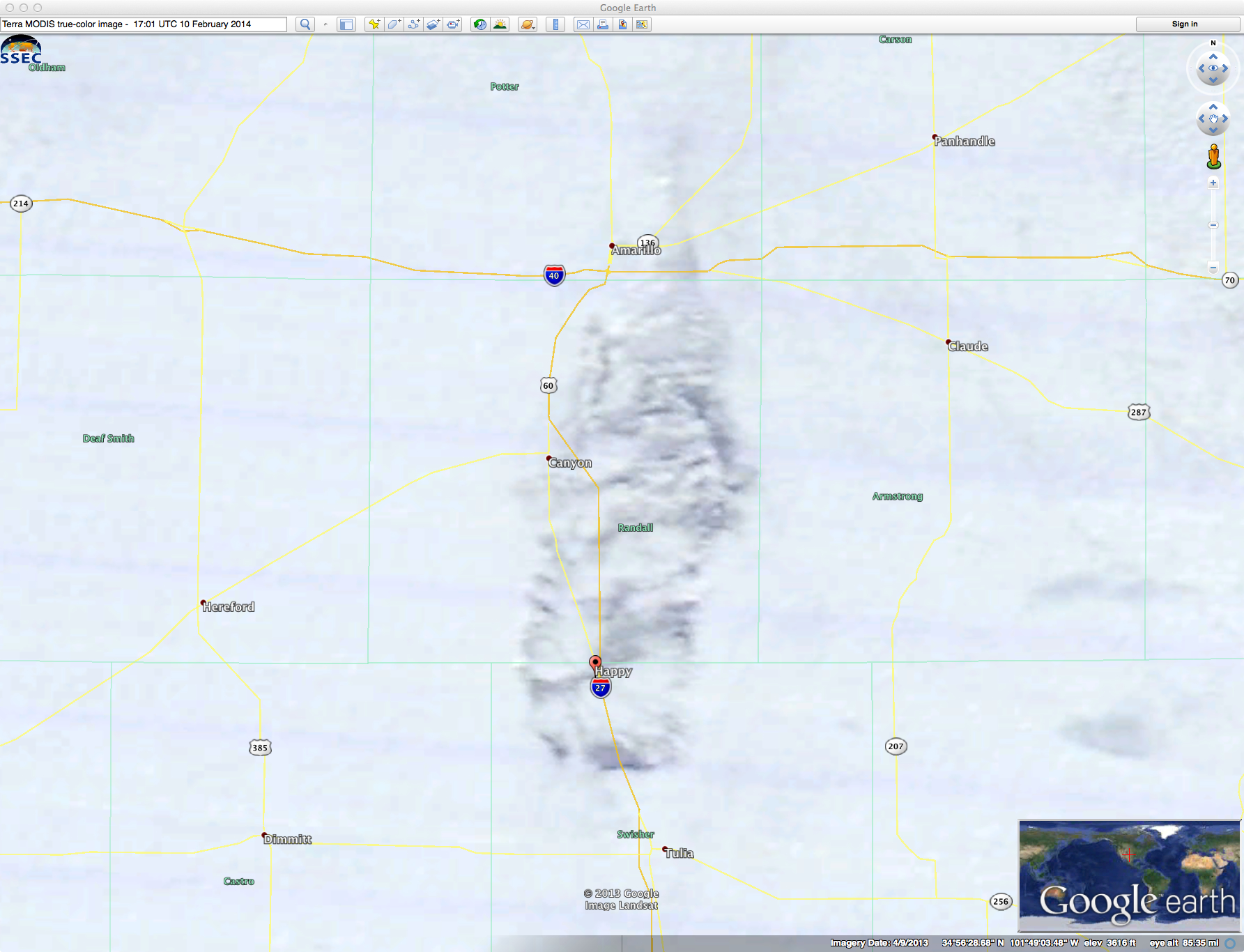
During the following overnight hours the clouds had cleared across the Texas panhandle region, which allowed the Suomi NPP VIIRS 0.7 µm Day/Night Band (below) to provide a “visible image at night” (aided by bright illumination from the “full snow moon”) to display the areal extent of the fresh snow cover at 08:38 UTC or 3:38 AM local time. While the deep snow pack appeared somewhat colder on the corresponding VIIRS 11.45 µm IR image, the exact edges of the snow cover were easier to see on the Day/Night Band image.

Suomi NPP VIIRS 0.7 µm Day/Night Band and 11.45 µm IR images

Suomi NPP VIIRS 0.7 µm Day/Night Band and 11.45 µm IR images

During the afternoon hours on 26 February, a comparison of the Suomi NPP VIIRS 0.64 µm visible channel image with the corresponding false-color Red/Green/Blue (RGB) image at 20:02 UTC or 3:02 PM local time (below) aided in the discrimination between snow cover (varying shades of darker red on the RGB image) and supercooled water droplet cloud features (lighter shades of white). Glaciated (ice crystal) cloud features exhibit a lighter pink appearance in the RGB image.

Suomi NPP VIIRS 0.64 µm visible and False-color Red/Green/Blue (RGB) composite images

Suomi NPP VIIRS 0.64 µm visible and False-color Red/Green/Blue (RGB) composite images

Development of an intense winter storm off the US East Coast

February 8th, 2013
POES AVHRR 0.86 µm, MODIS 0.65 µm, and Suomi NPP VIIRS 0.64 µm visible channel images

POES AVHRR 0.86 µm, MODIS 0.65 µm, and Suomi NPP VIIRS 0.64 µm visible channel images

A winter storm began to intensify just off the East Coast of the US on 08 February 2013. A sequence of 1-km resolution POES AVHRR 0.86 µm, MODIS 0.65 µm, and Suomi NPP VIIRS 0.64 µm visible channel images (above) revealed the formation of gravity waves in the lower-tropospheric cloud field within the southwest quadrant of the area of low pressure (corresponding IR images).

GOES-13 4-km resolution 6.5 µm water vapor channel images (below; click image to play animation) showed a very well-defined dry slot and the development of a distinct comma head. Strong northwesterly winds were also causing mountain waves to the lee of the Appalachians.

GOES-13 6.5 µm water vapor channel images (click image to play animation)

GOES-13 6.5 µm water vapor channel images (click image to play animation)

The MIMIC Total Precipitable Water (TPW) product (below; click image to play animation) showed TPW values as high as 48 mm or 1.9 inches being drawn northward into the intensifying low.

MIMIC Total Precipitable Water product (click image to play animation)

MIMIC Total Precipitable Water product (click image to play animation)

Similarly, the Blended Total Precipitable Water product (below; click image to play animation) also showed high values of TPW (up to 36 mm or 1.4 inches) off the Virginia/North Carolina coast as the low was intensifying.

Blended Total Precipitable Water product (click image to play animation)

Blended Total Precipitable Water product (click image to play animation)

These TPW values were in excess of 200% of normal for this region and this time of year (below; click image to play animation).

Percent of Normal TPW product (click image to play animation)

Percent of Normal TPW product (click image to play animation)

A MODIS 11.0 µm IR image at 03:04 UTC on 09 February (10:04 PM local time on 08 February) revealed a distinct hook-shaped pattern to the cloud features near the storm center as it continued to intensify (below). Peak wind gusts at this time were 58 knots at Nantucket and 54 knots at Boston.

MODIS 11.0 µm IR image with overlays of surface/buoy resports and surface analysis

MODIS 11.0 µm IR image with overlays of surface/buoy resports and surface analysis

===== 09 February Update =====

MODIS 0.65 µm visible image with surface/buoy reports and surface analysis

MODIS 0.65 µm visible image with surface/buoy reports and surface analysis

As the storm was nearing peak intensity on the morning of 09 February 2013, the formation of a tight circulation around its center was becoming evident in 1-km resolution visible channel images with overlays of surface data from MODIS at 15:06 UTC (above) and VIIRS at 17:01 UTC (below).

Suomi NPP VIIRS 0.64 µm visible image with surface/buoy reports

Suomi NPP VIIRS 0.64 µm visible image with surface/buoy reports

A 250-meter resolution MODIS true-color Red/Green/Blue (RGB) image from the SSEC MODIS Today site (below; displayed using Google Earth) showed the locations of maximum snowfall totals for select states (which included 40.0 inches at Hamden, Connecticut), as well as some of the maximum wind gusts (which included 83 mph at Cuttyhunk, Massachusetts).

MODIS true-color Red/Green/Blue (RGB) image with maximum storm total snowfall amounts and peak wind gusts

MODIS true-color Red/Green/Blue (RGB) image with maximum storm total snowfall amounts and peak wind gusts

GOES-13 Water Vapor imagery, displayed in a 2-day loop below, captures many interesting aspects of this potent storm.

GOES-13 6.5 µm water vapor channel images (click image to play animation)

GOES-13 6.5 µm water vapor channel images (click image to play animation)