This website works best with a newer web browser such as Chrome, Firefox, Safari or Microsoft
Edge. Internet Explorer is not supported by this website.
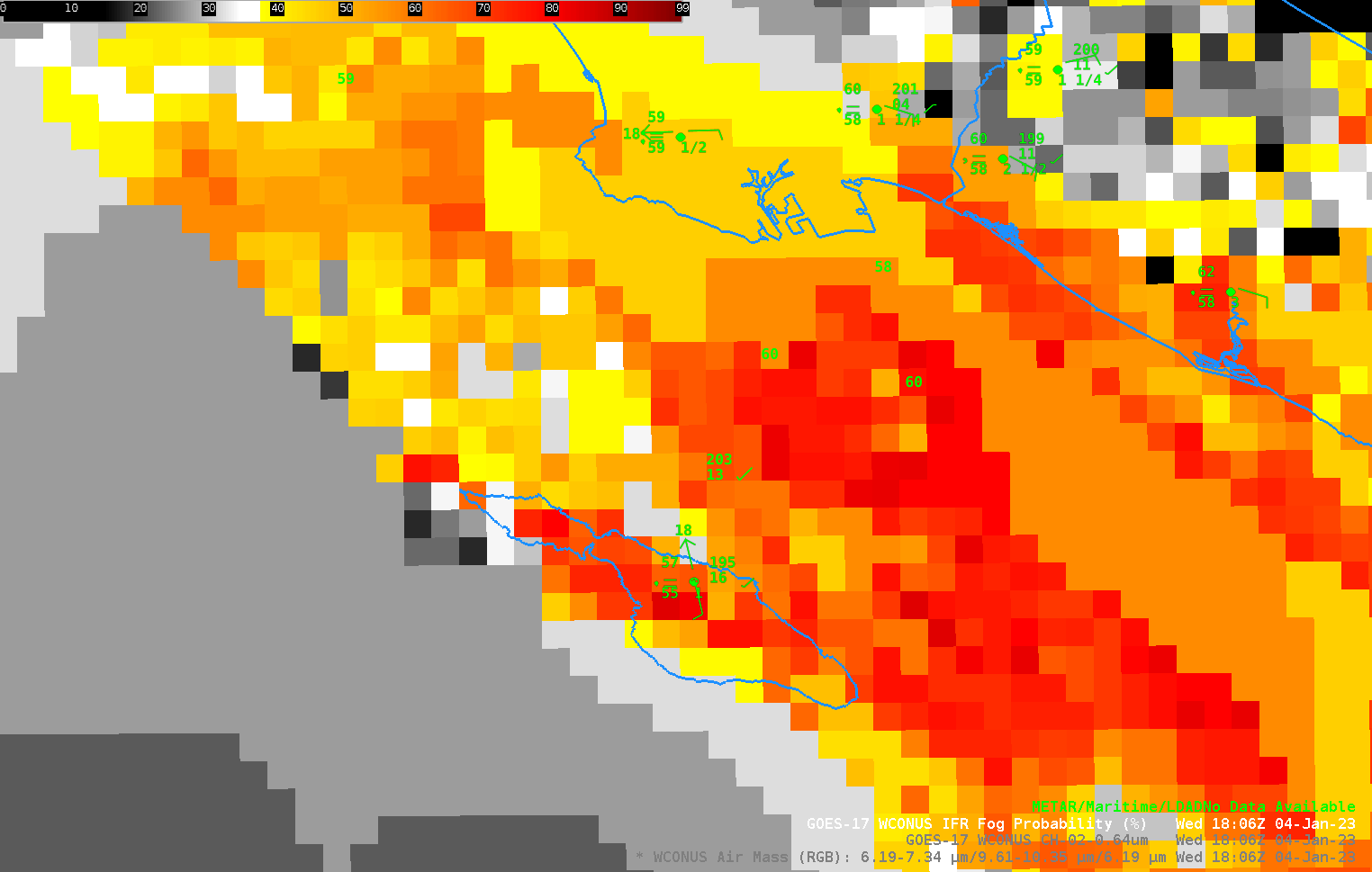
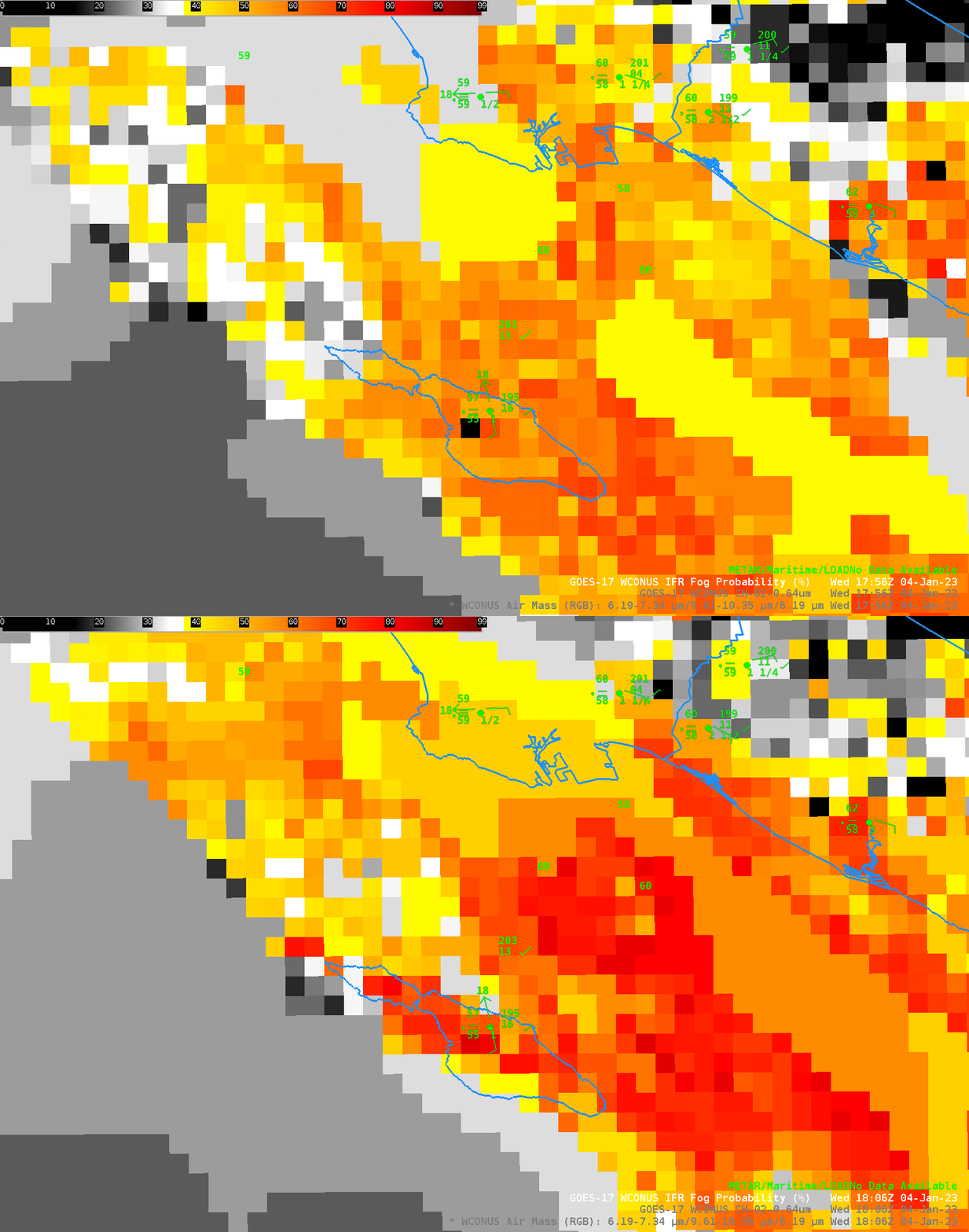
GOES-18 became the operational GOES-West satellite at 1800 UTC on 4 January. The toggle above shows the GOES-West (labeled as GOES-17, but the 1806 UTC image is using GOES-18 satellite information) IFR Probability Fields before/after the changeover. The IFR Probability field gives more useful information about surface visibility/ceiling restrictions than (for example) visible imagery (shown here) that shows widespread cloudiness at the... Read More
GOES-West IFR Probability fields near Catalina Island, 1756 and 1806 UTC on 4 January 2023 (Click to enlarge)
GOES-18 became the operational GOES-West satellite at 1800 UTC on 4 January. The toggle above shows the GOES-West (labeled as GOES-17, but the 1806 UTC image is using GOES-18 satellite information) IFR Probability Fields before/after the changeover. The IFR Probability field gives more useful information about surface visibility/ceiling restrictions than (for example) visible imagery (shown here) that shows widespread cloudiness at the time. There are noticeable changes between the 1756 and 1806 UTC fields, likely because the numerical model output used in GOES-R IFR Probability fields will change every hour, that is (in this case) at 1800 UTC.
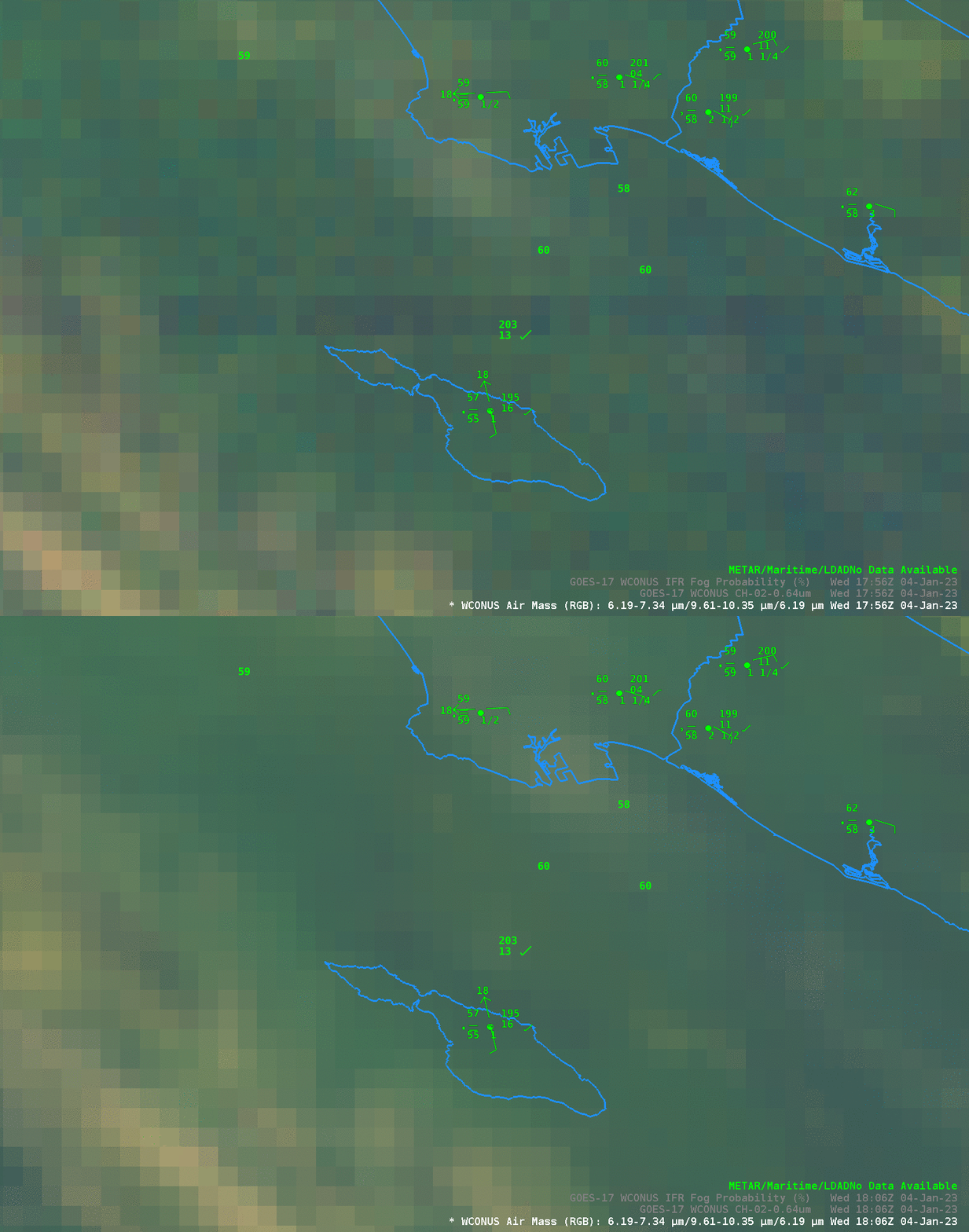
The toggle below shows the airmass RGB from GOES-17 at 1756 and from GOES-18 at 1806 UTC over the same domain; note that stripes at 1756 UTC (an artifact of Loop Heat Pipe issues in GOES-17) are not present at 1806 UTC in the GOES-18 imagery.
GOES-17 (1756 UTC) and GOES-18 (1806 UTC) Airmass RGB near Catalina Island, 4 January 2023 (Click to enlarge)
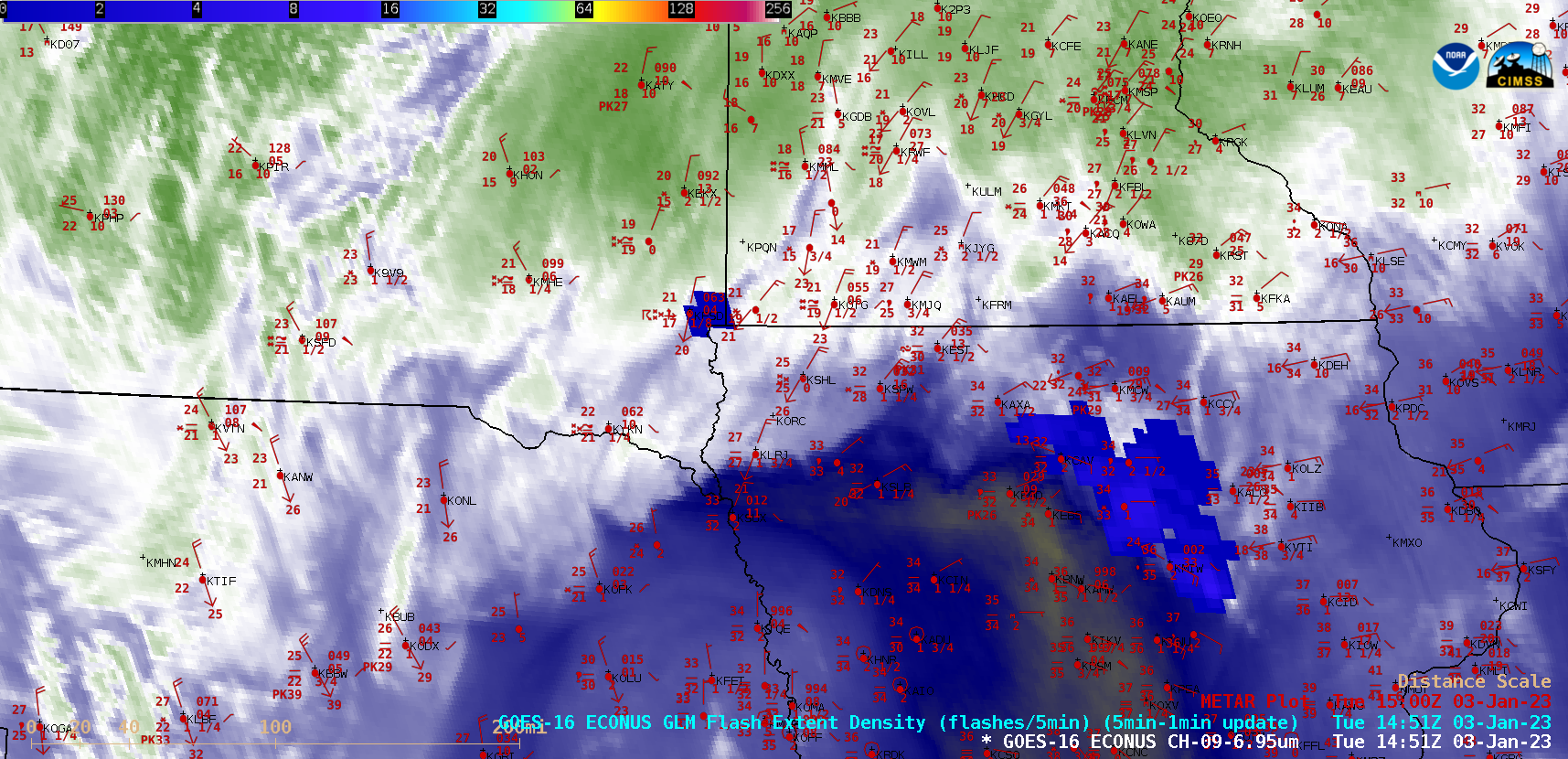
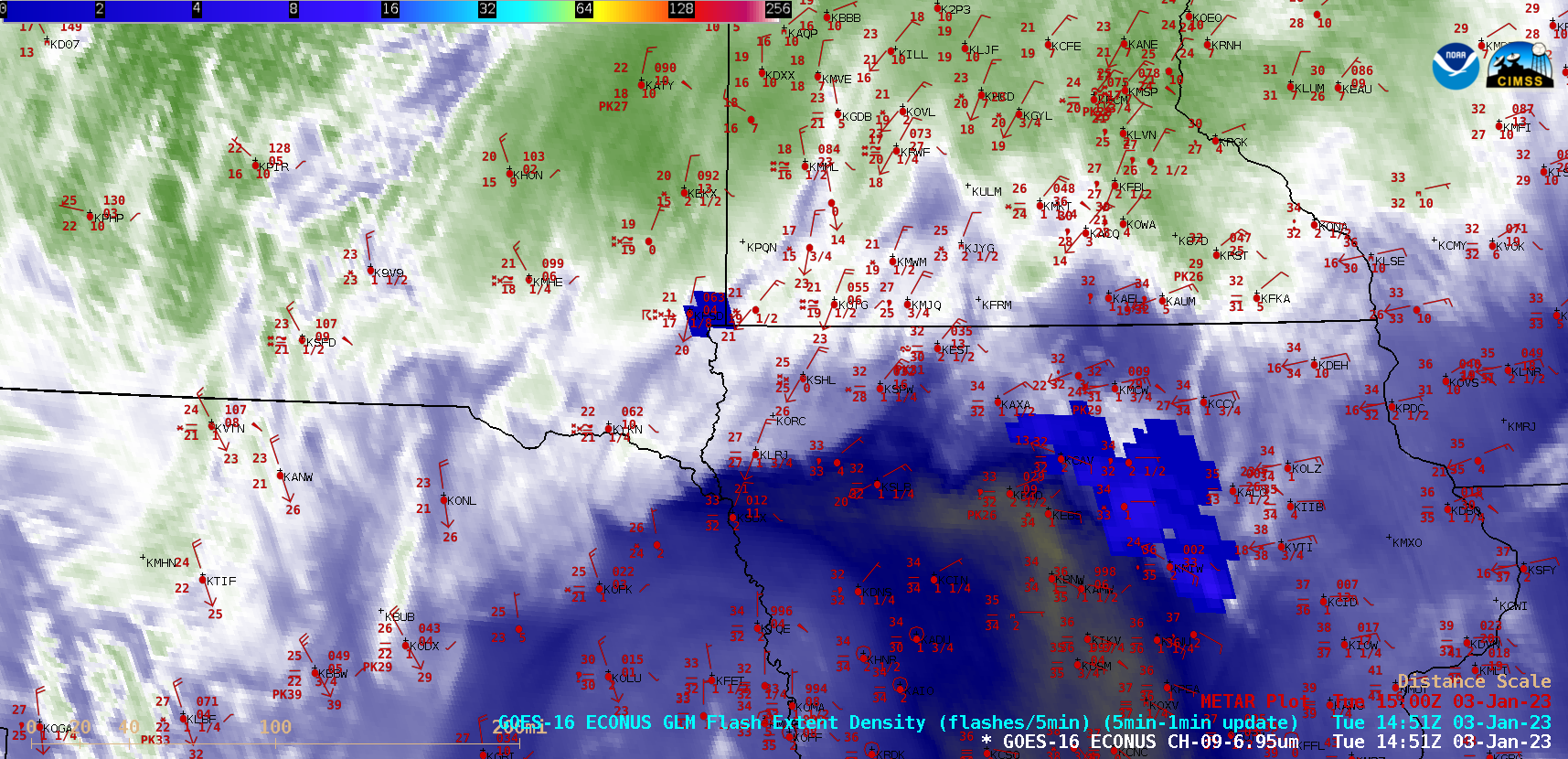
GOES-16 (GOES-East) Mid-level Water Vapor (6.9 µm) images with an overlay of GLM Flash Extent Density (above) covered part of a widespread winter storm event — which included thundersnow in parts of Nebraska, Iowa, South Dakota and Minnesota — that occurred on 03 January 2023. Areas that reported thundersnow experienced convectively-enhanced snowfall rates... Read More
GOES-16 Mid-level Water Vapor (6.9 µm) images with GLM Flash Extent Density and plots of hourly surface reports [click to play MP4 animation | animated GIF]
GOES-16 (GOES-East) Mid-level Water Vapor (6.9 µm) images with an overlay of GLM Flash Extent Density (above) covered part of a widespread winter storm event — which included thundersnow in parts of Nebraska, Iowa, South Dakota and Minnesota — that occurred on 03 January 2023. Areas that reported thundersnow experienced convectively-enhanced snowfall rates of 2-3 inches per hour; storm total snowfall amounts were as high as 27 inches in southeastern South Dakota and 18 inches in northeastern Nebraska (NWS Sioux Falls event summary | WPC storm summary).
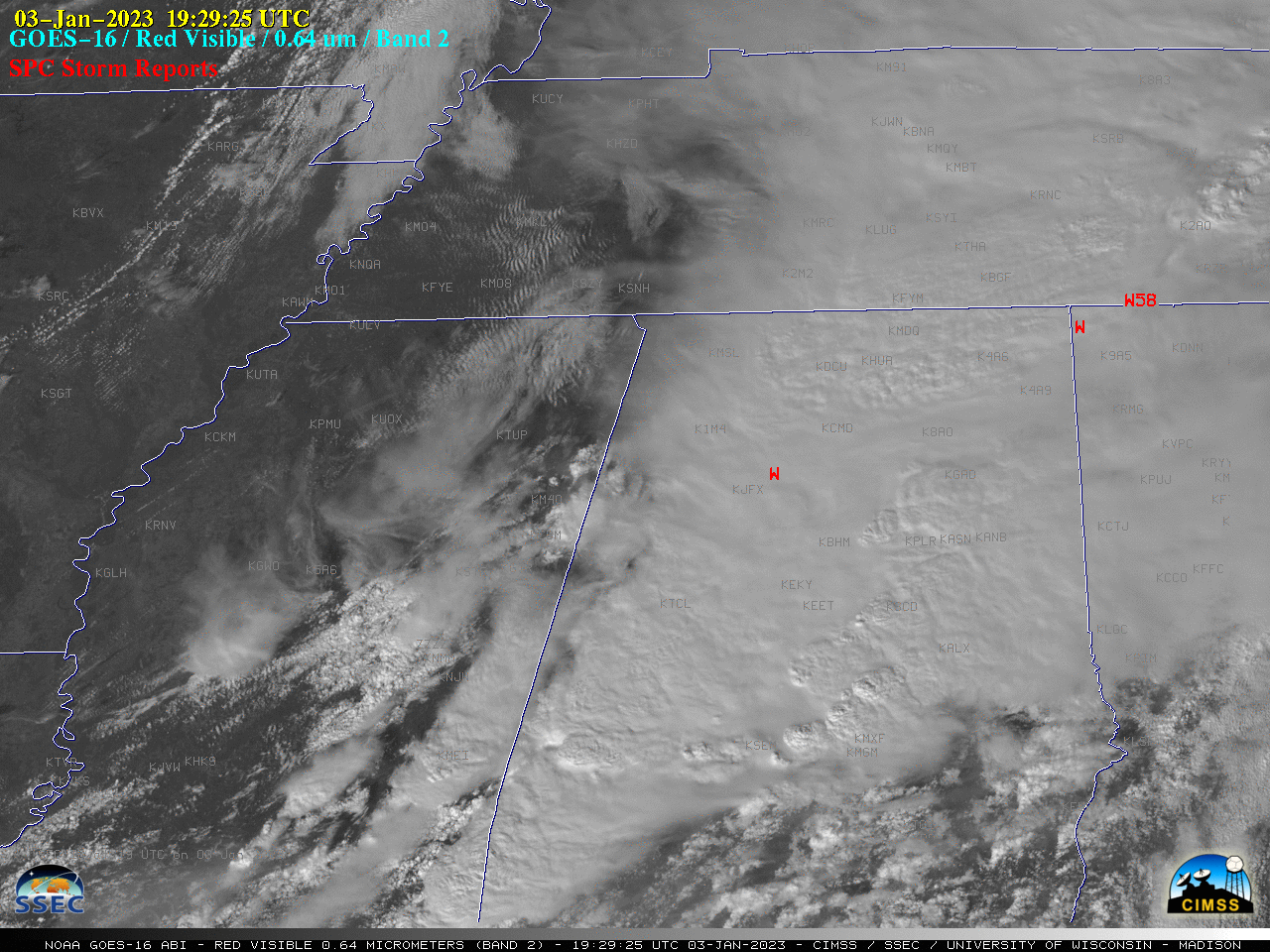
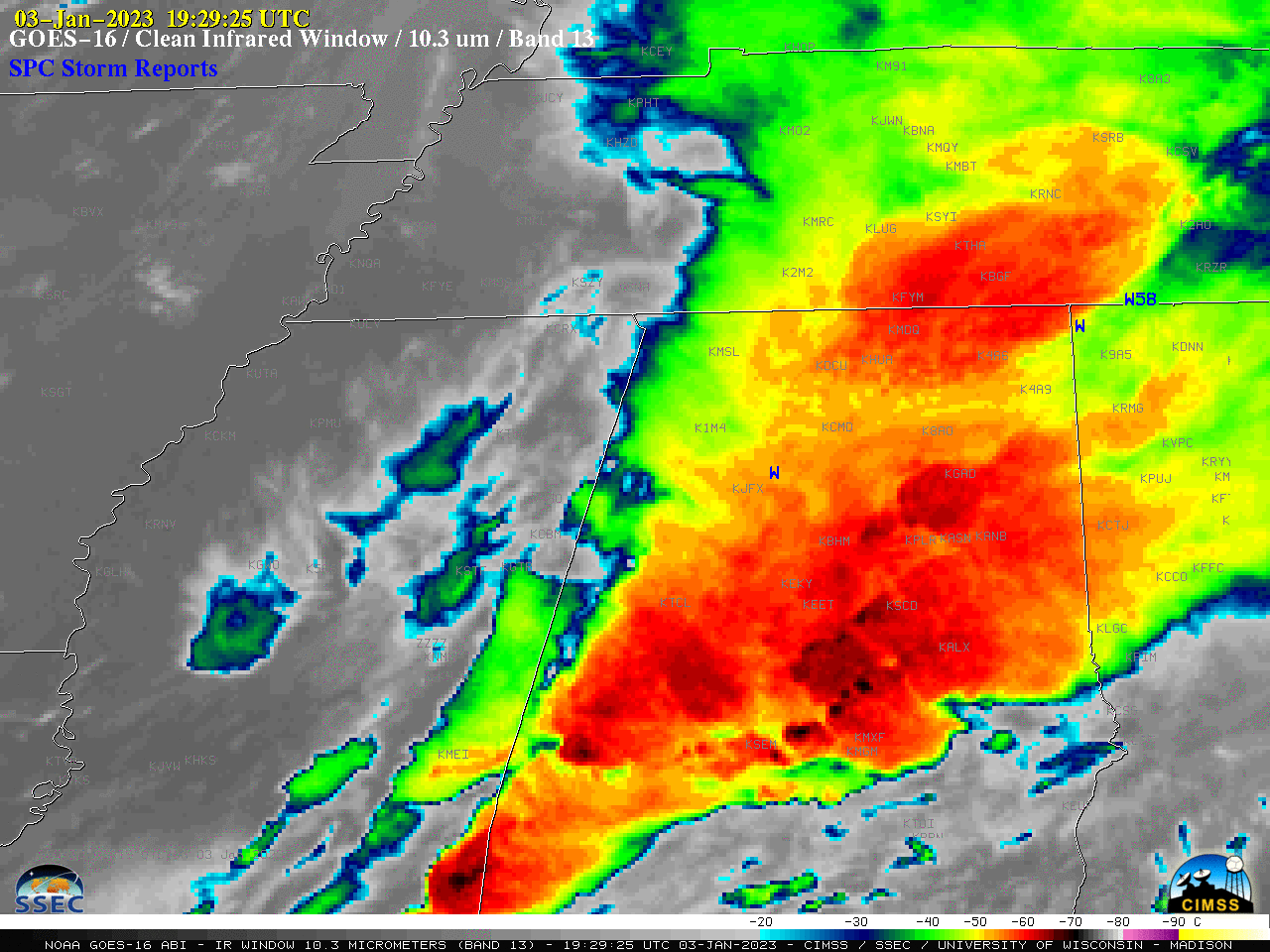
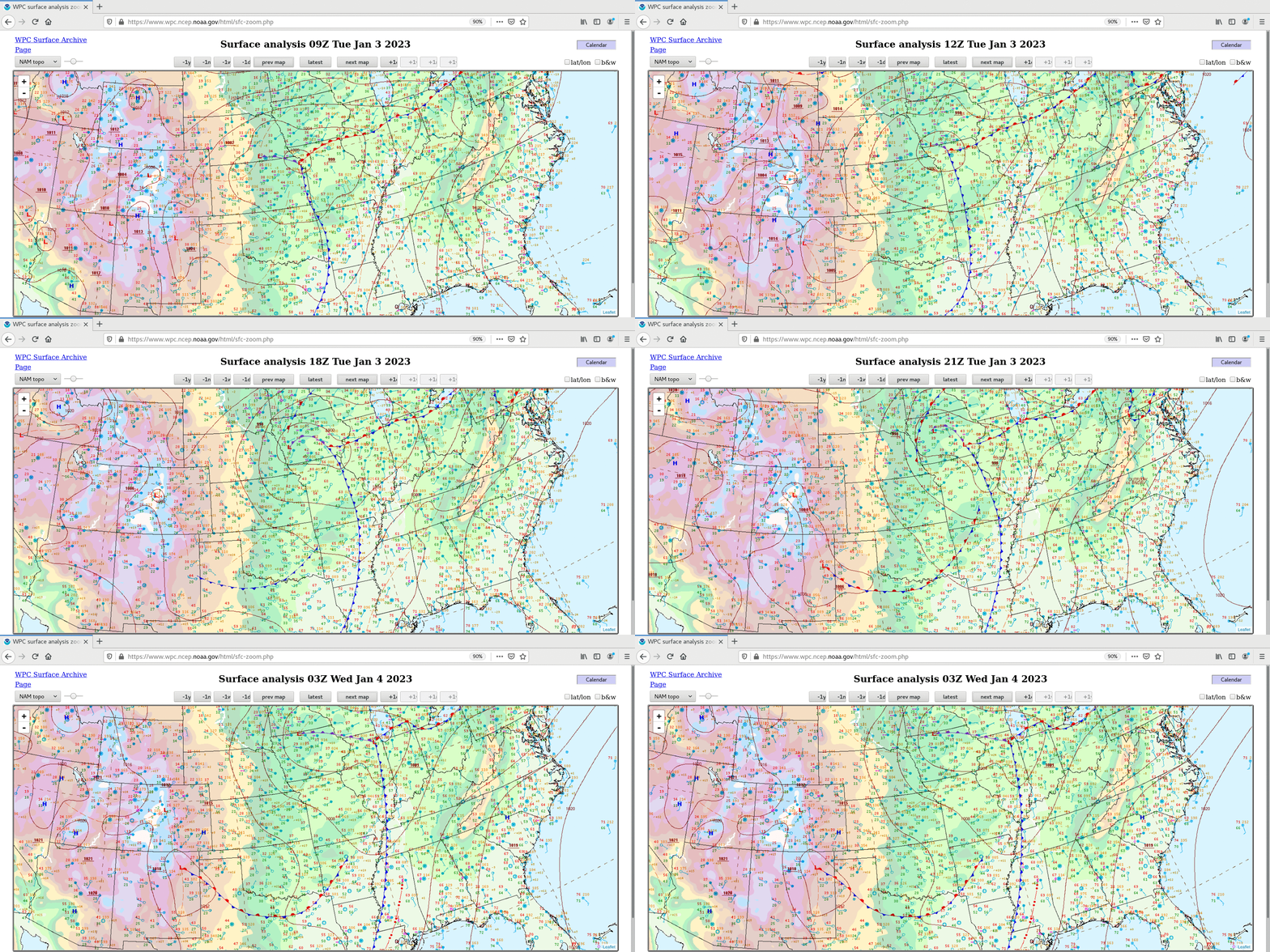
Ahead of the cold front associated with this winter storm (surface analyses), severe thunderstorms produced tornadoes, large hail and damaging winds (SPC Storm Reports) from the Upper Midwest to the Deep South. Overlapping GOES-16 Mesoscale Domain Sectors provided imagery at 30-second intervals over parts of Mississippi, Alabama, Georgia and Tennessee where some of the severe weather occurred — “Red” Visible (0.64 µm) and “Clean” Infrared Window (10.3 µm) images that include time-matched plots of SPC Storm Reports are shown below. With some of these thunderstorms, pulsing overshooting tops exhibited infrared brightness temperatures as cold as -70 to 75ºC.
GOES-16 “Red” Visible (0.64 µm) images, with time-matched SPC Storm Reports plotted in red [click to play MP4 animation | animated GIF]
GOES-16 “Clean” Infrared Window (10.3 µm) images, with time-matched SPC Storm Reports plotted in blue [click to play MP4 animation | animated GIF]
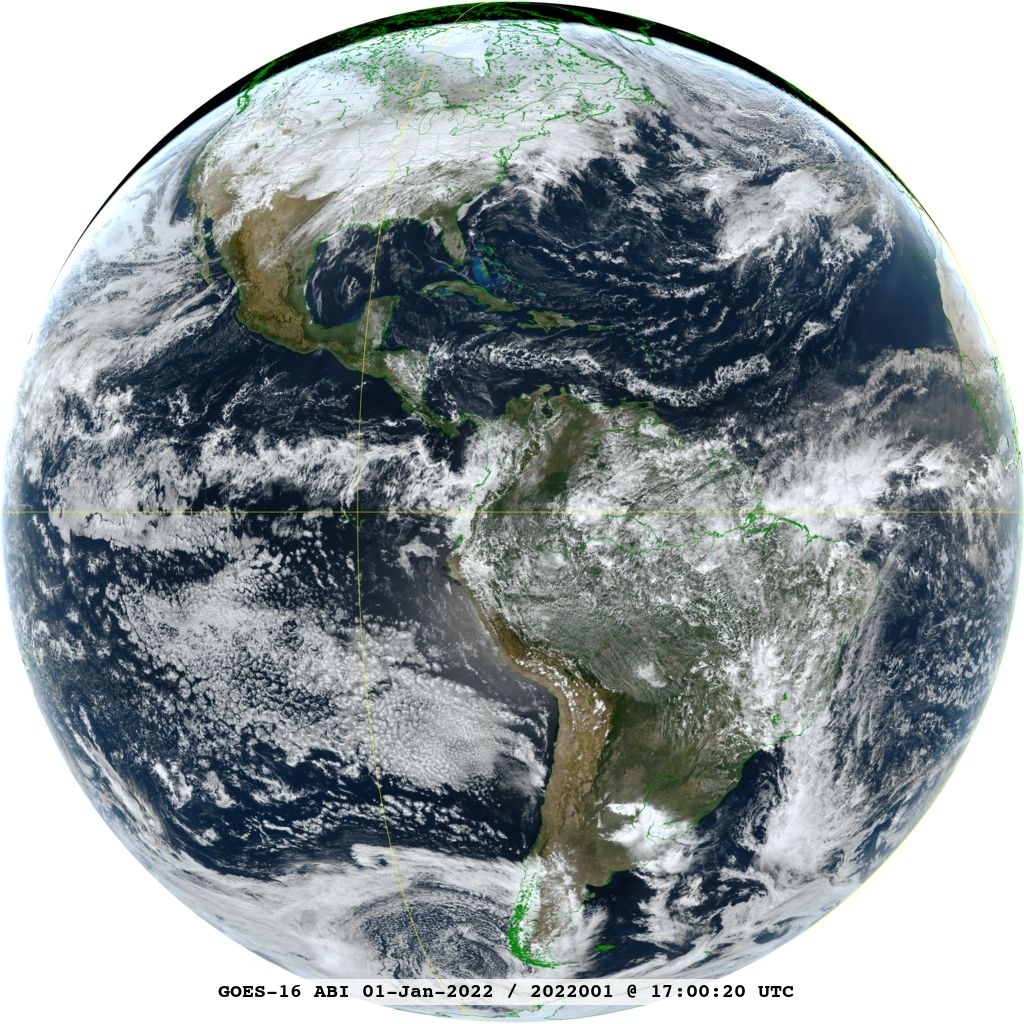
Daily Full Disk imageryBy animating daily NOAAGOES-16ABI Full Disk composite imagery, the year 2022 can be shown quickly. The GOES-16 loop below displays a 17 UTC image from each day of 2022 (the images are Rayleigh-corrected True Color RGB composites). This GOES-16 loop is similar to a loop... Read More
Daily Full Disk imagery
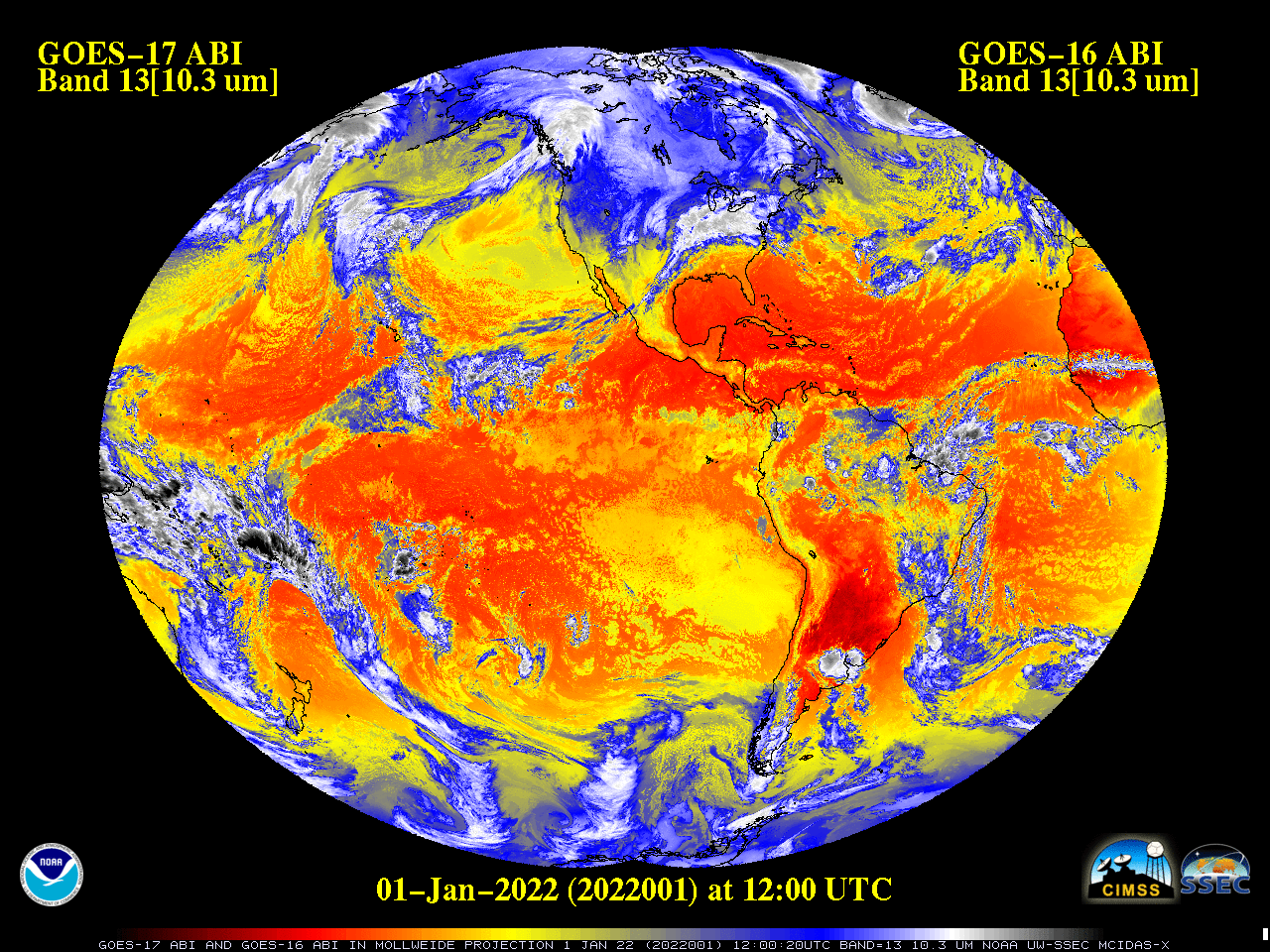
By animating daily NOAAGOES-16ABI Full Disk composite imagery, the year 2022 can be shown quickly. The GOES-16 loop below displays a 17 UTC image from each day of 2022 (the images are Rayleigh-corrected True Color RGB composites). This GOES-16 loop is similar to a loop that includes the Solstice-to-Solstice dates.
One GOES-16 ABI image for each day of 2022. Click to play mp4 animation.
A link to the mp4 animation above is available here (other versions: small, medium). It should be noted that all these images are drastically sub-sampled from the full spatial resolution data.
A similar year-long animation, on an interactive web page, from GOES-16 at 17 UTC on each day is shown below. This time was chosen for a maximum illumination of the full disk viewed by the satellite.
Click on the above image to link to a page with one GOES-16 ABI image for each day of 2022.A GOES-16 year-long loop, with one image at 11 UTC each day.
This post features 2022 highlights from a polar-orbiting perspective, with a focus on U.S. scenes, most acquired by the Visible Infrared Imaging Radiometer Suite (VIIRS) flying on the Suomi-NPP and NOAA-20 satellites. Also in 2022: NOAA’s Joint Polar Satellite System (JPSS) launched the JPSS-2 satellite, renamed NOAA-21. First light imagery... Read More
This post features 2022 highlights from a polar-orbiting perspective, with a focus on U.S. scenes, most acquired by the Visible Infrared Imaging Radiometer Suite (VIIRS) flying on the Suomi-NPP and NOAA-20 satellites. Also in 2022: NOAA’sJoint Polar Satellite System (JPSS) launched the JPSS-2 satellite, renamed NOAA-21. First light imagery from this exciting fleet addition is featured in November.
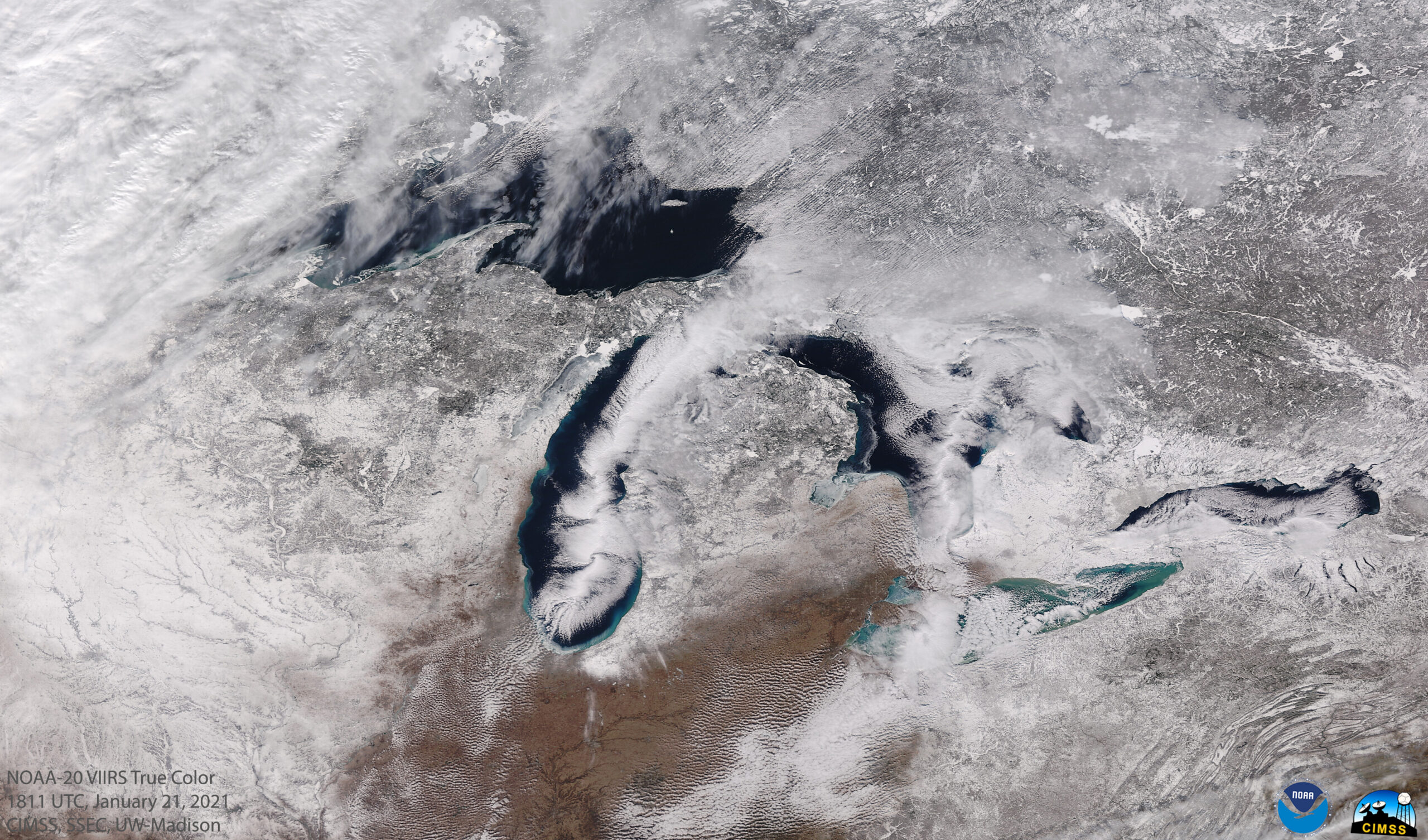
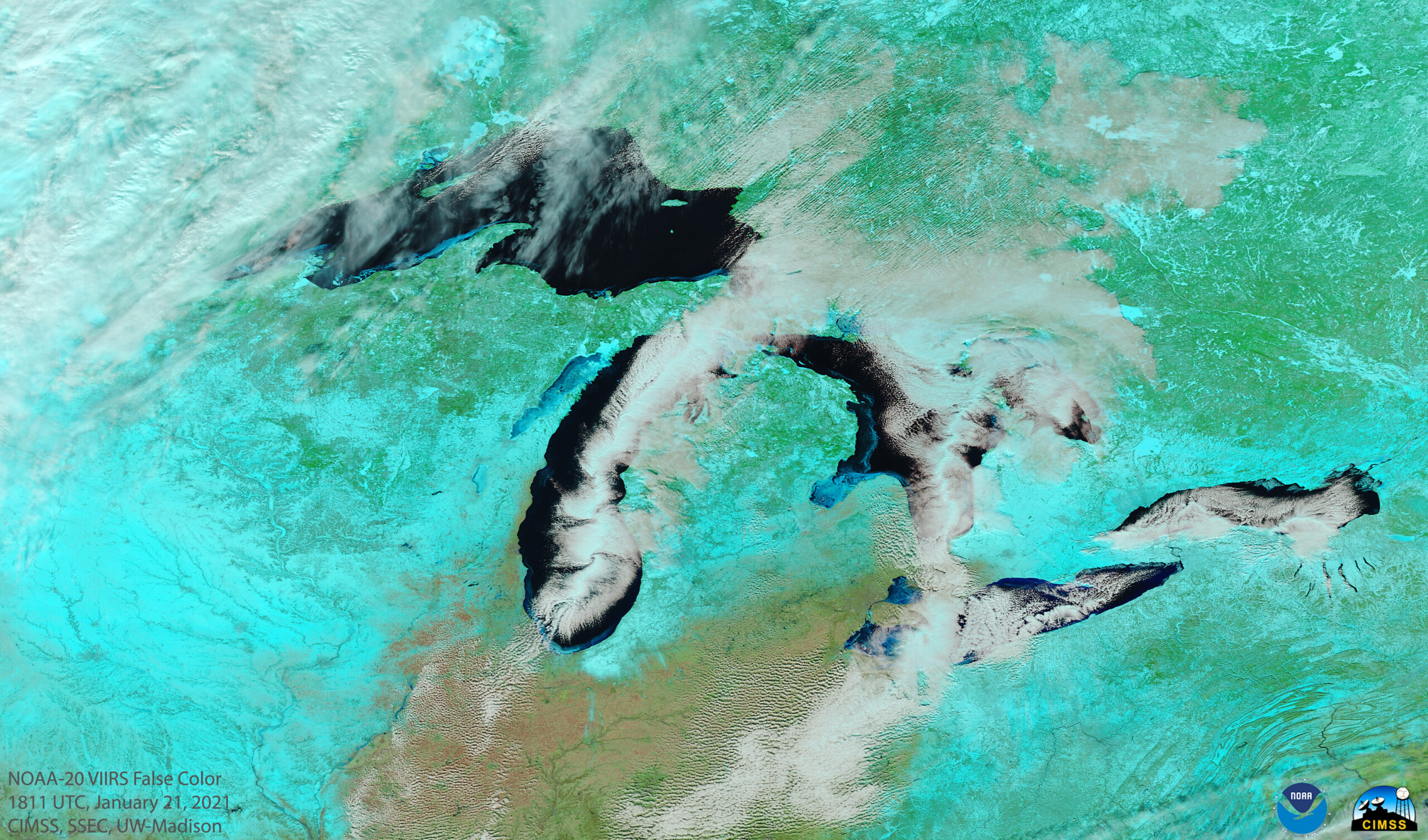
The top two images from January capture mesovortices on Lake Michigan, with False Color helping reveal snow cover and lake ice.
January 2022 – VIIRS True Color view of the Great Lakes Region
January 2022 – VIIRS False Color view of the Great Lakes Region
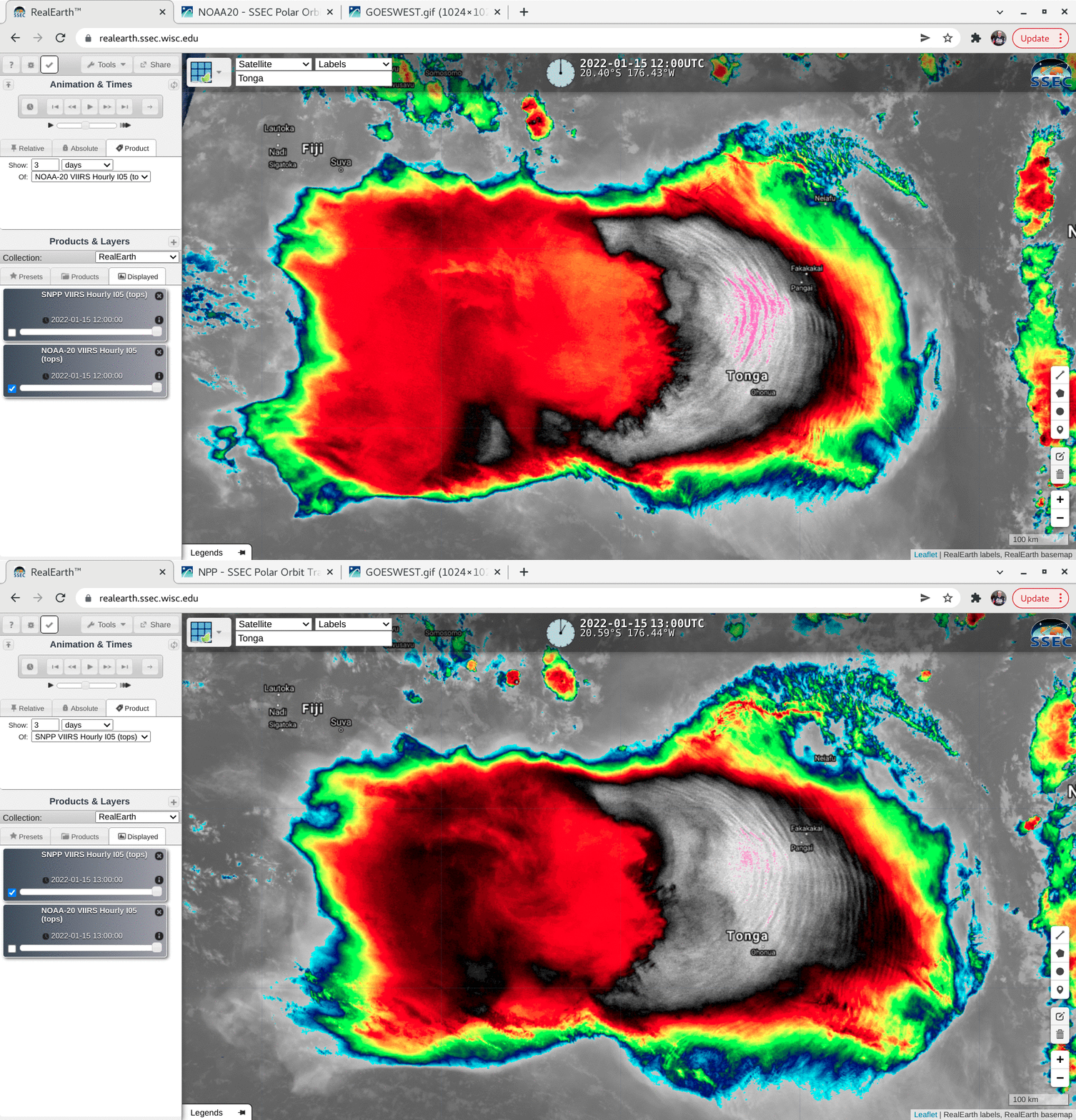
But the big global event in January was the Hunga-Tonga Volcano eruption in the South Pacific, also viewed by VIIRS.
January 2022 – VIIRS IR view of cloud-top gravity waves associated with the Hunga-Tona volcano eruption on January 15th, click on the image for a Suomi-NPP/NOAA-20 toggle.
Scroll down for additional satellite imagery from each month in 2022 …
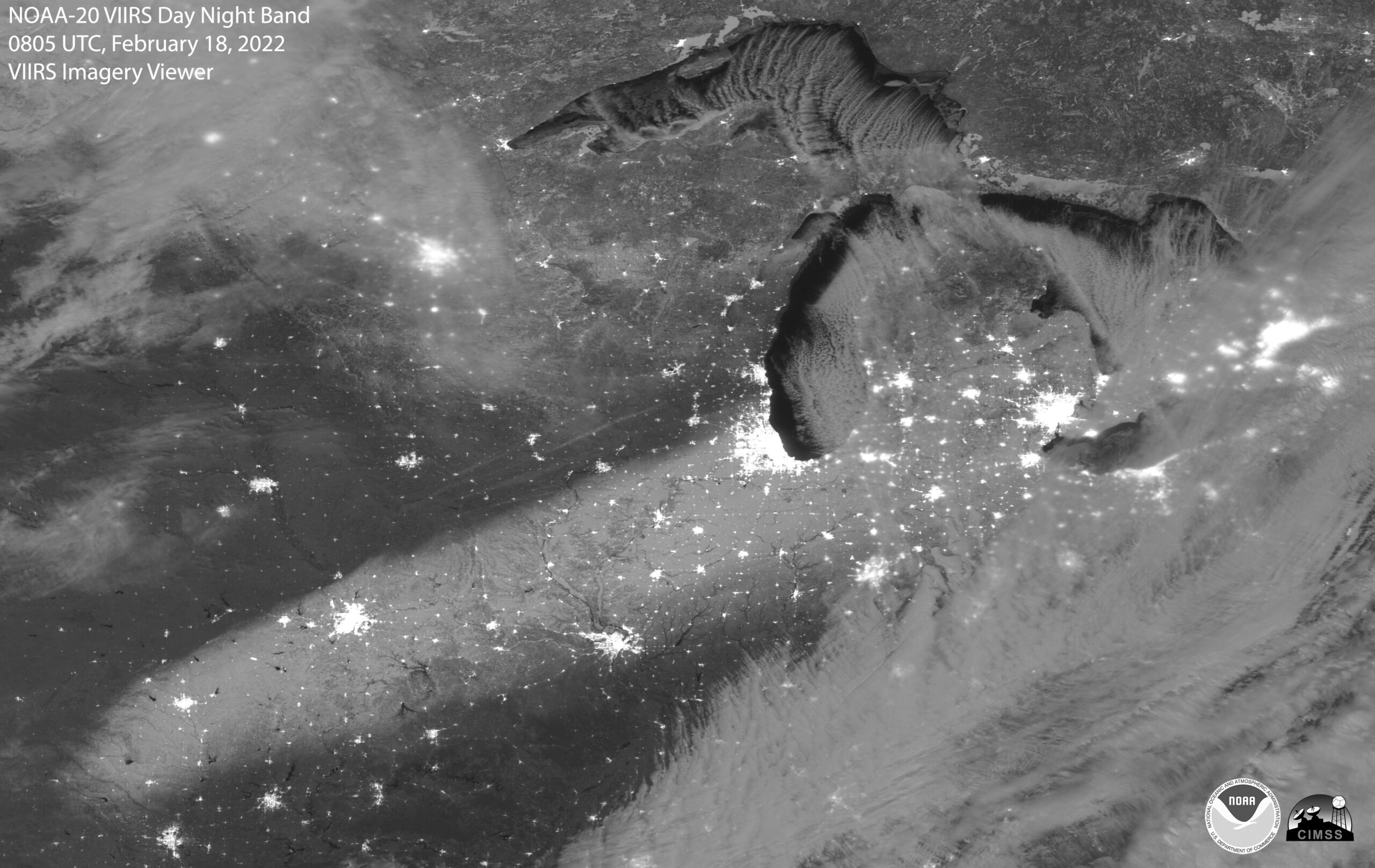
February 2022 – VIIRS Day Night Band imagery leverages moonlight to reveal a snow storm track and lake-effect clouds.
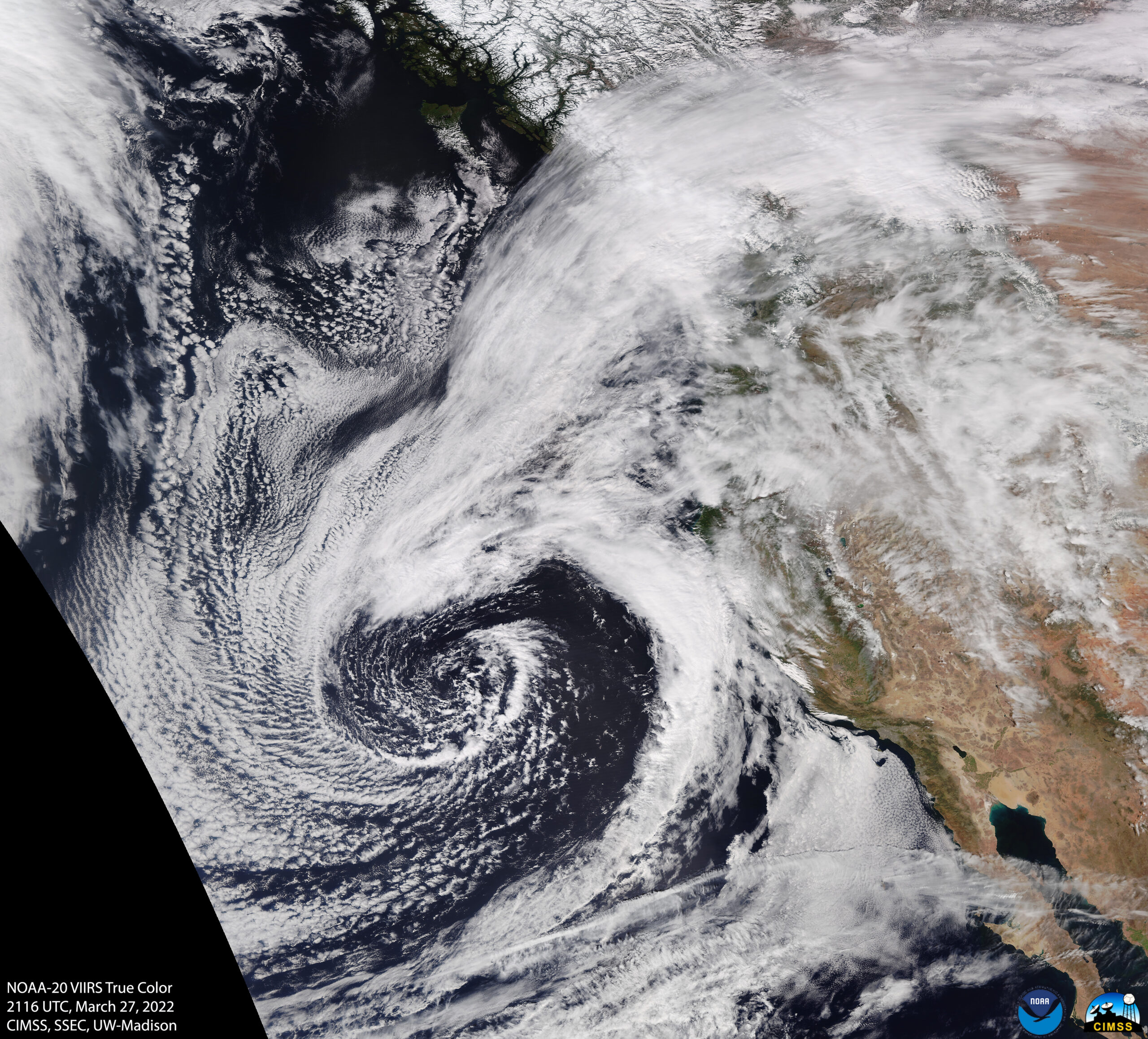
March 2022 – VIIRS True Color imagery captures a mid-latitude cyclone offshore the U.S. West Coast
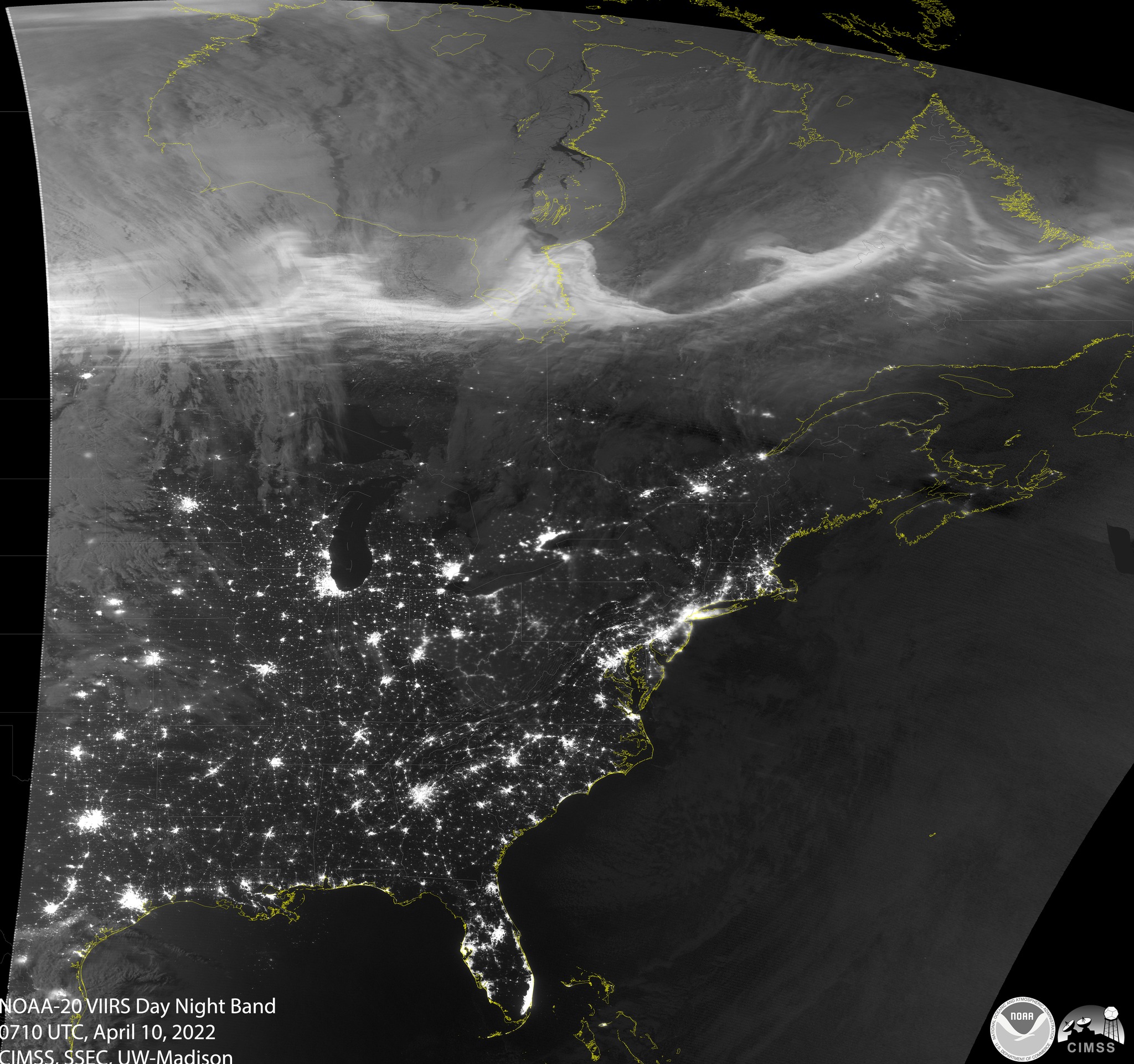
April 10 – VIIRS Day Night Band view of the Aurora Borealis from the VIIRS Imagery Viewer
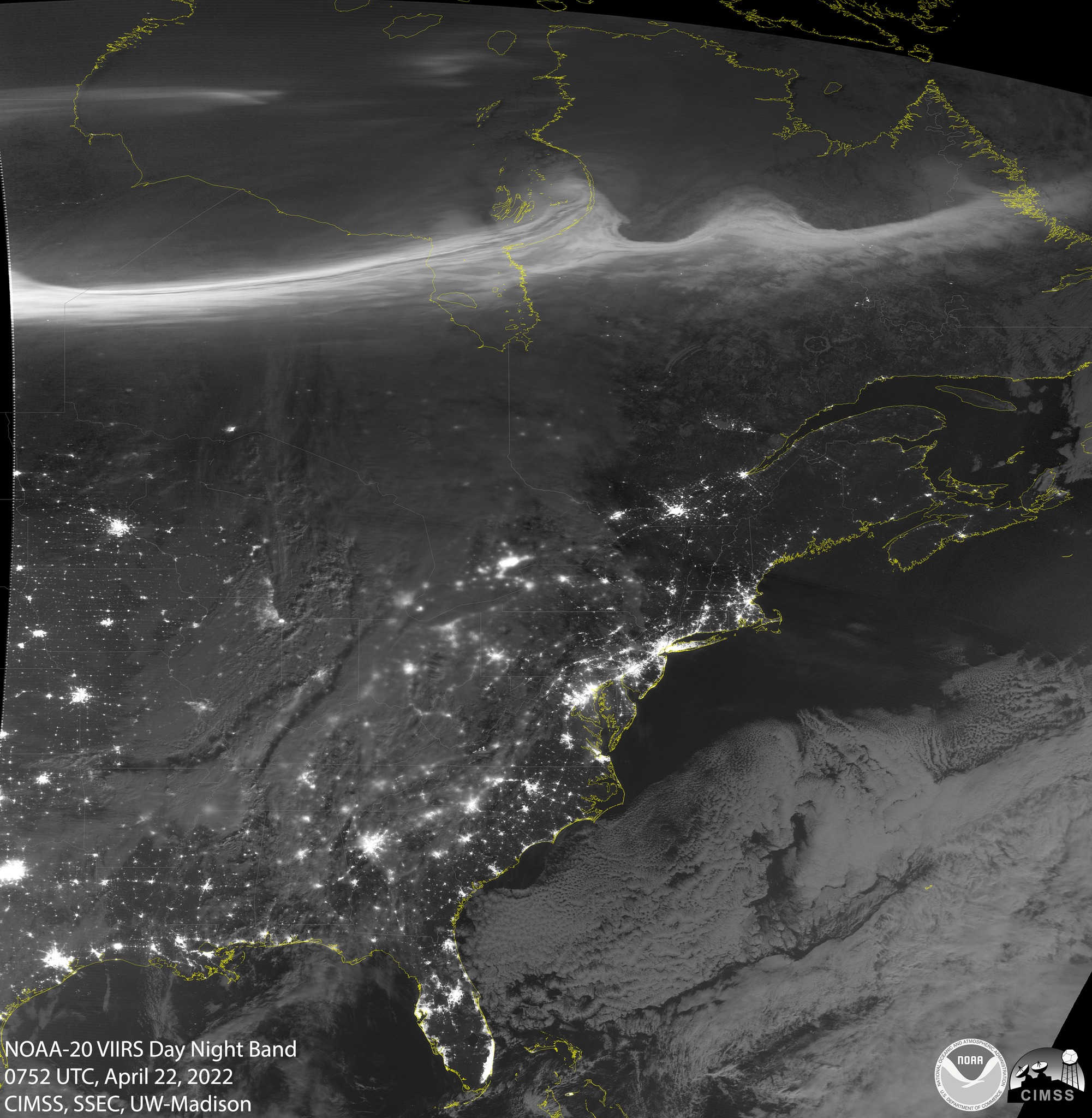
April 22 – VIIRS Day Night Band View of the Aurora Borealis from the VIIRS Imagery Viewer
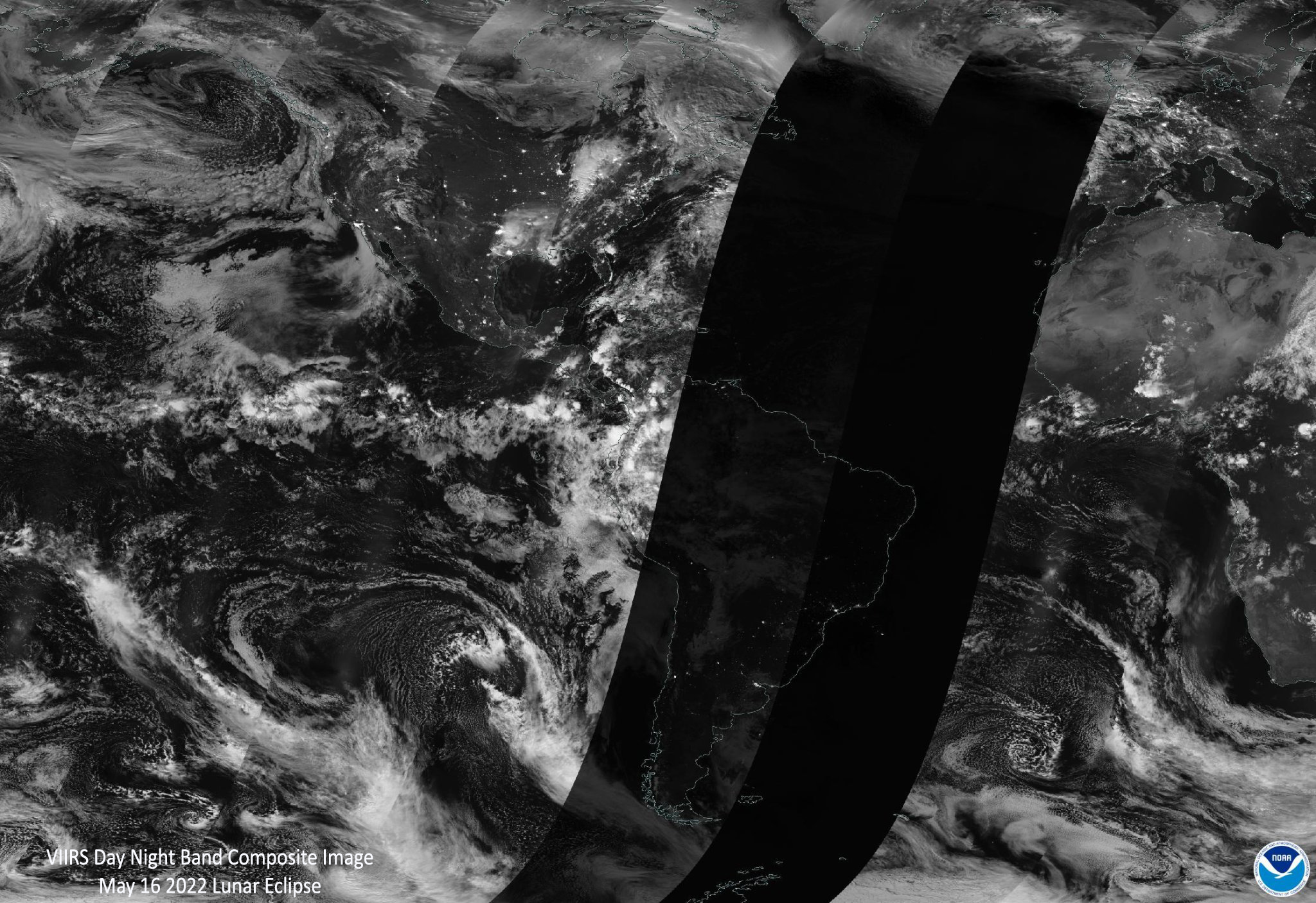
May 2022 – Lunar Eclipse composite image from NOAA. The full moon illuminates Day Night Band swaths but “blackouts” occur when Earth’s shadow blocks moonlight during Atlantic Ocean and South America overpasses for the May 16th total lunar eclipse.
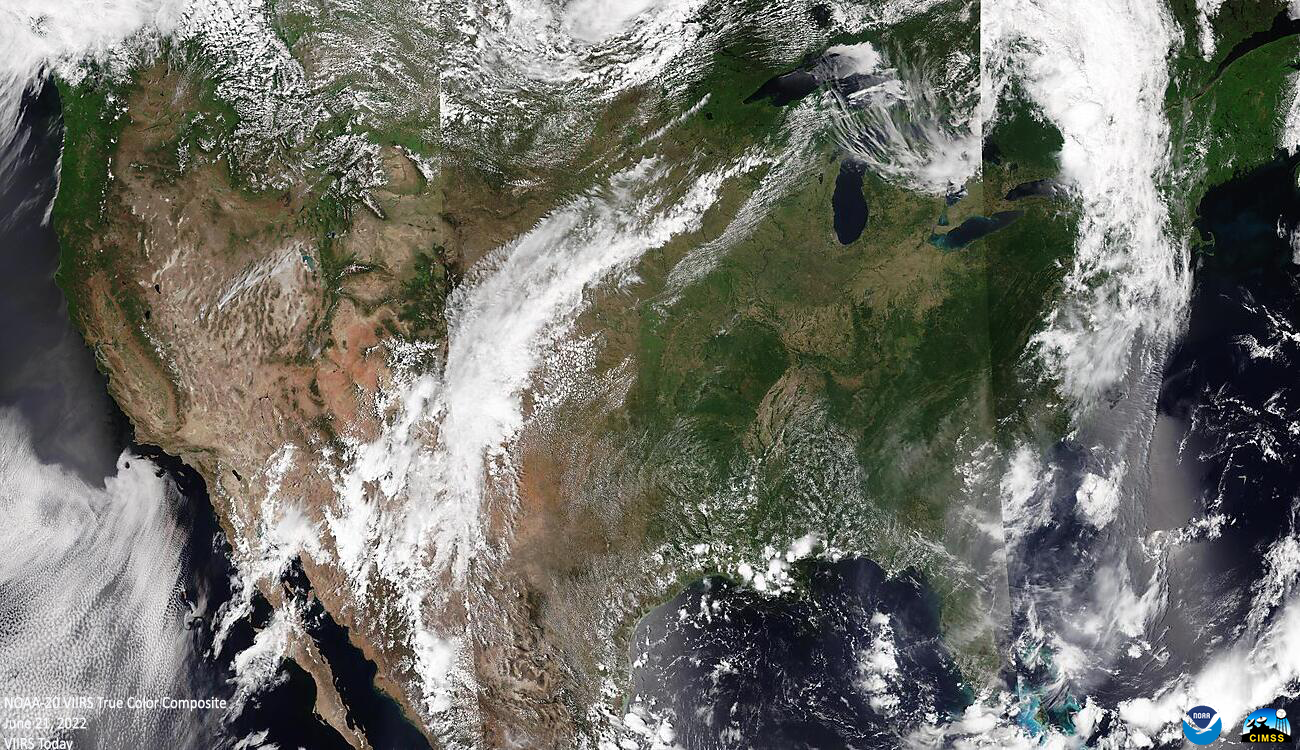
June 2022 – This True Color USA composite on the summer solstice from VIIRS Today shows tranquil summer weather and persistent High pressure over the southwest.
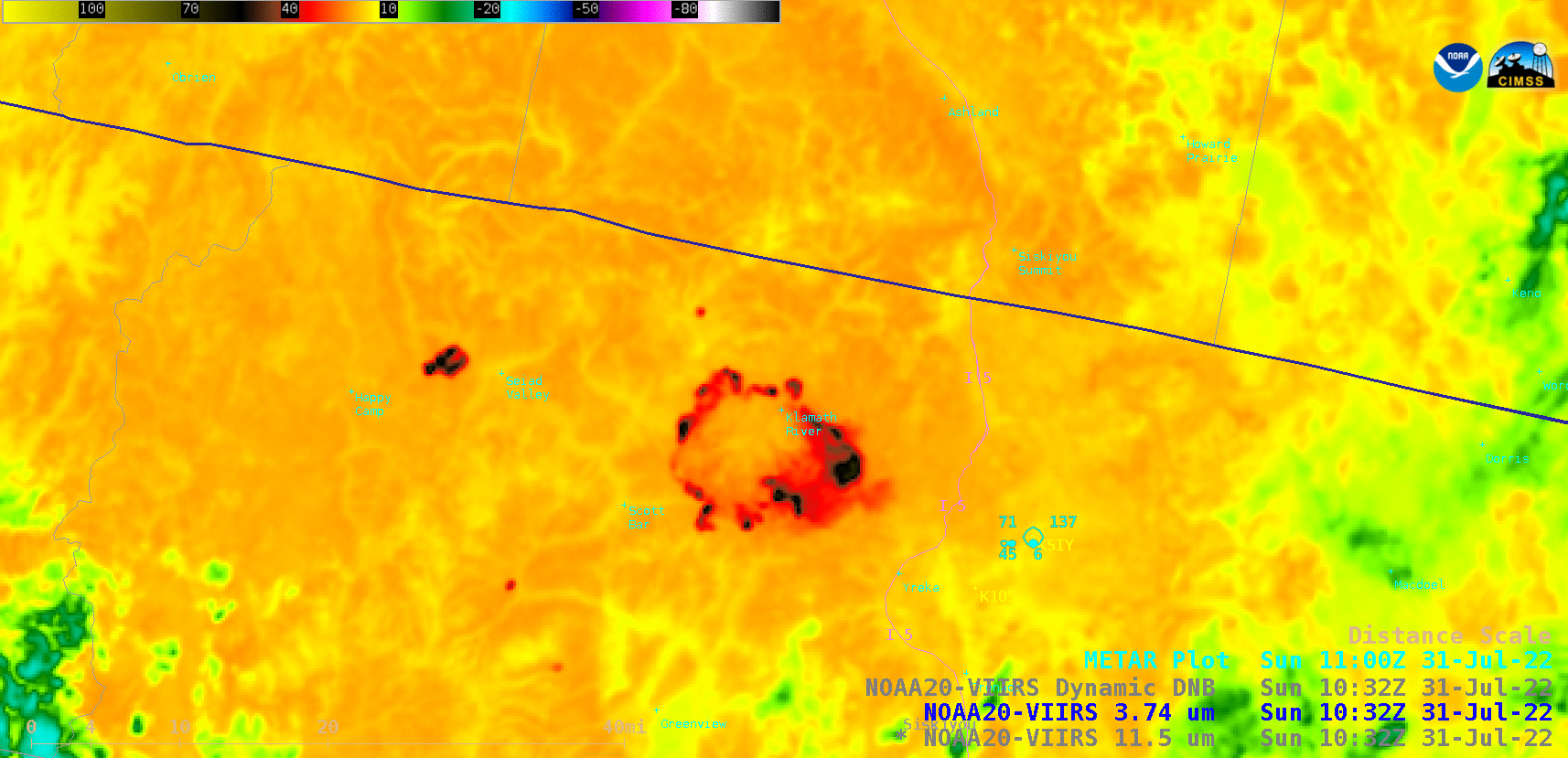
July 2022 – VIIRS Shortwave IR (3.74 µm) showed the hot thermal signature of the McKinney Fire in California on July 31st
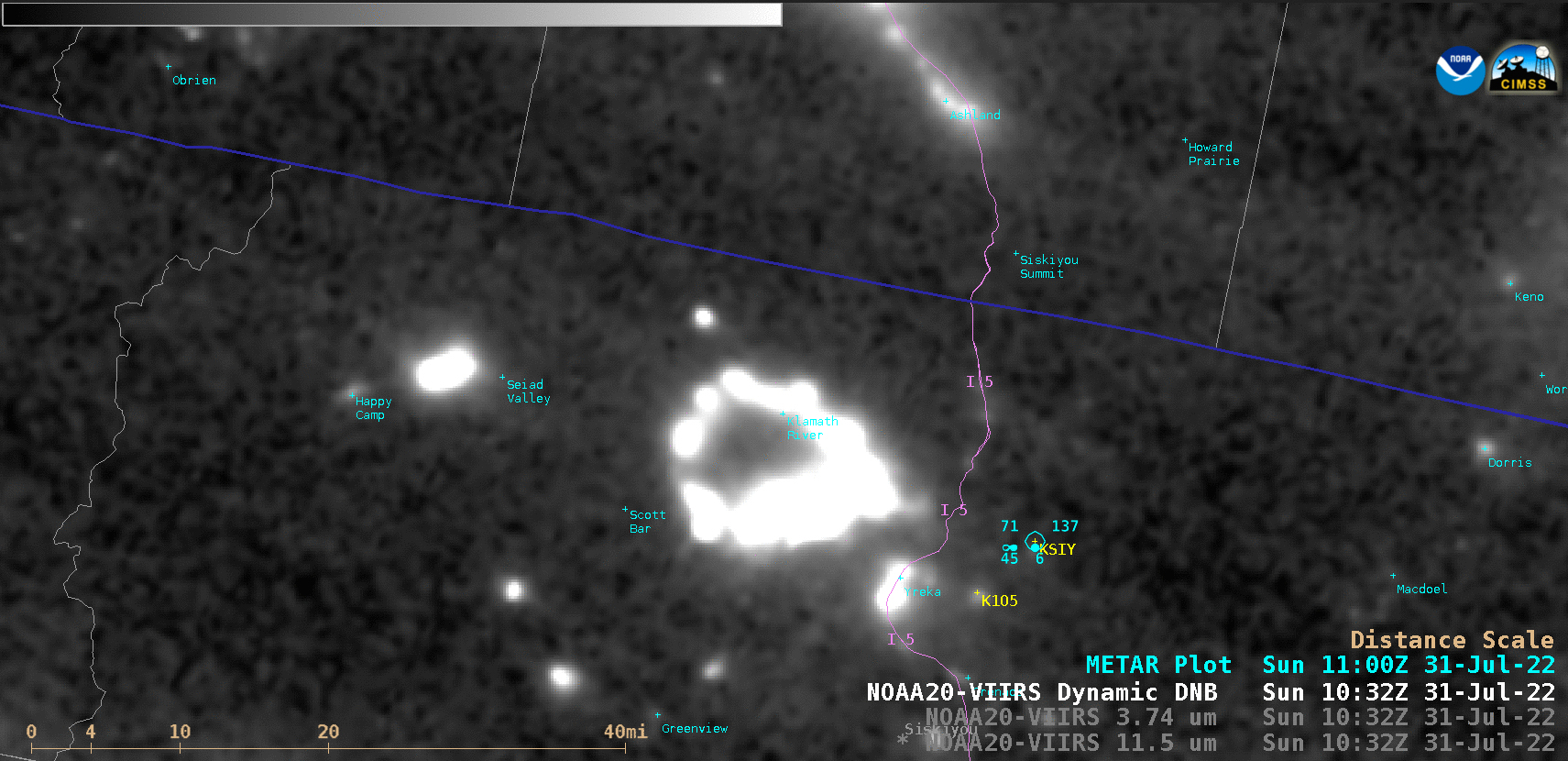
July 2022 – VIIRS Day Night Band showed the bright glow of flames associated with the McKinney Fire in California on July 31st
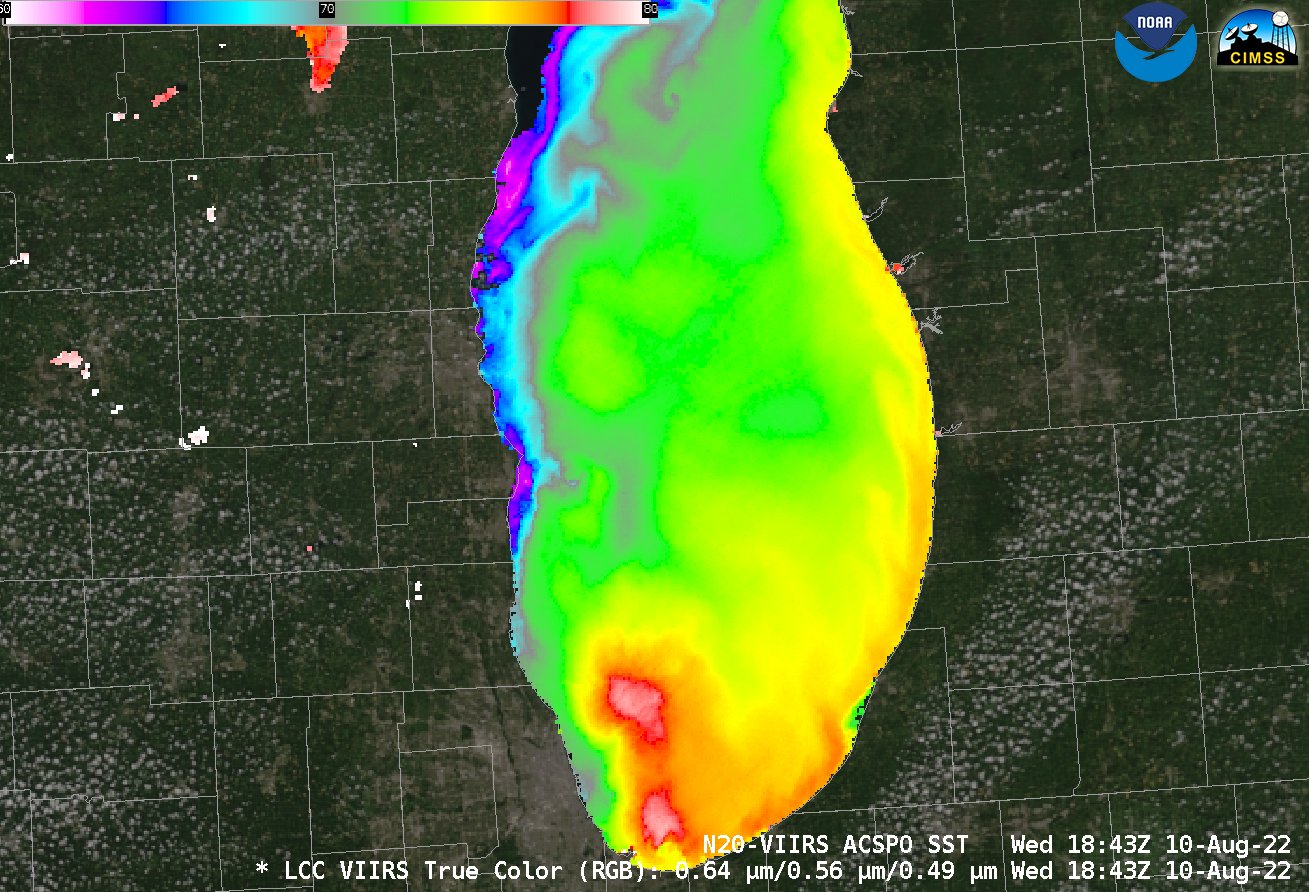
August 2022 – VIIRS lake surface temperatures depicted an upwelling event of cold waters on the western side of Lake Michigan on August 10th.
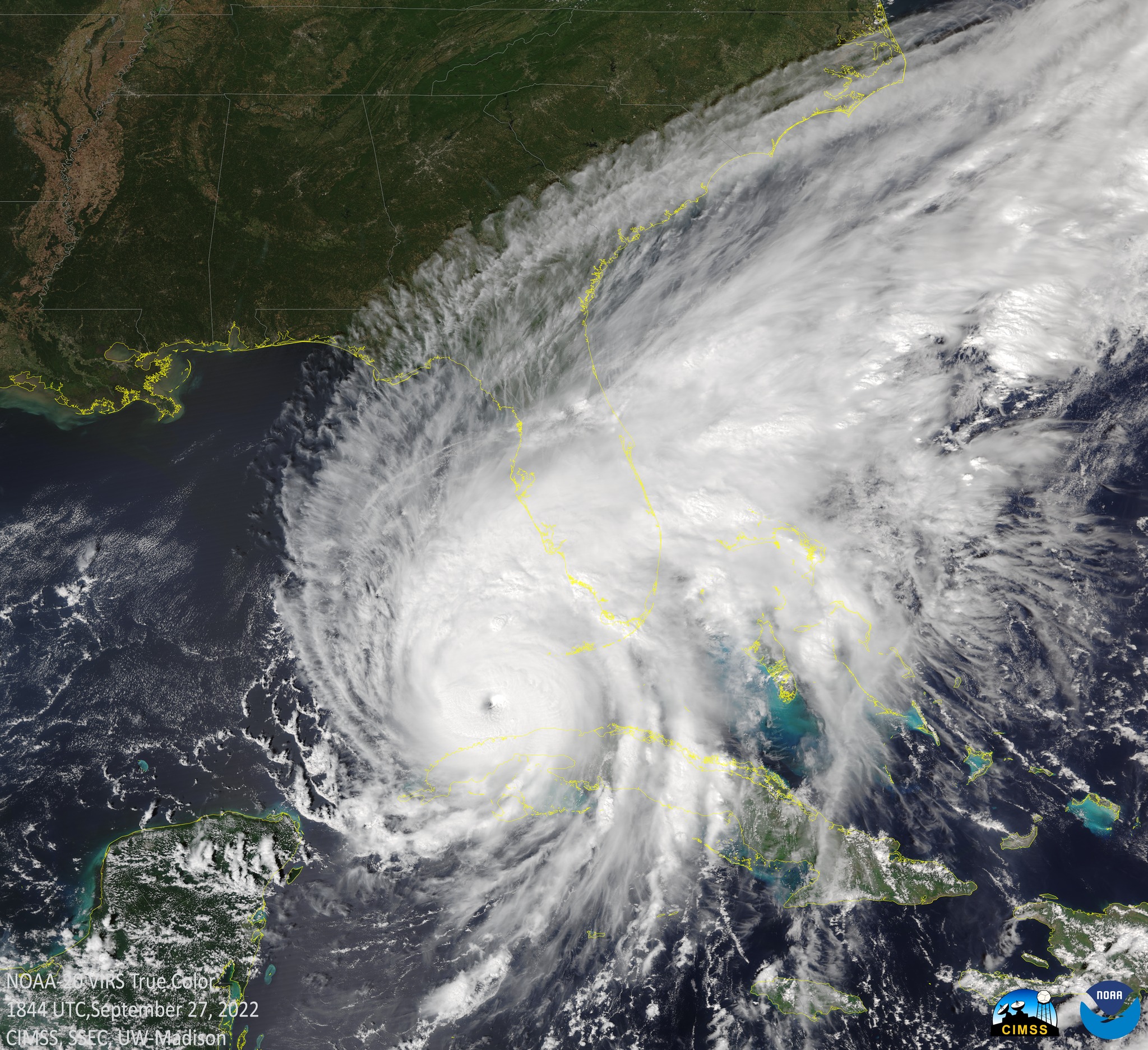
September 2022 – Category 4 Hurricane Ian headed toward Florida on September 27th via VIIRS True Color.
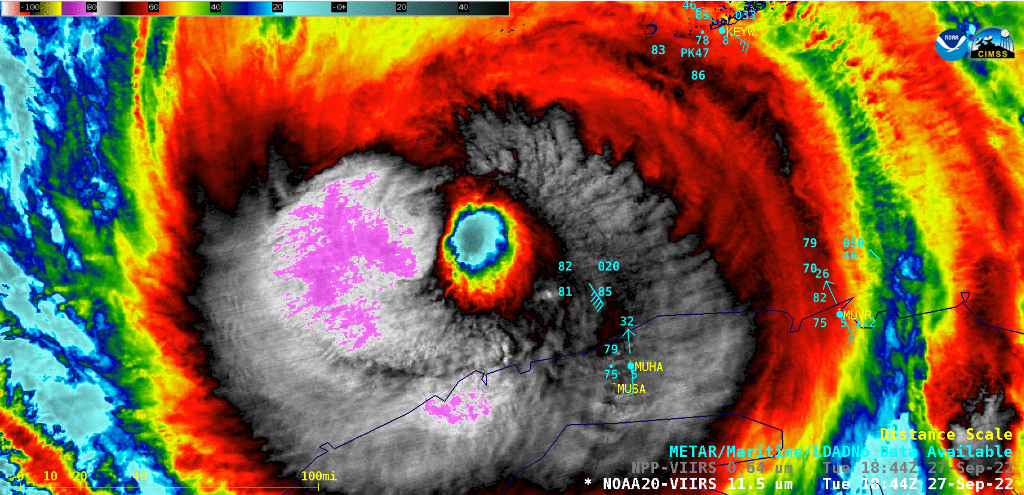
September 2022 – VIIRS IR reveals cold cloud-top temperatures near -83ºC (shades of purple) with Hurricane Ian on September 27th.
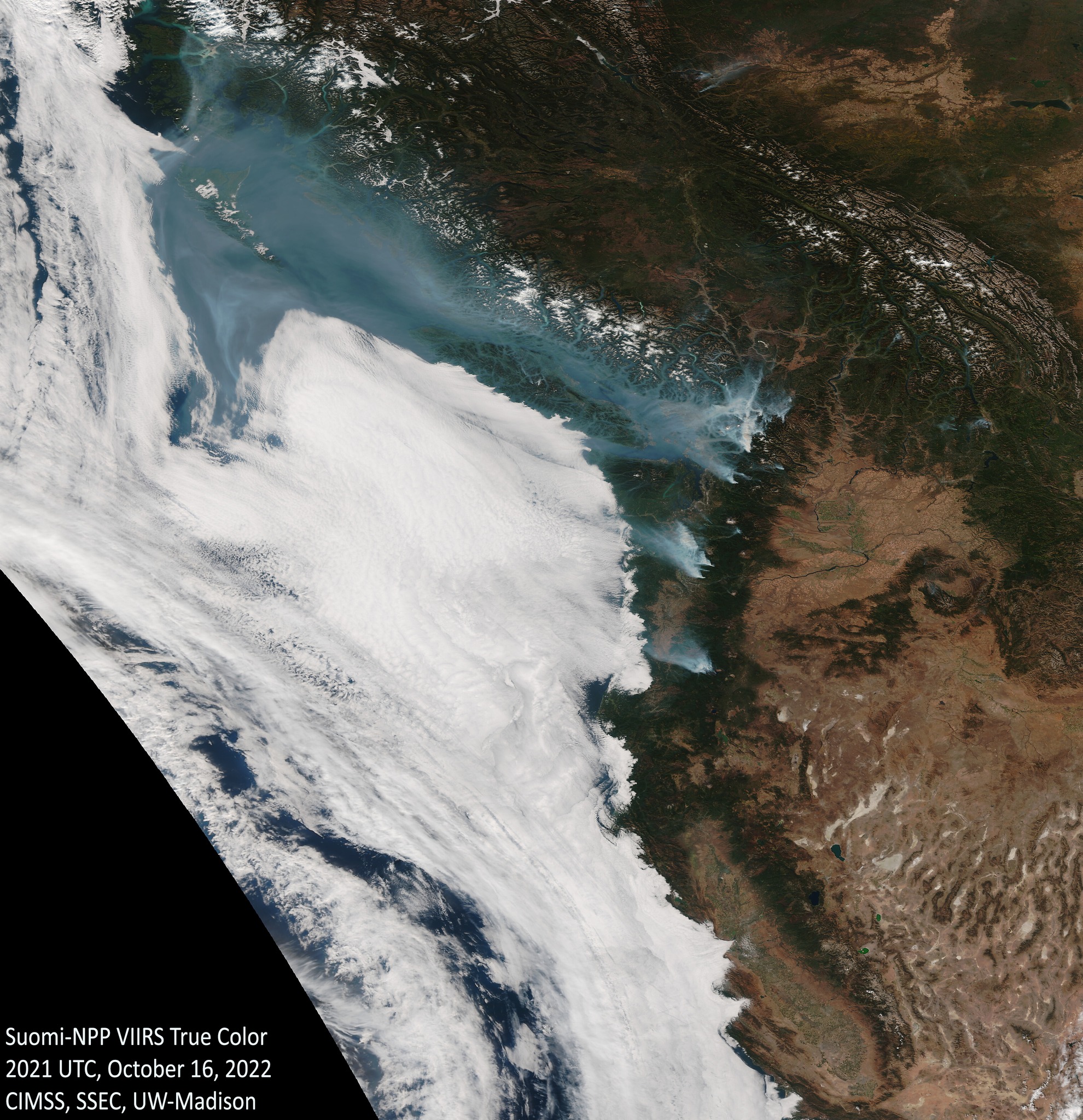
October 2022 – VIIRS True Color captured wildfires in Oregon and Washington on October 16th with smoke flowing north into Canada.
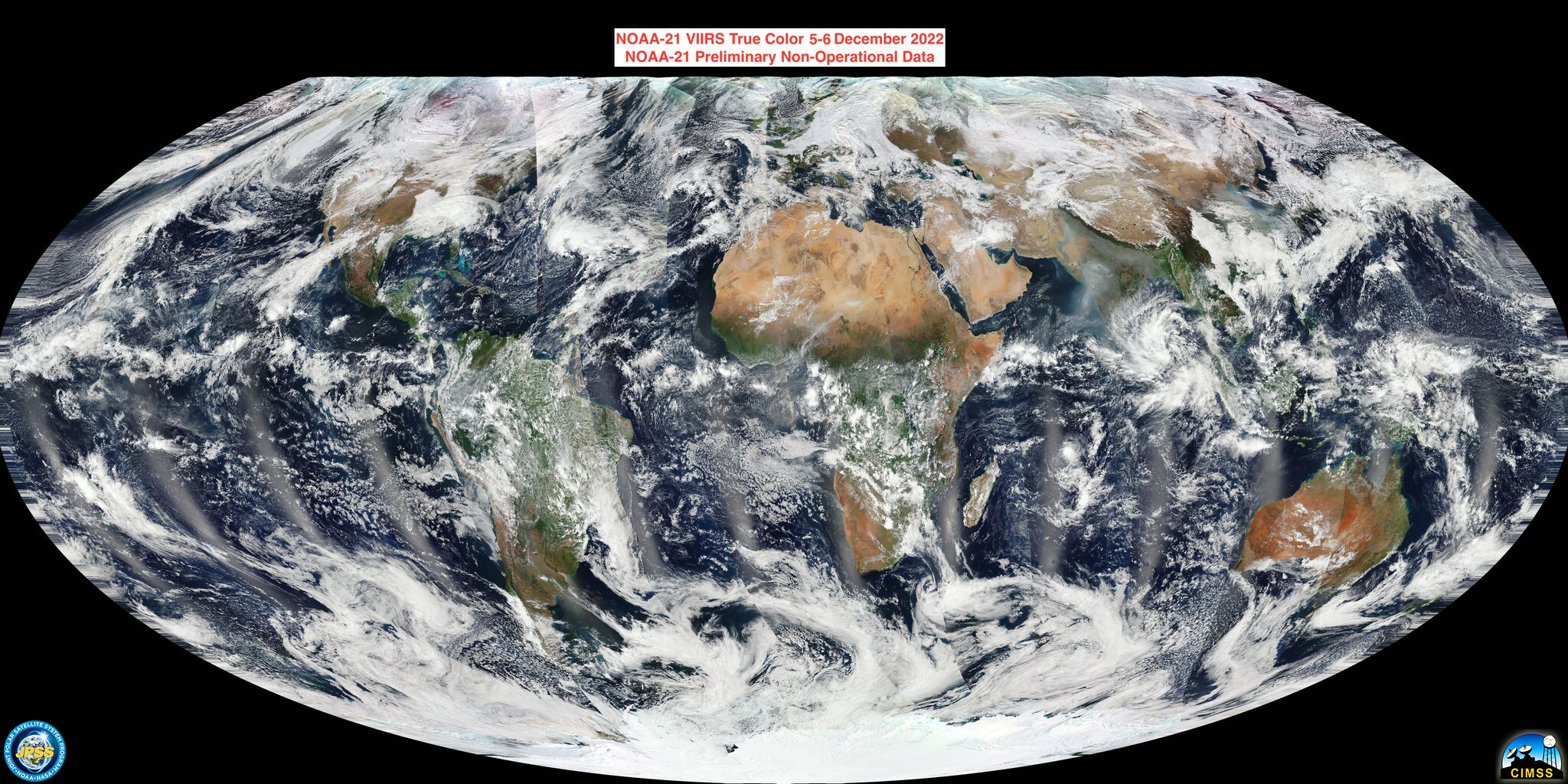
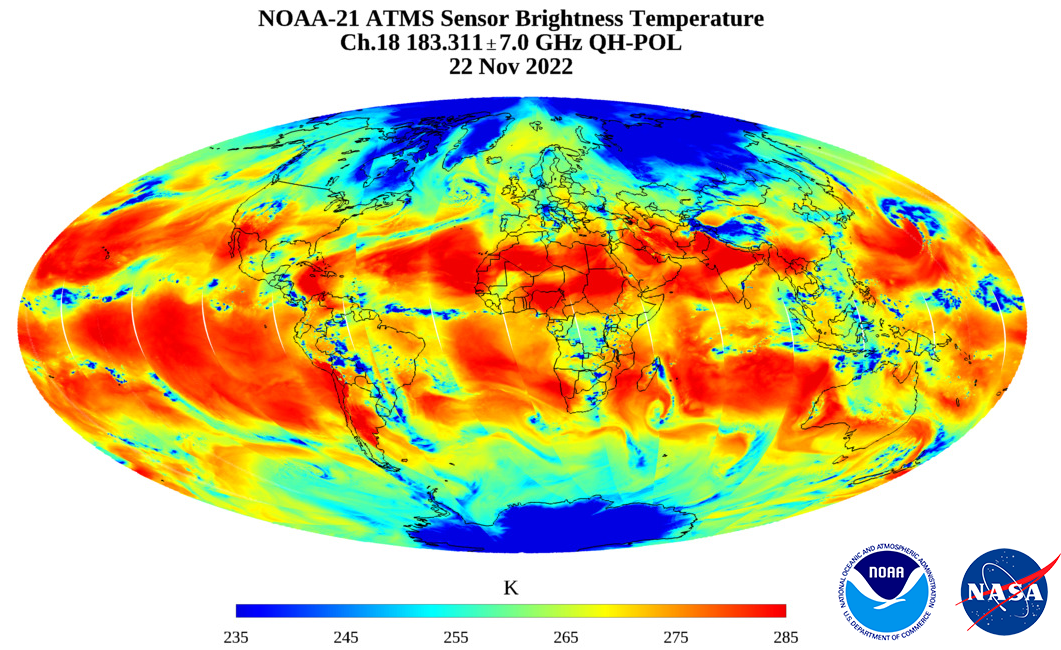
The JPSS-2 satellite launched from from California’s Vandenberg Space Force Base on November 10, 2022, just before 2am Pacific time. Once in orbit it was renamed NOAA-21, the third in a series of advanced polar-orbiting satellites. Data was being received on Earth less than 2 weeks later!
November 2022- First Light global composite from NOAA-21’s ATMS sensor released on November 22.
November/December 2022 – First Light VIIRS True Color global composite from NOAA-21 downloaded via CIMSS Direct Broadcast.
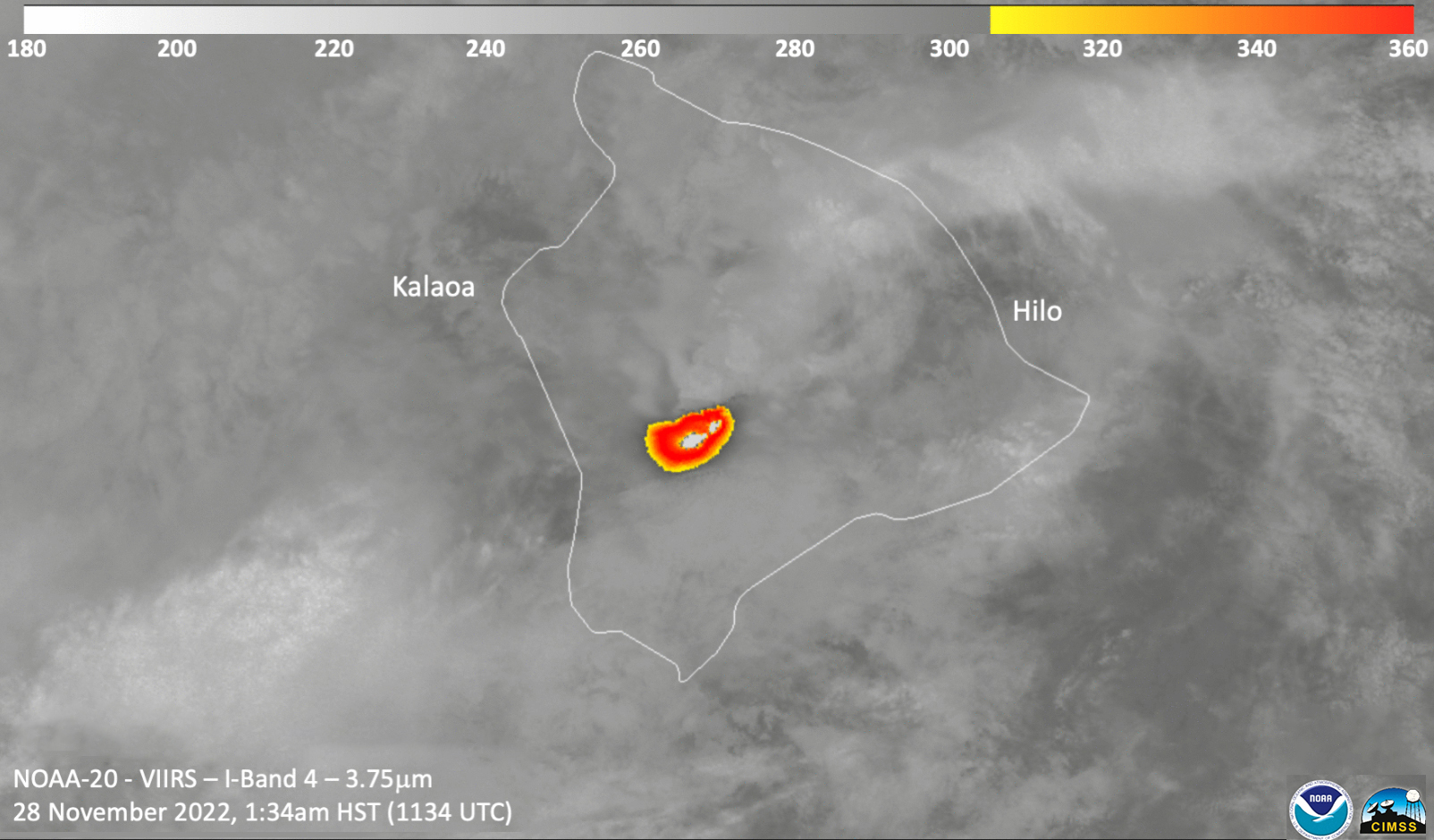
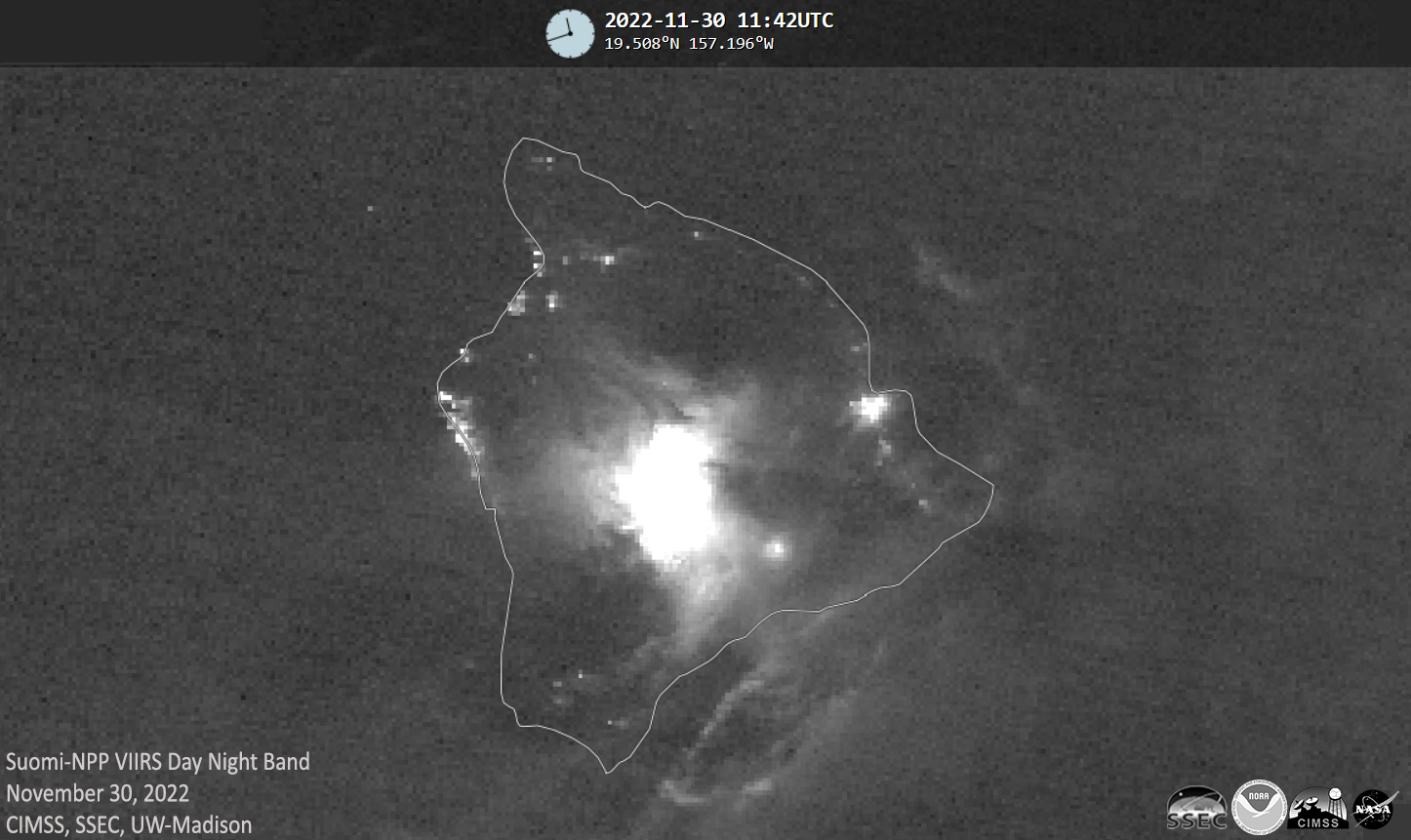
Meanwhile Mauna Loa erupted on the Big Island of Hawaii for the first time in 38 years on November 27th 2022. VIIRS provided regular insights into the extended volcanic event which lasted until December 13th.
November 2022 – NOAA-20 VIIRS IR (3.74 µm) view of the Mauna Loa eruption acquired on November 28th.
November 2022 – VIIRS Day Night Band depiction of hot lava from Mauna Loa and the smaller glow from Kilauea on November 30th.
December wrapped up the year with an Arctic Blast in the east and an Atmospheric River aimed at the west coast. Polar-orbiting satellites tracked both events.
December 2022 – An Arctic Blast during the holidays depicted by data collected by the CrIS and ATMS instruments.
December 2022 – Historic lake-effect snow associated with the Arctic Blast via VIIRS True and False Color imagery on 12/25.
This collection is merely a sampling of polar-orbiting satellite applications. Tune in to future blog posts and CIMSS social media for additional imagery from the JPSS fleet in 2023, including more NOAA-21 imagery!