
This website works best with a newer web browser such as Chrome, Firefox, Safari or Microsoft Edge. Internet Explorer is not supported by this website.

Cold water upwelling in western Lake Michigan

As pointed out by the NWS forecast office at Milwaukee/Sullivan WI, a narrow ribbon of cooler water temperatures was seen along parts of the western nearshore waters of Lake Michigan on 19 September 2007. Strong westerly winds in the wake of a cold frontal passage aided in the upwelling of cooler water from below the lake surface,... Read More

MODIS SST images (18 and 19 September)

As pointed out by the NWS forecast office at Milwaukee/Sullivan WI, a narrow ribbon of cooler water temperatures was seen along parts of the western nearshore waters of Lake Michigan on 19 September 2007. Strong westerly winds in the wake of a cold frontal passage aided in the upwelling of cooler water from below the lake surface, which was evident in a comparison of AWIPS images of MODIS Sea Surface Temperature (SST) from 18 and 19 September (above).

A comparison of the 19 September MODIS SST image with the MODIS visible channel image on the following day (20 September, below) shows that patchy low-level fog and stratus cloud had formed over much of the western portion of Lake Michigan (where cooler SST values were seen on the previous day).

MODIS SST (19 Sep) + MODIS visible (20 Sep)

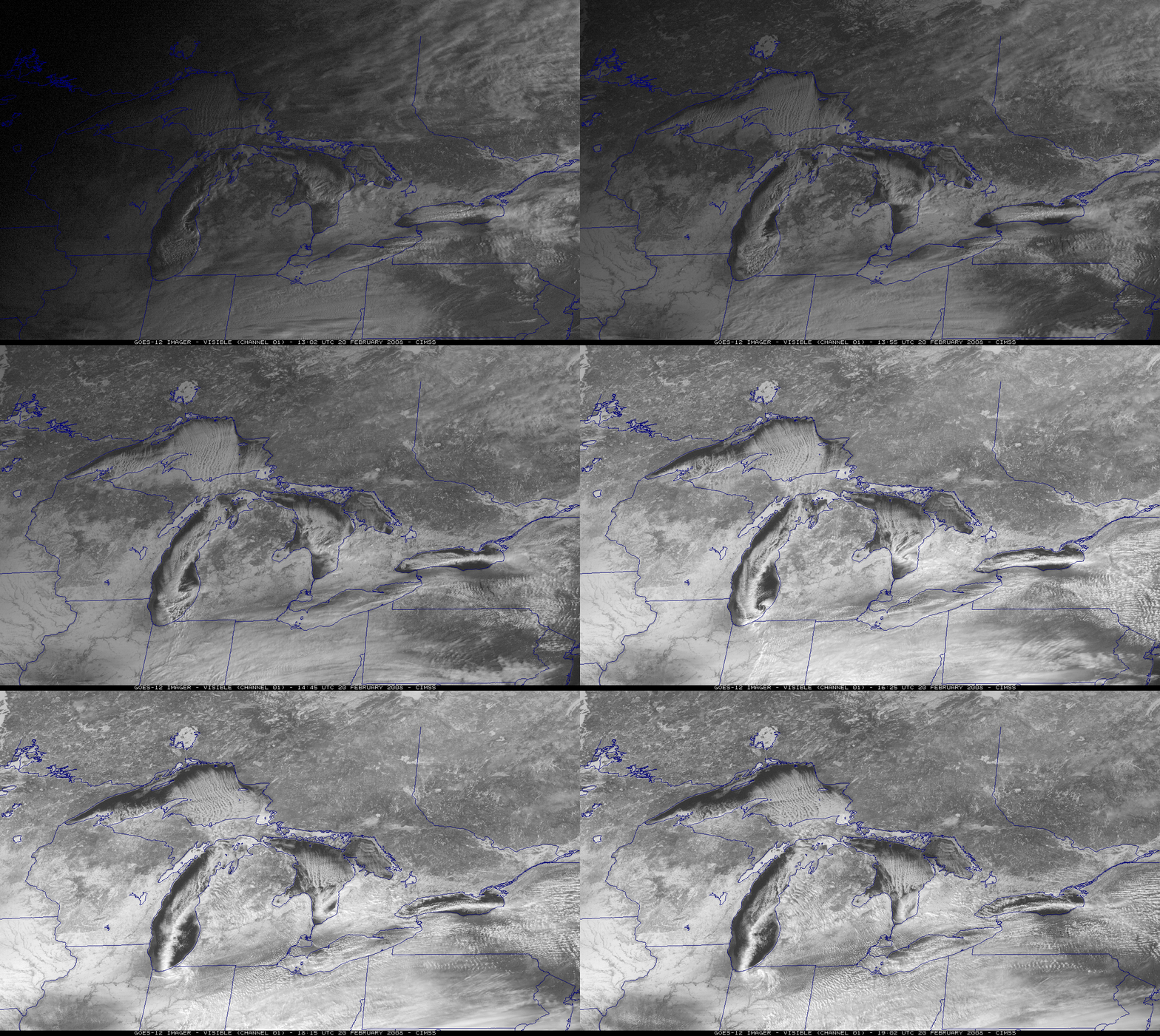
An animation of GOES-12 visible imagery (below) indicated that the offshore fog and stratus persisted for much of the day on 20 September, and even began to move inland along parts of the lakeshore counties in southeastern Wisconsin shore as an easterly component of the surface winds increased during the afternoon hours. The cooler nearshore waters seen on the MODIS SST images above likely played a role in maintaining the fog/stratus along the west coast of Lake Michigan.

GOES-12 visible images (Animated GIF)

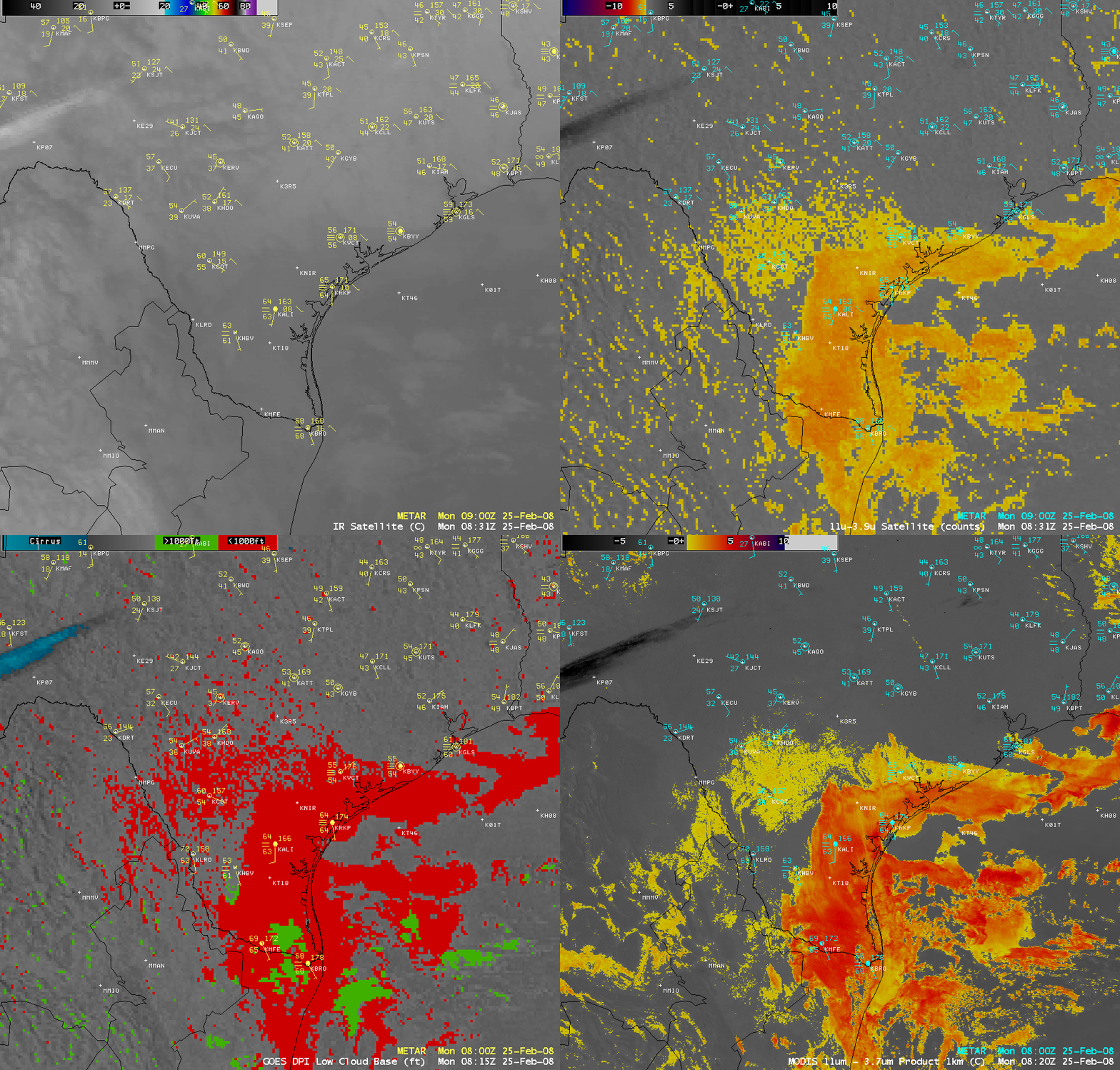
Also evident in the early portion of the GOES-12 visible animation are fingers of river valley fog across southwestern Wisconsin, northeastern Iowa, and southwestern Minnesota — this fog (which formed during the nighttime hours) quickly burned off with daytime heating. A comparison of the MODIS and GOES-12 fog/stratus products (below) around 08 UTC (3am local time) shows the more detailed river valley fog structure that was apparent on the 1-km resolution MODIS imagery (compared to the 4-km resolution data from GOES-12).

MODIS + GOES-12 fog/stratus product

View only this post Read Less

Intensifying upper-level low over Florida

AWIPS images of the GOES-12 6.5µm “water vapor” channel (above) show an upper-level low that was intensifying over Florida during the day on 18 September 2007. As warm/dry middle to upper tropospheric air (yellow enhancement) wrapped around and into the southwestern quadrant of the cyclone, convection was seen to develop along the... Read More

GOES-12 water vapor images (Animated GIF)

AWIPS images of the GOES-12 6.5µm “water vapor” channel (above) show an upper-level low that was intensifying over Florida during the day on 18 September 2007. As warm/dry middle to upper tropospheric air (yellow enhancement) wrapped around and into the southwestern quadrant of the cyclone, convection was seen to develop along the southern Gulf Coast of Florida. This dry air was associated with a tropopause anomaly, where the “dynamic tropopause” (taken to be the 1.5 Potential Vorticity Unit contour) descended to around the 380 hPa pressure level according to the GFS40 model (below).

GOES-12 water vapor image + GFS PV1.5 pressure

A cross section of GFS40 model fields (oriented from east on the left to west on the right) across Florida (below) reveals the lowering tropopause (color shaded potential vorticity values) and descending dry air (dashed green specific humidity contours) associated with the tropopause anomaly. Surface pressures were beginning to fall across that region in response to the tropopause anomaly, raising speculation that a subtropical or a tropical cyclone could eventually develop from this system as it moves slowly westward into the Gulf of Mexico.

GFS cross section

View only this post Read Less

Fog in Pennsylvania and New York

AWIPS images of the MODIS fog/stratus product (above) and the corresponding GOES-12 fog/stratus product (below) revealed areas of fog that were forming in the valleys of Pennsylvania and New York around 08 UTC (4am local time) on 17 September 2007. The 1-km resolution MODIS imagery offered a more detailed view of the... Read More

AWIPS MODIS fog/stratus product

AWIPS images of the MODIS fog/stratus product (above) and the corresponding GOES-12 fog/stratus product (below) revealed areas of fog that were forming in the valleys of Pennsylvania and New York around 08 UTC (4am local time) on 17 September 2007. The 1-km resolution MODIS imagery offered a more detailed view of the fog structure compared to the 4-km resolution GOES-12 product. Also note the “false signal” of fog that appeared on the GOES-12 image along certain land/water boundaries (the Finger Lakes region of New York, portions of Lakes Erie and Ontario, and the New Jersey coast of the Delaware Bay). With clear skies and light wind conditions associated with high pressure in place across much of the northeastern US, fog formation (due to strong radiational cooling during the night-time hours) was prevalent over a large area.

AWIPS GOES-12 fog/stratus product

View only this post Read Less

Lee wave lenticular clouds in southern Nevada

GOES-11 visible channel imagery (above) showed a nice example of lee wave “lenticular clouds” immediately downwind of the Spring Mountains (whose highest peak is Mt. Charleston at 11,918 ft or 3362 m) just to the northwest of Las Vegas, Nevada (Google maps) on 14 September 2007. The vertical motions associated with lee waves can cause... Read More

GOES-11 visible images (Animated GIF)

GOES-11 visible channel imagery (above) showed a nice example of lee wave “lenticular clouds” immediately downwind of the Spring Mountains (whose highest peak is Mt. Charleston at 11,918 ft or 3362 m) just to the northwest of Las Vegas, Nevada (Google maps) on 14 September 2007. The vertical motions associated with lee waves can cause moderate to severe turbulence which is a hazard to aviation, but on this particular day there were no pilot reports of turbulence noted in the immediate vicinity of the lenticular cloud formations (McCarran International Airport is located about 20 miles or 50 km southeast of the Spring Mountain range, and no lenticular clouds were seen on the satellite imagery directly over the Las Vegas metropolitan area or the airport itself).

Such lee waves are generated when strong atmospheric flow encounters a barrier to the flow — in this case, the axis of a strong southwesterly jet stream was located over the region, as indicated by an AWIPS image of RUC80 model 250 hPa wind fields overlaid on GOES-11 water vapor channel imagery (below). The lenticular clouds associated with this lee wave were seen to dissipate later in the day as the strongest jet stream winds propagated northeastward away from the region.

GOES-11 water vapor image + model winds

In order for these types of stationary lee wave clouds to form and be maintained, there often needs to be a stable layer located at altitudes above the top of the terrain obstruction. In this case, the 12 UTC rawinsonde data from Desert Rock, Nevada (below) did indeed indicate the presence of a shallow stable layer between about 600 and 650 hPa (with a 50 knot wind speed maximum at the 650 hPa level).

Desert Rock NV rawinsonde data

View only this post Read Less