
This website works best with a newer web browser such as Chrome, Firefox, Safari or Microsoft Edge. Internet Explorer is not supported by this website.

PHS model output during Day 1 of Week 2 at HWT

A WRF model run that includes assimilated Low-Earth-Orbit (LEO) satellite sounder data (fused with ABI data) is being evaluated at the Hazardous Weather Testbed (Blog posts from forecasters at HWT are here). On 20 May 2024, the PHS model output included convective development over the eastern Plains of Colorado, as... Read More

A WRF model run that includes assimilated Low-Earth-Orbit (LEO) satellite sounder data (fused with ABI data) is being evaluated at the Hazardous Weather Testbed (Blog posts from forecasters at HWT are here). On 20 May 2024, the PHS model output included convective development over the eastern Plains of Colorado, as shown in the animation below of model Composite Reflectivity at hourly time-steps. The screenshots below are from AWIPS; model output is also available here.

PHS model output of Composite Reflectivity, hourly from 20 UTC 20 May through 00 UTC 21 May 2024 (Click to enlarge)

The PHS model accurately predicted convective initiation, as shown in the (hourly) animation below of GOES-East visible imagery.

GOES-East Band 2 (0.64 µm) Visible Imagery, 20-23 UTC on 20 May 2024 (Click to enlarge)

The three toggles below compare the forecasts of Composite Reflectivity and Visible Imagery at 2000, 2100 and 2200 UTC.

PHS 3-h forecast of Composite Reflectivity and GOES-East Band 2 (0.64 µm) Visible Imagery, 2000 UTC on 20 May 2024
PHS 3-h forecast of Composite Reflectivity and GOES-East Band 2 (0.64 µm) Visible Imagery, 2100 UTC on 20 May 2024
PHS 4-h forecast of Composite Reflectivity and GOES-East Band 2 (0.64 µm) Visible Imagery, 2200 UTC on 20 May 2024

Based on the forecast, a LightningCast monitoring point was created where the model forecast initiation (approximately 39.7oN, 104.7oW; National Weather Service forecasters have the ability to request monitoring points to supplement the airports/stadiums that are done routinely and are available at this website). That LightningCast probabilities are shown below for the point.

GOES-East and GOES-West LightningCast Probabilities for a point in eastern CO where the 17z and 18z PHS model runs predicted Convective Initiation (Click to enlarge)

The animation below shows the Day Cloud Phase Distinction RGB and the LightningCast Probability contours over eastern CO (figure above and animation below courtesy John Cintineo, NSSL).

Meso Sector LightningCast Probability over eastern Colorado, 1920-2120 UTC on 21 May 2024

View only this post Read Less
Severe thunderstorms across Kansas

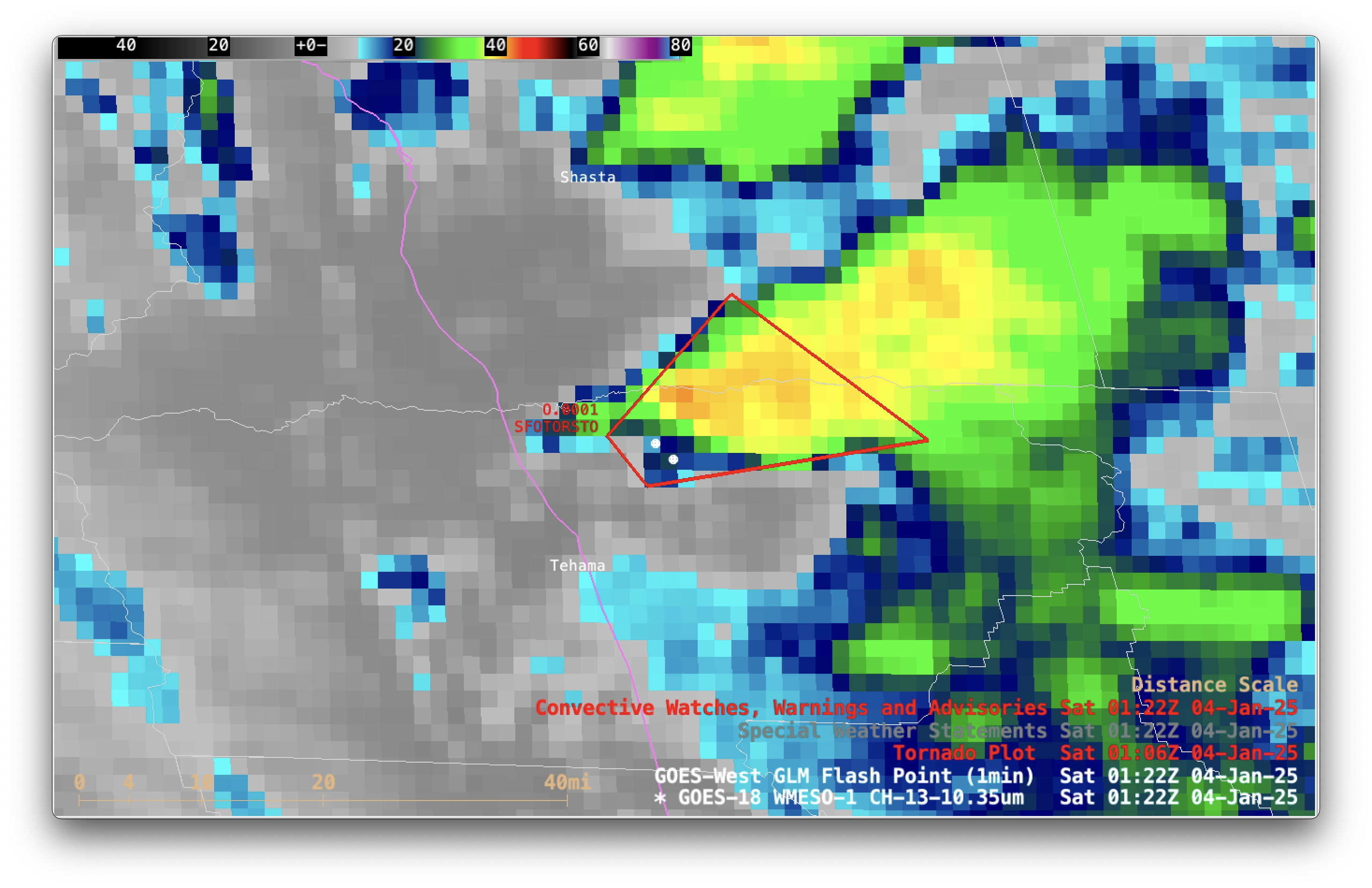
While much of Kansas was under a “Particularly Dangerous Situation” Severe Thunderstorm Watch, 1-minute Mesoscale Domain Sector GOES-16 (GOES-East) Visible/Infrared Sandwich RGB images (above) showed thunderstorms that produced tornadoes, large hail (to 3.00 inches in diameter) and damaging winds (gusts of 90-100 mph) (SPC Storm Reports) across parts of Kansas on 19 May 2024. Some flash flooding was also reported, with water covering portions of... Read More

1-minute GOES-16 Visible/Infrared Sandwich RGB images with time-matched Local Storm Reports plotted in cyan [click to play animated GIF | MP4]

While much of Kansas was under a “Particularly Dangerous Situation” Severe Thunderstorm Watch, 1-minute Mesoscale Domain Sector GOES-16 (GOES-East) Visible/Infrared Sandwich RGB images (above) showed thunderstorms that produced tornadoes, large hail (to 3.00 inches in diameter) and damaging winds (gusts of 90-100 mph) (SPC Storm Reports) across parts of Kansas on 19 May 2024. Some flash flooding was also reported, with water covering portions of Interstate 70 and other nearby roads. The discrete supercell thunderstorms that initially developed during the late afternoon hours eventually consolidated into a larger organized Mesoscale Convective System / squall line by about 0000 UTC on 20 May.

1-minute GOES-16 Visible/Infrared Sandwich RGB images combined with the Total Precpitable Water derived product in cloud-free areas, with time-matched Local Storm Reports plotted in cyan [click to play animated GIF | MP4]

1-minute GOES-16 Visible/Infrared Sandwich RGB images combined with the Total Precpitable Water derived product (above) and the CAPE derived stability index (below) revealed a plume of moisture (TPW values to 1.6 in) and instability (CAPE values to 2200 J/kg) that was spreading northward along the I-35 corridor, feeding into the tornado/hail/wind/flash-flood-producing supercell thunderstorm that was propagating eastward along the I-70 corridor.

1-minute GOES-16 Visible/Infrared Sandwich RGB images combined with the Convective Available Potential Energy (CAPE) derived product in cloud-free areas, with time-matched Local Storm Reports plotted in cyan [click to play animated GIF | MP4]

View only this post Read Less
30-second images of thunderstorms that produced tornadoes and damaging winds (with some fatalities) in the Houston, Texas area

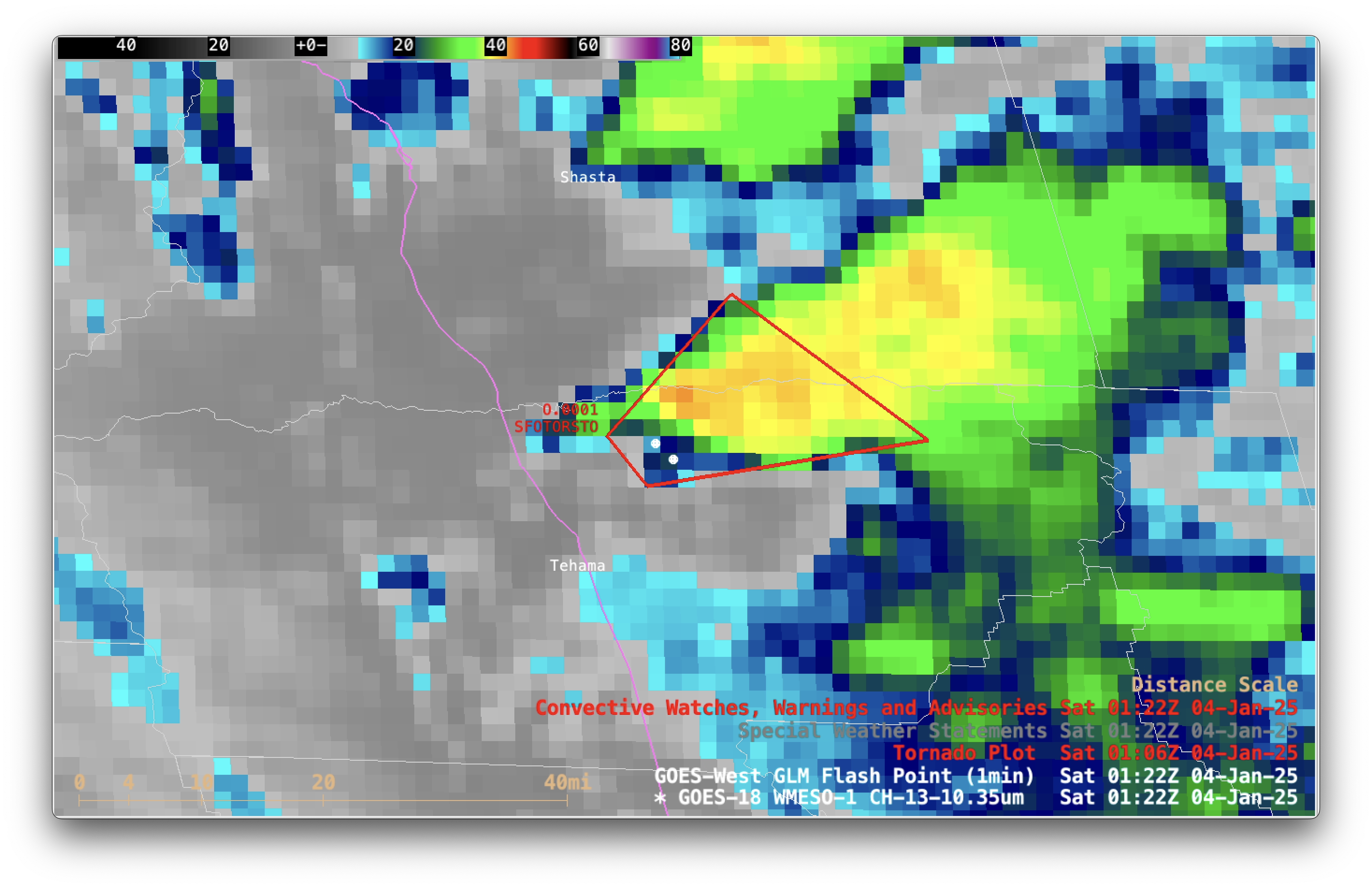
Overlapping 1-minute Mesoscale Domain Sectors provided 30-second interval GOES-16 (GOES-East) “Red” Visible (0.64 µm) and “Clean” Infrared Window (10.3 µm) images (above) — which showed thunderstorms that produced two EF1-rated tornadoes as well as damaging winds (resulting in some fatalities) across the Houston area (SPC Storm Reports) on 16 May 2024. Widespread structural damage occurred in downtown Houston — and there were also... Read More

30-second GOES-16 “Red” Visible (0.64 µm, top) and “Clean” Infrared Window (10.3 µm, bottom) images with time-matched (+/- 3 minutes) SPC Storm Reports plotted in cyan, from 2230 UTC on 16 May to 0018 UTC on 17 May [click to play animated GIF | MP4]

Overlapping 1-minute Mesoscale Domain Sectors provided 30-second interval GOES-16 (GOES-East) “Red” Visible (0.64 µm) and “Clean” Infrared Window (10.3 µm) images (above) — which showed thunderstorms that produced two EF1-rated tornadoes as well as damaging winds (resulting in some fatalities) across the Houston area (SPC Storm Reports) on 16 May 2024. Widespread structural damage occurred in downtown Houston — and there were also power outages across much of the area. The Infrared images revealed numerous pulses of thunderstorm overshooting tops that exhibited infrared brightness temperatures of -80ºC or colder (shades of violet embedded within brighter white regions).

Larger-scale views of 30-second GOES-16 Visible and Infrared images are shown below.

30-second GOES-16 “Red” Visible (0.64 µm) images with time-matched SPC Storm Reports plotted in red, from 2130 UTC on 16 May to 0017 UTC on 17 May [click to play animated GIF | MP4]

30-second GOES-16 “Clean” Infrared Window (10.3 µm) images with time-matched SPC Storm Reports plotted in cyan, from 2130 UTC on 16 May to 0017 UTC on 17 May [click to play animated GIF | MP4]

Taking a closer look at the Houston metro area, 30-second GOES-16 Visible images with/without an overlay of GLM Flash Extent Density (below) showed the lightning activity associated with these thunderstorms, which included a few brief lightning jumps.

30-second GOES-16 “Red” Visible (0.64 µm) images, with/without an overlay of GLM Flash Extent Density, from 2300 UTC on 16 May to 0030 UTC on 17 May [click to play animated GIF | MP4]

View only this post Read Less
Blowing dust in West Texas

5-minute CONUS Sector GOES-16 (GOES-East) Ash RGB images (above) showed a pulse of blowing dust — lofted by thunderstorm outflow winds gusting as high as 70 kt (81 mph) — that was moving southward across West Texas late in the day on 16 May 2024. This dust reduced surface visibility to 1-1/4 mi... Read More

GOES-16 Ash RGB images [click to play animated GIF | MP4]

5-minute CONUS Sector GOES-16 (GOES-East) Ash RGB images (above) showed a pulse of blowing dust — lofted by thunderstorm outflow winds gusting as high as 70 kt (81 mph) — that was moving southward across West Texas late in the day on 16 May 2024. This dust reduced surface visibility to 1-1/4 mi at some sites as it made its way south across Interstates I-20 and I-10. In this particular case, the Ash RGB provided a better depiction of the blowing dust than the Dust RGB — for example, at 0001 UTC (both RGBs use the same spectral bands, but are scaled differently).

GOES-16 True Color RGB images from the CSPP GeoSphere site (below) provided a clearer view of the areal coverage of this blowing dust.

GOES-16 True Color RGB images [click to play MP4 animation]

View only this post Read Less