
Severe weather outbreak across the southeastern US

January 23rd, 2012
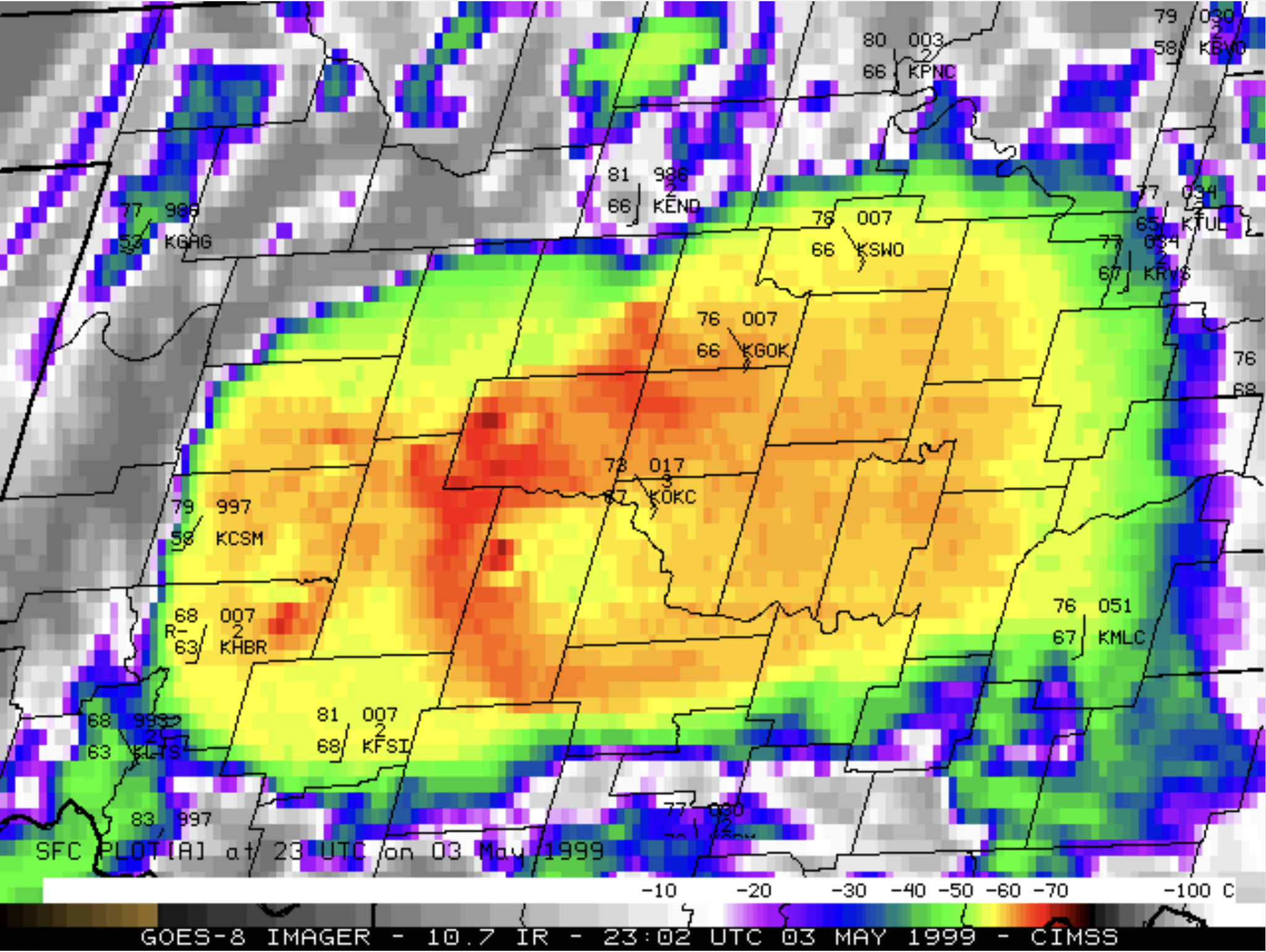
GOES-13 10.7 µm IR channel images + severe weather reports (click image to play animation)

GOES-13 10.7 µm IR channel images + severe weather reports (click image to play animation)

A major outbreak of severe thunderstorms along a strong cold frontal boundary swept eastward across much of the southeastern US on 22 January23 January 2012, producing widespread damaging winds, large hail, and tornadoes (SPC storm reports). Two tornadoes produced EF-3 damage in Alabama. AWIPS images of 4-km resolution GOES-13 10.7 µm IR channel data with overlays of severe weather reports (above; click image to play animation) showed the cold cloud top IR brightness temperatures of -60 to -70 C (red to black color enhancement) associated with some of the strongest storms. For more information, see summaries from the National Weather Service forecast offices at Litttle Rock AR, Jackson MS, and Birmingham AL.

POES AVHRR 12.0 µm and MODIS 11.0 µm IR images

POES AVHRR 12.0 µm and MODIS 11.0 µm IR images

A sequence of 1-km resolution POES AVHRR 12.0 µm IR and MODIS 11.0 µm IR images (above) displayed greater detail in the storm top thermal structures, with a number of  -70 to -80 C (black to light gray color enhancement) IR brightness temperature values seen on the higher resolution imagery.

Of particular interest was what appeared to be some sort of “cloud trench” oriented from north to south across Tennessee around 08:00 UTC, which exhibited significantly warmer MODIS 11.0 µm IR brightness temperatures and a warmer/drier signal on the corresponding MODIS 6.7 µm water vapor image (below). This feature was also apparent on a few of the 4-km resolution GOES-13 IR images around that time. The etiology of this satellite signature is unclear at this time.

MODIS 11.0 µm IR channel and 6.7 µm water vapor channel images

MODIS 11.0 µm IR channel and 6.7 µm water vapor channel images

GOES-15: improved spatial resolution water vapor channel

September 14th, 2011


GOES-11 6.7 µm (left) and GOES-15 6.5 µm (right) water vapor channel images (click image to play animation)

GOES-11 6.7 µm (left) and GOES-15 6.5 µm (right) water vapor channel images (click image to play animation)

McIDAS images of 8-km resolution GOES-11 6.7 µm and 4-km resolution GOES-15 6.5 µm water vapor channel data (above) demonstrated the advantage of improved spatial resolution for the detection of features and gradients in the water vapor imagery associated with a weak upper level low moving eastward across the southwestern US on 14 September 2010. GOES-15 is scheduled to replace GOES-11 as the operational GOES-West satellite in December 2011.

AWIPS images of the GOES-11 sounder Convective Available Potential Energy (CAPE) product (below) showed that the atmosphere was destabilizing in advance of the upper low, with CAPE values in the 1000-2000 J/kg range.

GOES-11 sounder Convective Available Potential Entegy (CAPE)

GOES-11 sounder Convective Available Potential Entegy (CAPE)

With the increasing instability and large scale lift ahead of the upper low, areas of thunderstorms developed over parts of Nevada, Arizona, and Utah, as seen on a MODIS 11.0 µm IR image with an overlay of cloud-to-ground lightning strikes (below). About an hour after the time of the MODIS image, one of these storms produced 1.0-inch diameter hail that covered the ground near Munds in northern Arizona (SPC storm reports).

MODIS 11.0 µm IR image + cloud-to-ground lightning strikes

MODIS 11.0 µm IR image + cloud-to-ground lightning strikes

CIMSS participation in GOES-R Proving Ground activities includes making a variety of MODIS and additional GOES Sounder images and products available for National Weather Service offices to add to their local AWIPS workstations. Currently there are 49 NWS offices receiving MODIS imagery and products from CIMSS.


Overshooting Tops in the Tropics

September 1st, 2011
GOES-13 Visible (0.63 µm) image and auto-detected Overshooting Tops (click image to toggle)

GOES-13 Visible (0.63 µm) image and auto-detected Overshooting Tops (click image to toggle)

Overshooting tops above a thunderstorm suggest an updraft powerful enough to penetrate through the tropopause into the stratosphere. In mid-latitudes, overshoots are well-correlated with both heavy precipitation and severe weather. In the tropics, overshooting tops are linked to intensification in tropical systems. In the image toggle above of an area of disturbed weather that may become a named tropical system in the Gulf of Mexico over the weekend, visible imagery and infrared data are shown with the automatically-detected overshooting tops (red being a more intense OT, that is, a bigger temperature difference between the tower top and the surrounding anvil cirrus through which the OT penetrates). Overshooting tops over the Continental United States are shown here (computed using data from GOES-13); Data from MSG are used to compute OTs over the tropical Atlantic, as shown here.

GOES-13 IR/WV (10.7 µm - 6.5 µm) used to detect Overshooting Tops

GOES-13 IR/WV (10.7 µm - 6.5 µm) used to detect Overshooting Tops

Difference fields between infrared data at 10.7 µm and the so-called water vapor channel (6.5 µm) can also be used to infer overshooting tops because Hot Towers push water vapor into the stratosphere and this alters the difference between the two channels. The image above, taken from the CIMSS Tropical Weather website, shows maxima in the difference field in the region where strong convection is occurring. (Click here for the toggle between the visible image and a similar WV/IR difference image). The automated detection algorithm seems to miss some towers; the wv/ir difference field identifies too many.

As the system in the Gulf of Mexico intensifies, the signal from the IR/WV difference and the number of autmomated detections should both increase. Intensification for now is inhibited by high shear over the region. The CIMSS Tropical Weather website offers information on this developing Gulf system.