This website works best with a newer web browser such as Chrome, Firefox, Safari or Microsoft Edge. Internet Explorer is not supported by this website.

Fog and stratus deck over the North Slope region of Alaska

The Area Forecast Discussion issued by the National Weather Service forecast office in Fairbanks mentioned the presence of a layer of fog and stratus over parts of the North Slope region of Alaska:NORTHERN ALASKA FORECAST DISCUSSION NATIONAL WEATHER SERVICE FAIRBANKS AK 1258 PM AKDT MON MAR 11 2013 NORTH SLOPE…THE... Read More

The Area Forecast Discussion issued by the National Weather Service forecast office in Fairbanks mentioned the presence of a layer of fog and stratus over parts of the North Slope region of Alaska:

NORTHERN ALASKA FORECAST DISCUSSION
NATIONAL WEATHER SERVICE FAIRBANKS AK
1258 PM AKDT MON MAR 11 2013

NORTH SLOPE…THE SUOMI NPP VIIRS SATELLITE FOG PRODUCT WAS INDICATING A DECENT LAYER OF STRATUS ALONG THE NORTH SLOPE. OBSERVATIONS ACROSS THE AREA GENERALLY INDICATED 1 TO 2 MILES IN VISIBILITY WITH FLURRIES AND FOG. THE IFR CONDITIONS ALIGN VERY WELL WITH THE HIGHER PROBABILITIES OF MODIS IFR PRODUCT. THERE ARE SOME VERY ISOLATED POCKETS OF HIGHER PROBABILITIES OF THE MODIS LIFR CONDITIONS. THESE CONDITIONS SHOULD REMAIN THROUGH TUESDAY EVENING OR WEDNESDAY MORNING AS THE SURFACE HIGH PRESSURE REMAINS WITHIN THE AREA. BY WEDNESDAY MORNING THE SURFACE PRESSURE GRADIENT BEGINS TO TIGHTEN…PROVIDING AN INCREASE IN WINDS AND PERHAPS A BREAK IN SOME OF THE FOG.

AWIPS images of the Suomi NPP VIIRS IR brightness temperature difference “fog/stratus product” (below) showed the coverage of the fog and stratus over the area.

Suomi NPP VIIRS IR brightness temperature difference "fog/stratus product"

Suomi NPP VIIRS IR brightness temperature difference “fog/stratus product”

The MODIS Instrument Flight Rules (IFR) Probability product (below) exhibited probabilities in excess of 90% (darker red color enhancement) over some areas. As mentioned in the forecast discussion, surface high pressure centered over the region was helping to maintain the presence of fog and stratus.

MODIS Instrument Flight Rules (IFR) Probability product

MODIS Instrument Flight Rules (IFR) Probability product

The corresponding MODIS Low Instrument Flight Rules (LIFR) Probability product (below) had some values greater that 70% (red color enhancement) over the eastern portion of the North Slope. However, you will notice that a large data gap appears in the LIFR product, in an area where IFR probabilities were high. Corey Calvert from CIMSS explained:

“Looks like the issue stems from the RAP model. The max RH in the lowest 1000′ layer is well over 90% for the area being discussed. However, the max RH in the lowest 500′ layer decreases significantly northward toward the water where is terrain is lower. Looks like the RAP is representing an elevated cloud layer with a ceiling between 500′-1000′ above sea level in that area. The high LIFR probs appear to coincide with higher terrain, therefore the lowest 500′ layer is elevated into the RAP cloud layer. The low LIFR probs (the hole in the data) match up with the lower RH values at lower terrain under the RAP cloud layer. The ceiling obs do indicate an elevated cloud layer (one station measuring 300′ and another 700′ in the area), but it’s hard to tell which is right due to the sparsity of obs. If the ceiling truly is hovering around 500′ though then this is believable representation from the products (high prob of IFR but low prob of LIFR)”.

MODIS Low Instrument Flight Rules (LIFR) Probability product

MODIS Low Instrument Flight Rules (LIFR) Probability product

These examples of new satellite products are being evaluated in an operational environment as part of the GOES-R Proving Ground, in an effort to prepare forecasters for the types of satellite data that will be available from the next generation of meteorological satellites (JPSS and GOES-R)

View only this post Read Less
Thunderstorms over Arizona: turbulence, hail, and damaging winds

AWIPS images of MODIS 0.64 µm visible channel and 6.7 µm water vapor channel images with an overlay of CRAS model 500 hPa geopotential height contours (above) showed an upper-level trough of low pressure that was moving inland across southern California and Arizona on Read More

MODIS 0.65 µm visible channel and 6.7 µm water vapor channel images (with CRAS model 500 hPa geopotential height contours)

MODIS 0.65 µm visible channel and 6.7 µm water vapor channel images (with CRAS model 500 hPa geopotential height contours)

AWIPS images of MODIS 0.64 µm visible channel and 6.7 µm water vapor channel images with an overlay of CRAS model 500 hPa geopotential height contours (above) showed an upper-level trough of low pressure that was moving inland across southern California and Arizona on 08 March 2013.

Suomi NPP VIIRS 0.64 µm visible channel and 11.45 µm IR channel images (with surface reports and surface fronts)

Suomi NPP VIIRS 0.64 µm visible channel and 11.45 µm IR channel images (with surface reports and surface fronts)

A comparison of Suomi NPP VIIRS 0.64 µm visible channel and 11.45 µm IR channel images (above) showed that widespread thunderstorms had developed on either side of a cold frontal boundary that was moving eastward across Arizona. The Blended Total Precipitable Water (TPW) product (below) indicated that TPW values were as high as 20 mm or 0.79 inch over much of Arizona, which was in excess of 200% or normal for this time of the year. With unseasonably high moisture in place, these thunderstorms produced a daily record rainfall  of 0.84 inch at Phoenix, with several locations in the Phoenix area receiving over 1 inch of precipitation (Public Information Statement). Hail up to 0.5 inch in diameter was reported — in some cases the hail accumulated to the point of totally covering the ground — and winds gusted to 45-55 mph at several locations.

Blended Total Precipitable Water and Percent of Normal Total Precipitable Water products

Blended Total Precipitable Water and Percent of Normal Total Precipitable Water products

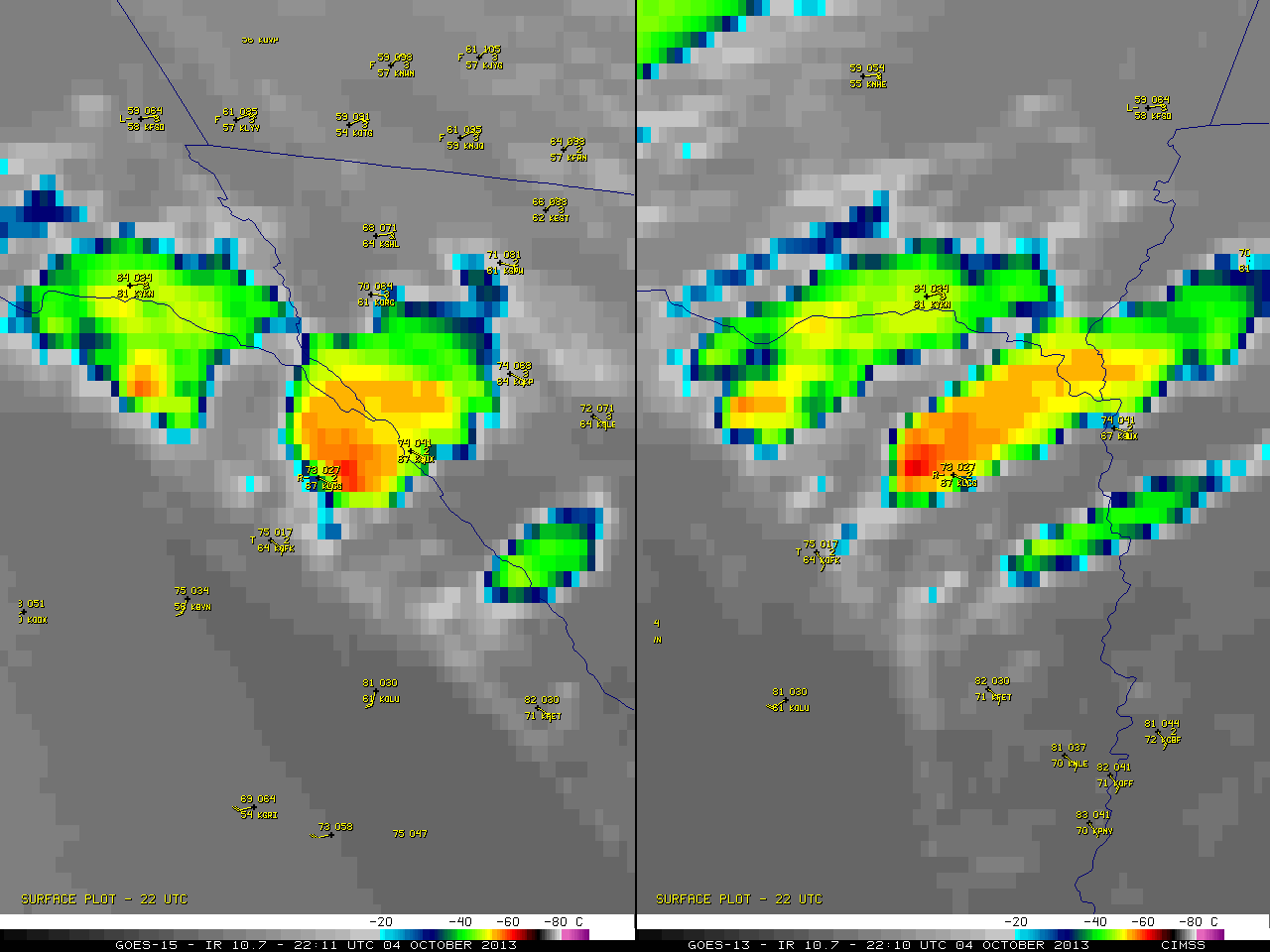
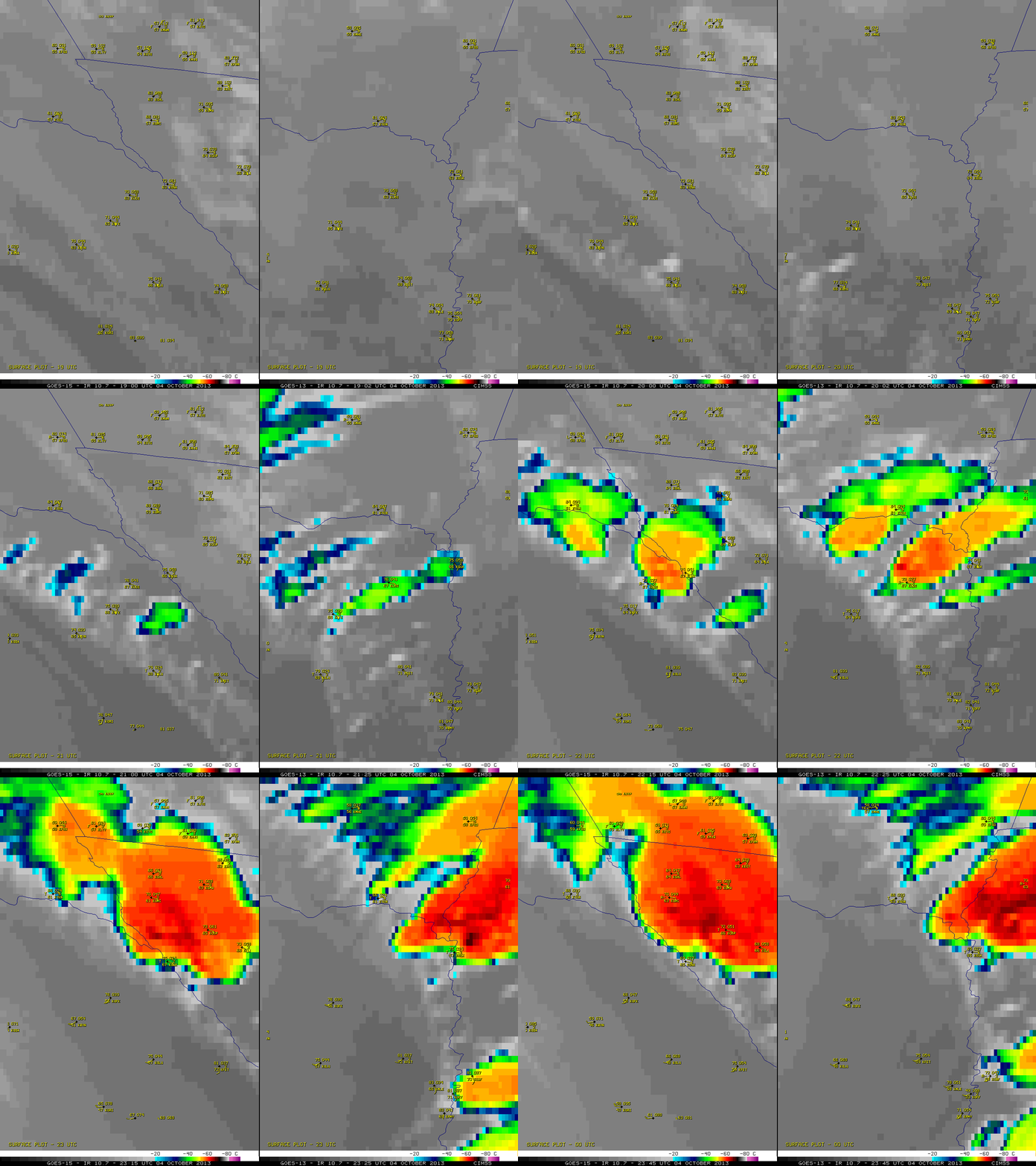
In addition to heavy rainfall, hail, and damaging surface winds, there were several pilot reports of turbulence. Particularly noteworthy were a pilot report of Severe turbulence at an altitude of 28,000 feet, and a pilot report of Severe to Extreme turbulence at an altitude of 11,000 feet. Both of these turbulence reports appeared to be associated with convective cells that were growing rapidly, as seen with GOES-13 10.7 µm IR channel images (below; click image to play animation).

GOES 15/13 10.7 µm IR channel images with pilot reports of turbulence (click image to play animation)

GOES 15/13 10.7 µm IR channel images with pilot reports of turbulence (click image to play animation)


View only this post Read Less
Volcanic ash fall plume over the Kamchatka Peninsula

AWIPS images of Suomi NPP VIIRS 0.64 µm visible channel images (above) revealed some interesting curved ice floe gyres in the Bering Sea just off the eastern coast of the Russian Kamchatka Peninsula on 07 March 2013. Also evident near the center of the visible images was a long, narrow,... Read More

Suomi NPP VIIRS 0.64 µm visible channel images

Suomi NPP VIIRS 0.64 µm visible channel images

AWIPS images of Suomi NPP VIIRS 0.64 µm visible channel images (above) revealed some interesting curved ice floe gyres in the Bering Sea just off the eastern coast of the Russian Kamchatka Peninsula on 07 March 2013. Also evident near the center of the visible images was a long, narrow, and slightly darker feature that was oriented approximately west-to-east, and located to the northwest and north of the village of Ust’-Kamchatsk (station identifier 32408). This darker feature was a volcanic ash fall plume from the Sheveluch Volcano (located 31 miles or 50 km to the northwest), which had experienced eruptions producing volcanic ash (photos) on 02 March and 04 March — the darker color of the narrow strip of volcanic ash made it stand out against the adjacent snow-covered areas (annotated visible image).

A comparison of a Suomi NPP VIIRS 0.64 µm visible channel image with the corresponding false-color Red/Green/Blue (RGB) image (below) also showed the contrast between the narrow strip of ash-covered snow and the surrounding undisturbed snow cover (snow and ice appear as darker shades of red in the RGB image).

Suomi NPP VIIRS 0.64 µm visible channel image + False-color Red/Green/Blue (RGB) image

Suomi NPP VIIRS 0.64 µm visible channel image + False-color Red/Green/Blue (RGB) image

A comparison of Suomi NPP VIIRS 0.64 µm visible channel, 3.74 µm shortwave IR channel, and 11.45 µm IR channel images (below) showed that the strip of ash-covered snow appeared significantly warmer (darker) on the shortwave IR image, due to the fact that the volcanic ash particles were efficient reflectors of incoming solar radiation. The ash-covered snow even appeared slightly warmer (darker) on the 11.45 µm IR image, since the lower albedo of the ash-covered snow allowed it to absorb more incoming solar radiation.Also evident on the shortwave IR image was a distinct hot thermal anomaly (yellow to red color enhancement) associated with the active Kizimen volcano.

Suomi NPP VIIRS 0.64 µm visible channel, 3.74 µm shortwave IR channel. and 11.45 µm IR channel images

Suomi NPP VIIRS 0.64 µm visible channel, 3.74 µm shortwave IR channel. and 11.45 µm IR channel images

An animation of McIDAS images of MTSAT-2 0.73 µm visible channel data (below; click image to play animation) confirmed that the darker volcanic ash fall plume was a stationary feature, and not an airborne volcanic ash plume. The animation also showed the anticyclonic rotation of the gyres of ice floes just off the east coast of Kamchatka.

MTSAT-2 0.73 µm visible channel images (click image to play animation)

MTSAT-2 0.73 µm visible channel images (click image to play animation)

View only this post Read Less
Undular bore over Texas and the Gulf of Mexico

A comparison of AWIPS images of MODIS 11.0-3.7 µm IR brightness temperature difference “fog/stratus product”, 3.7 µm shortwave IR, 11.0 µm IR window, and 6.7 µm water vapor channel images (above) showed the night-time (08:04 UTC or 3:04 AM local time) development of parallel cloud bands associated with an undular... Read More

MODIS IR brightness temperature difference

MODIS IR brightness temperature difference “fog/stratus product”, 3.7 µm shortwave IR, 11.0 µm IR window, and 6.7 µm water vapor channel images

A comparison of AWIPS images of MODIS 11.0-3.7 µm IR brightness temperature difference “fog/stratus product”, 3.7 µm shortwave IR, 11.0 µm IR window, and 6.7 µm water vapor channel images (above) showed the night-time (08:04 UTC or 3:04 AM local time) development of parallel cloud bands associated with an undular bore that was forming in advance of a strong cold frontal boundary which was  moving southward across Texas on 05 March 2013. Note how the cloud band features showed up with better clarity in the 3.7 µm IR image compared to the 11.0 µm IR image, since the shortwave IR channel is more sensitive to warmer temperatures (the IR brightness temperatures of the cloud bands averaged about +5º C).

After sunrise, the undular bore cloud bands coud be seen moving southeastward off the coast of Texas and across the adjacent offshore waters of the Gulf of Mexico on McIDAS images of GOES-13 0.63 µm visible channel data (below; click image to play animation).

GOES-13 0.63 µm visible channel images (click image to play animation)

GOES-13 0.63 µm visible channel images (click image to play animation)

As the leading edge of the bore passed through Corpus Christi, Texas (CRP on the GOES-13 visible images), surface observations (below) indicated that winds gusted to 38 knots or 44 mph at 12:27 UTC.

Corpus Christi surface observations

Corpus Christi surface observations

The 12 UTC morning rawinsonde data from Corpus Christi (below) revealed a very strong and deep boundary layer temperature inversion (with a top around 962 hPa or 2460 feet), which was acting to duct the undular bore as it propagated southeastward.

Corpus Christi, Texas rawinsonde data

Corpus Christi, Texas rawinsonde data

MODIS 0.65 µm visible channel image and MODIS Sea Surface Temperature product

MODIS 0.65 µm visible channel image and MODIS Sea Surface Temperature product

It is interesting to note that in the wake of the undular bore passage, there appeared to be a signal of Gulf of Mexico water wave activity in both the MODIS Sea Surface Temperature product (above) and the Suomi NPP VIIRS 11.45 µm IR channel image (below). On each corresponding visible channel image, a subtle wave signature could also be seen, but these waves did not appear to be cloud features. Could the strong winds of the bore passage have created wave swells which then acted to mix the water surface enough to allow a small amount of cold water upwelling?

Suomi NPP VIIRS 0.64 µm visible channel and 11.45 µm IR channel images

Suomi NPP VIIRS 0.64 µm visible channel and 11.45 µm IR channel images

View only this post Read Less