
This website works best with a newer web browser such as Chrome, Firefox, Safari or Microsoft Edge. Internet Explorer is not supported by this website.

The Bakken oil shale region: at night, and during the day

Signatures of extensive drilling activity in the Bakken oil shale formation region (primarily in northwestern North Dakota and far eastern Montana) could be seen in AWIPS images of 1-km resolution Suomi NPP VIIRS 0.7 µm Day/Night Band (DNB), 3.74 µm shortwave IR, and IR brightness temperature difference “fog/stratus product” data... Read More

Suomi NPP VIIRS 0.7 µm Day/Night Band, 3.74 µm shortwave IR, and IR brightness temperature difference

Suomi NPP VIIRS 0.7 µm Day/Night Band, 3.74 µm shortwave IR, and IR brightness temperature difference “fog/stratus product”

Signatures of extensive drilling activity in the Bakken oil shale formation region (primarily in northwestern North Dakota and far eastern Montana) could be seen in AWIPS images of 1-km resolution Suomi NPP VIIRS 0.7 µm Day/Night Band (DNB), 3.74 µm shortwave IR, and IR brightness temperature difference “fog/stratus product” data at 09:32 UTC or 3:32 AM local time on 02 April 2013 (above). On the DNB image, the bright lights of cities and towns are very evident, along with the widespread illumination of the drilling activity “man camps” and a few natural gas flares. Farther to the west, in northeastern Montana, the brighter ice-covered portions of Fort Peck Lake can also be seen (south of Glasgow, station identifier KGGW).

While the majority of the drilling activity area was cloud-free, the fog/stratus product did show a few patches of stratus cloud to the north and to the south. The numerous black pixels on the fog/stratus product image indicated “hot spots” that were due to natural gas flares — the largest and hottest of which showed up with a yellow enhancement on the 3.74 µm shortwave IR image.

During the following daytime hours, a comparison of 250-meter resolution MODIS true-color and false-color Red/Green/Blue (RGB) images at 19:44 UTC or 1:44 PM local time (below) from the SSEC MODIS Today site showed that the Bakken drilling activity region was generally located along the boundary between snow cover (cyan on the false color image) and bare ground to the south. In North Dakota the morning snow depth was 16 inches at Minot Air Force Base and 21 inches at Lansford (both located in the northeastern corner of the satellite scene). The Missouri river upstream of Garrison Dam was also seen to be snow and ice-covered. The extensive grid of well-traveled north-to-south and west-to-east roads and highways was also becoming apparent across the busy Bakken drilling activity region on the MODIS images. More clarity in the ice-covered portions of Fort Peck Lake was also seen.

MODIS true-color and false-color Red/Green/Blue (RGB) images

MODIS true-color and false-color Red/Green/Blue (RGB) images

View only this post Read Less

53rd anniversary of the first image from a meteorological satellite

Today marks the 53rd anniversary of the first image from the meteorological satellite TIROS-1, which was available on 01 April 1960 (above). While TIROS-1 was only operational for 78 days, it provided a number of images of the Earth and cloud systems (including the first image of a tropical cyclone, over the South Pacific Ocean... Read More

TIROS-1 visible image

TIROS-1 visible image

Today marks the 53rd anniversary of the first image from the meteorological satellite TIROS-1, which was available on 01 April 1960 (above). While TIROS-1 was only operational for 78 days, it provided a number of images of the Earth and cloud systems (including the first image of a tropical cyclone, over the South Pacific Ocean on 10 April 1960).

One example that demonstrates how satellite imagery has improved over the past 53 years is a nighttime comparison of AWIPS images of Suomi NPP VIIRS 0.7 µm Day/Night Band and 11.45 µm IR channel data (below), covering the same general region as shown on the first TIROS-1 image (Maine, and the Canadian Maritime provinces). With ample illumination from the moon (in the Waning Gibbous phase, at 67% of full), the Day/Night Band offered a “visible image at night” which showed such features as the extent of sea ice in the channels between Nova Scotia, Prince Edward Island, and New Brunswick, as well as a series of banded wave clouds associated with an undular bore off the southern coast of Nova Scotia. Subtle details regarding the location and cloud-top IR brightness temperature of overshooting tops could also be seen in the convective clouds off the coast of Maine.

Suomi NPP VIIRS 0.7 µm Day/Night Band and 11.45 µm IR channel images

Suomi NPP VIIRS 0.7 µm Day/Night Band and 11.45 µm IR channel images

UPDATE: This information suggests that the TIROS-1 image shown at the top of this blog post was actually taken at 1608 UTC on 02 April 1960! Apparently the true “first image” from TIROS-1 was taken at 1331 UTC on 01 April 1960, shown below (courtesy of Rick Kohrs, SSEC). See

The actual first TIROS-1 image (taken on 01 April 1960)

The actual first TIROS-1 image (taken at 1331 UTC on 01 April 1960)

View only this post Read Less
Thunderstorms in Kansas

AWIPS images of 4-km resolution GOES-13 10.7 µm IR channel data (above; click image to play animation) showed clusters of strong to severe thunderstorms that moved across Kansas during the overnight (pre-sunrise) hours on 30 March 2013. Brief “enhanced-V” storm top signatures could be seen with a few of the stronger thunderstorms.... Read More

GOES-13 10.7 µm IR channel images (click image to play animation)

GOES-13 10.7 µm IR channel images (click image to play animation)

AWIPS images of 4-km resolution GOES-13 10.7 µm IR channel data (above; click image to play animation) showed clusters of strong to severe thunderstorms that moved across Kansas during the overnight (pre-sunrise) hours on 30 March 2013. Brief “enhanced-V” storm top signatures could be seen with a few of the stronger thunderstorms. There were numerous reports of hail, as large as 2.5 inches in diameter (SPC storm reports).

A more detailed view of the storms at 08:39 UTC or 3:39 AM local time can be seen on a comparison of 1-km resolution Suomi NPP VIIRS 11.45 µm IR channel and 0.7 µm Day/Night Band images (below). With ample illumination from a nearly-full moon (Waning Gibbous phase, 86% of full), the Day/Night Band provided a “visible image at night” which showed shadows from numerous overshooting tops. The coldest cloud-top IR brightness temperatures with these storms were -77º C along the Kansas/Oklahoma border and -75º C in central Kansas. Other features of interest on the Day/Night Band image included: (1) an arc of cloud bands associated with a low-level thunderstorm outflow boundary near Dodge City, Kansas (station identifier KDDC), and (2) the darker signature of swaths of wet soil from the thunderstom rainfall (which included 0.83 inches at Catharine and 0.60 inches near Hays) — since much of the Great Plains region was experiencing extreme to exceptional drought, these darker wet soil areas stood out against the adjacent very dry soil.

Suomi NPP VIIRS 11.45 µm IR channel and 0.7 µm Day/Night Band images

Suomi NPP VIIRS 11.45 µm IR channel and 0.7 µm Day/Night Band images

View only this post Read Less
Mesovortex formation in northwestern Wisconsin

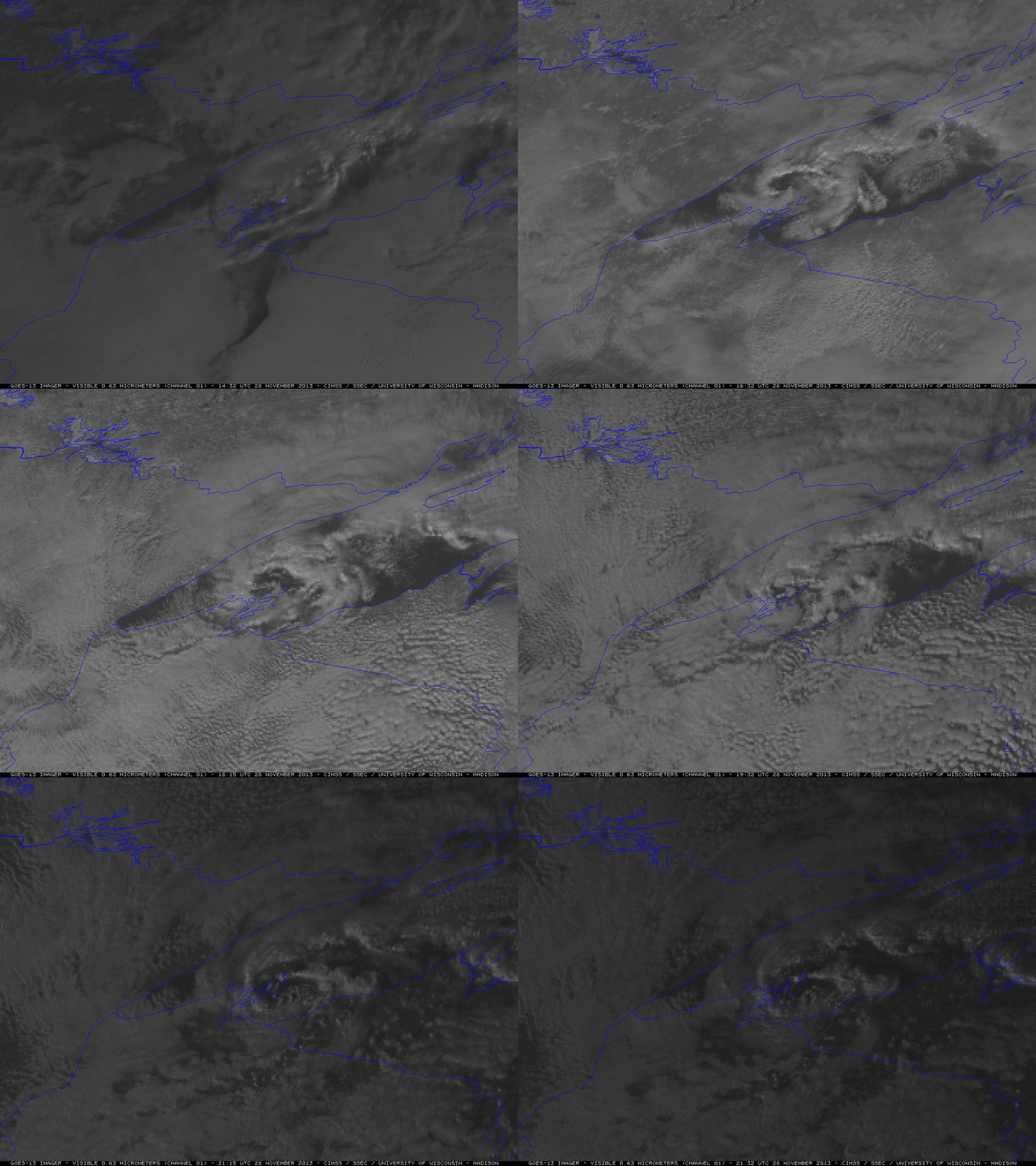
AWIPS images of GOES-13 0.63 µm visible channel data (above; click image to play animation) revealed the formation of a mesoscale vortex over far northwestern Wisconsin during the day on 26 March 2013. Overlays of MADIS 1-hour interval atmospheric motion vectors (below) showed... Read More

GOES-13 0.63 µm visible channel images (click image to play animation)

GOES-13 0.63 µm visible channel images (click image to play animation)

AWIPS images of GOES-13 0.63 µm visible channel data (above; click image to play animation) revealed the formation of a mesoscale vortex over far northwestern Wisconsin during the day on 26 March 2013. Overlays of MADIS 1-hour interval atmospheric motion vectors (below) showed that the satellite-derived winds were indicating some degree of cyclonic flow into the western portion of the mesovortex.

GOES-13 0.63 µm visible channel images with MADIS 1-hour interval atmospheric motion vectors

GOES-13 0.63 µm visible channel images with MADIS 1-hour interval atmospheric motion vectors

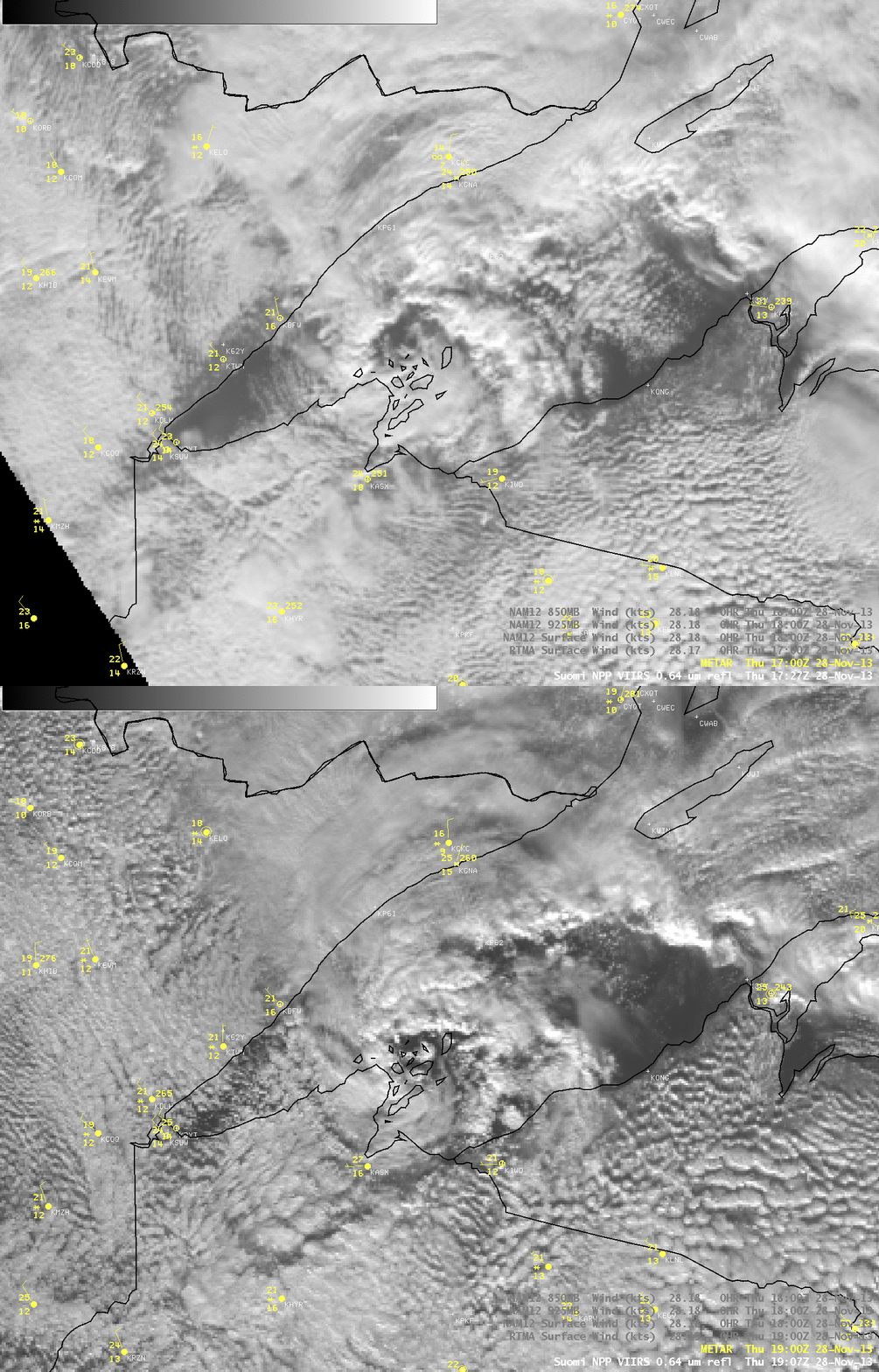
A comparison of Suomi NPP VIIRS 0.64 µm visible channel and 11.45 µm IR channel images (below) showed that the cloud elements comprising the mesoscale vortex appeared convective in nature, with many exhibiting IR cloud top brightness temperatures of -20º C or colder (light blue color enhancement). The morning rawinsonde data from Minneapolis, Minnesota indicated that a very unstable layer was present just above the surface between 950 and 750 hPa — so with a convective temperature of only 36º F the convective elements were quick to develop once surface temperatures began to warm after sunrise.

Suomi NPP VIIRS 0.64 µm visible channel and 11.45 µm IR channel images

Suomi NPP VIIRS 0.64 µm visible channel and 11.45 µm IR channel images

===== 27 April Update =====

During the following overnight hours, the cyclonic swirl signature of the mesoscale vortex could still be seen over northwestern Wisconsin at 07:53 UTC or 2:53 AM local time on the Suomi NPP VIIRS IR brightness temperature difference “fog/stratus product” (below). Due to ample illumination by a full Moon,  a “night-time visible image” provided by the corresponding 0.7 µm Day/Night Band (DNB) showed that city lights could still be seen through the low cloud deck; other features of interest on the DNB image included ice in Green Bay and a few areas along the south shore of Lake Superior, and the southern extent of the snow cover from far eastern South Dakota into southern Minnesota.

Suomi NPP VIIRS IR brightness temperature difference

Suomi NPP VIIRS IR brightness temperature difference “fog/stratus product” + 0.7 µm Day/Night Band image

View only this post Read Less