This website works best with a newer web browser such as Chrome, Firefox, Safari or Microsoft
Edge. Internet Explorer is not supported by this website.
1-minute GOES-16 (GOES-East) Mesoscale Domain Sector “Red” Visible (0.64 µm) images (above) included time-matched (+/- 3 minutes) plots of SPC Storm Reports — which showed severe thunderstorms that moved east-northeastward across parts of Texas, Oklahoma and Kansas on 26 February 2023. The hazy signature of blowing dust was apparent along the New Mexico / Texas border region, along and ahead... Read More
GOES-16 “Red” Visible (0.64 µm) images, with time-matched SPC Storm Reports plotted in red [click to play animated GIF | MP4]
1-minute GOES-16 (GOES-East) Mesoscale Domain Sector “Red” Visible (0.64 µm) images (above) included time-matched (+/- 3 minutes) plots of SPC Storm Reports — which showed severe thunderstorms that moved east-northeastward across parts of Texas, Oklahoma and Kansas on 26 February 2023. The hazy signature of blowing dust was apparent along the New Mexico / Texas border region, along and ahead of an approaching cold front.
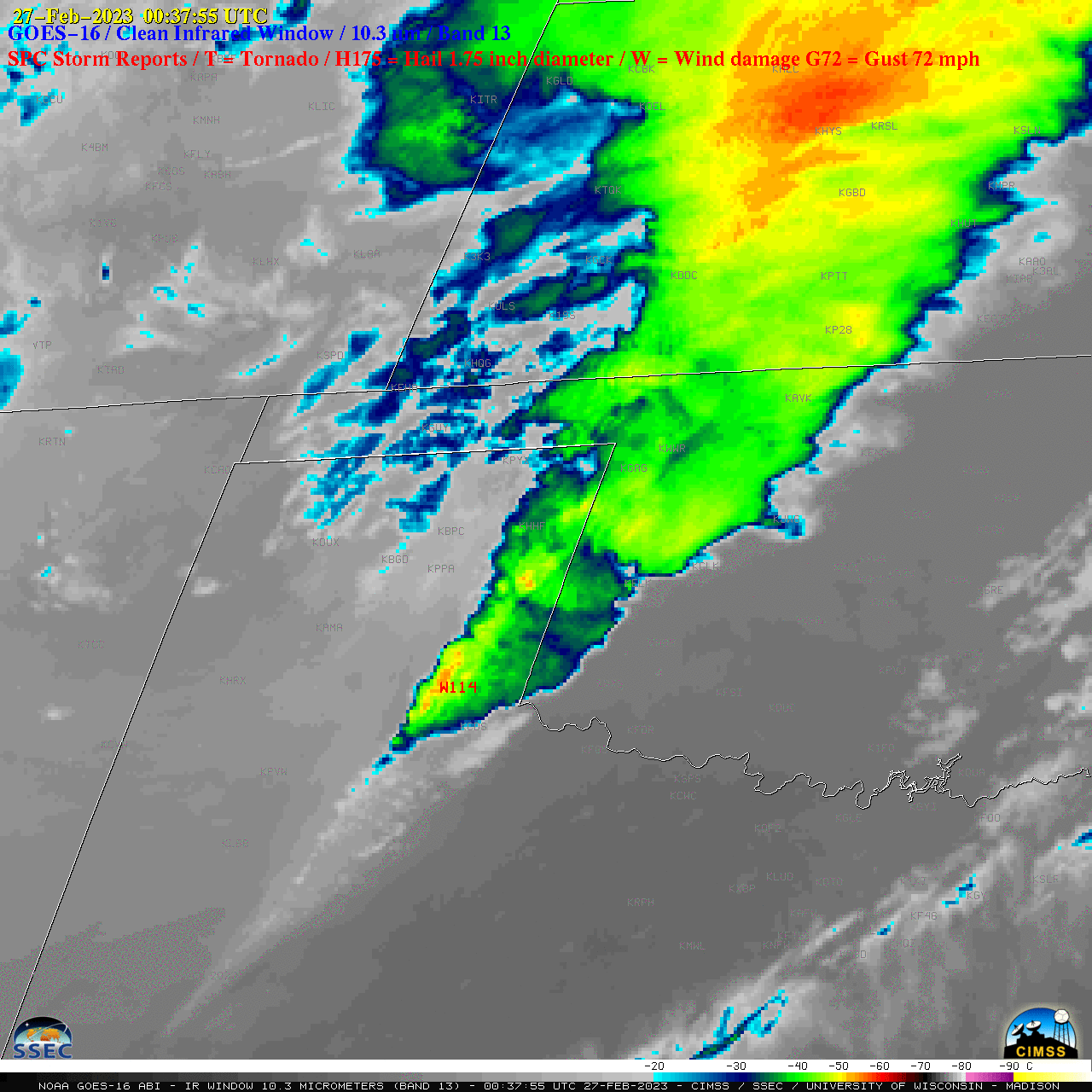
1-minute GOES-16 “Clean” Infrared Window (10.3 µm) images with plots of time-matched SPC Storm Reports (below) indicated that the coldest cloud tops associated with many of the storms exhibited infrared brightness temperatures around -60ºC range (darker red enhancement). These thunderstorms produced numerous tornadoes (the 12 in Oklahoma was a record for the month of February), hail up to 1.75 inches in diameter in Texas and Oklahoma, and damaging wind gusts as strong as 114 mph in Texas.
GOES-16 “Clean” Infrared Window (10.3 µm) images, with time-matched SPC Storm Reports plotted in red [click to play animated GIF | MP4]
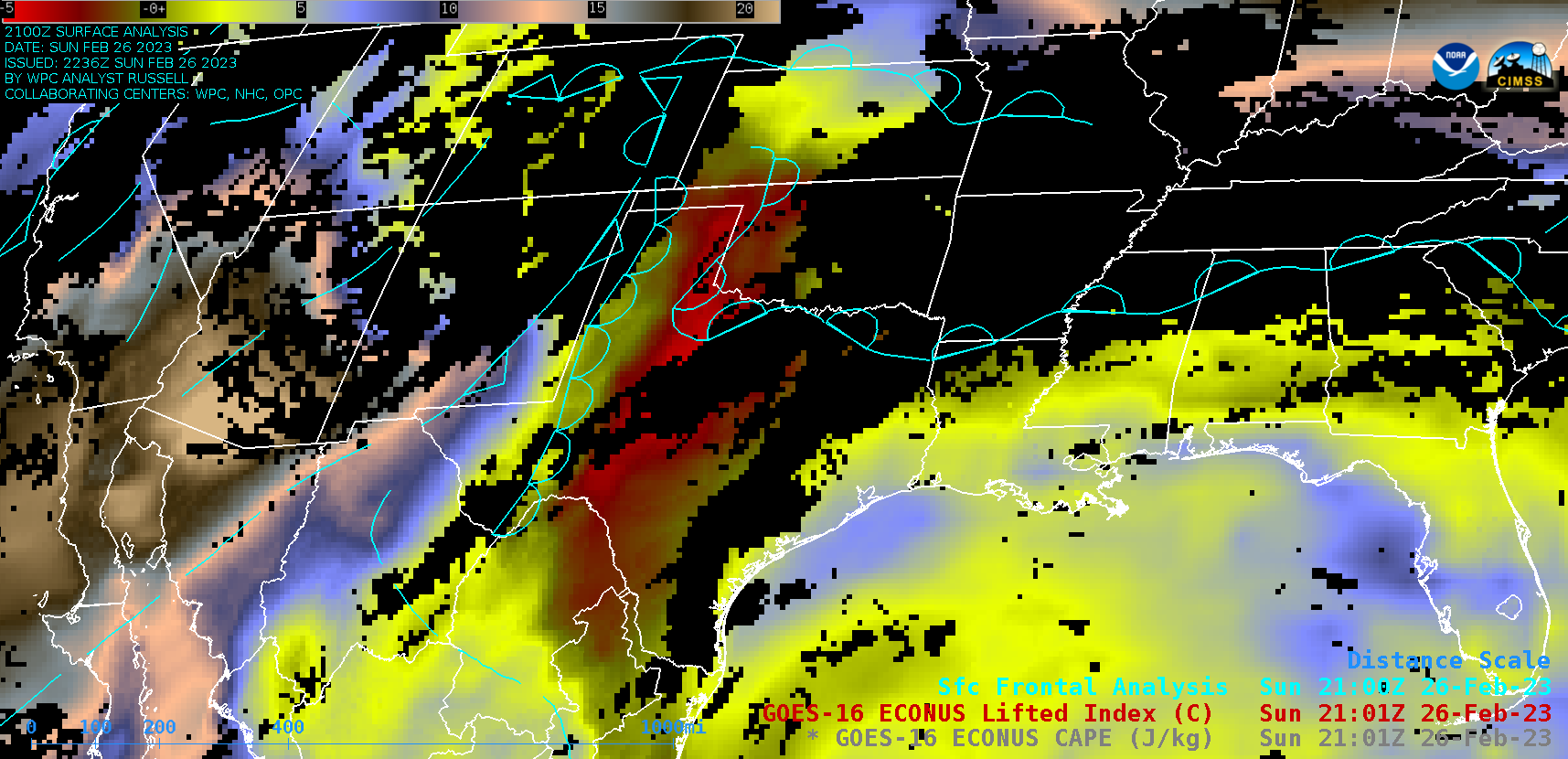
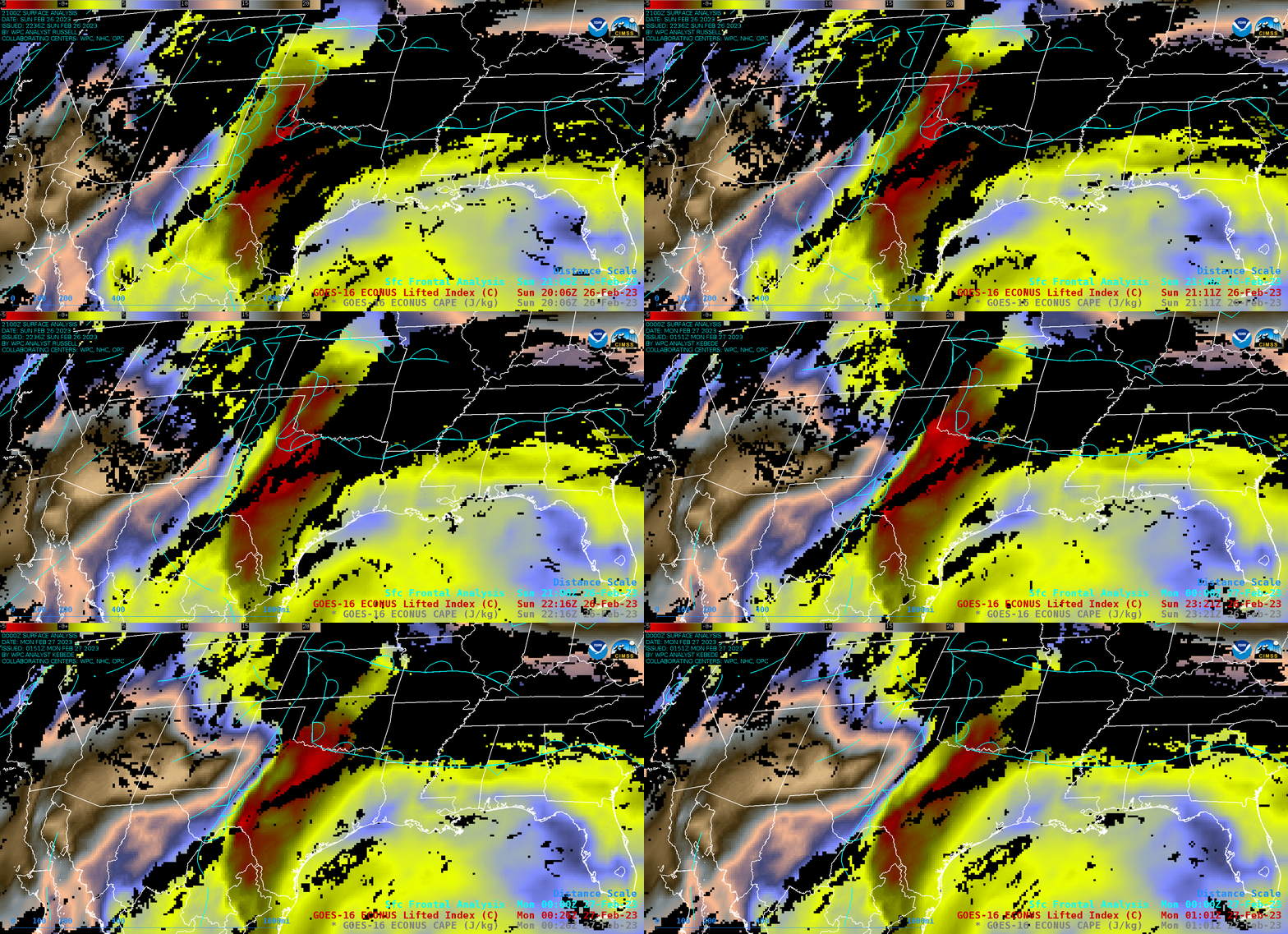
The GOES-16 Lifted Index (LI) derived product (below) displayed a corridor of instability with LI values as low as -5ºC (brighter red enhancement) extending northward from Texas into Oklahoma.
GOES-16 Lifted Index derived product, with surface fronts plotted in cyan [click to play animated GIF | MP4]
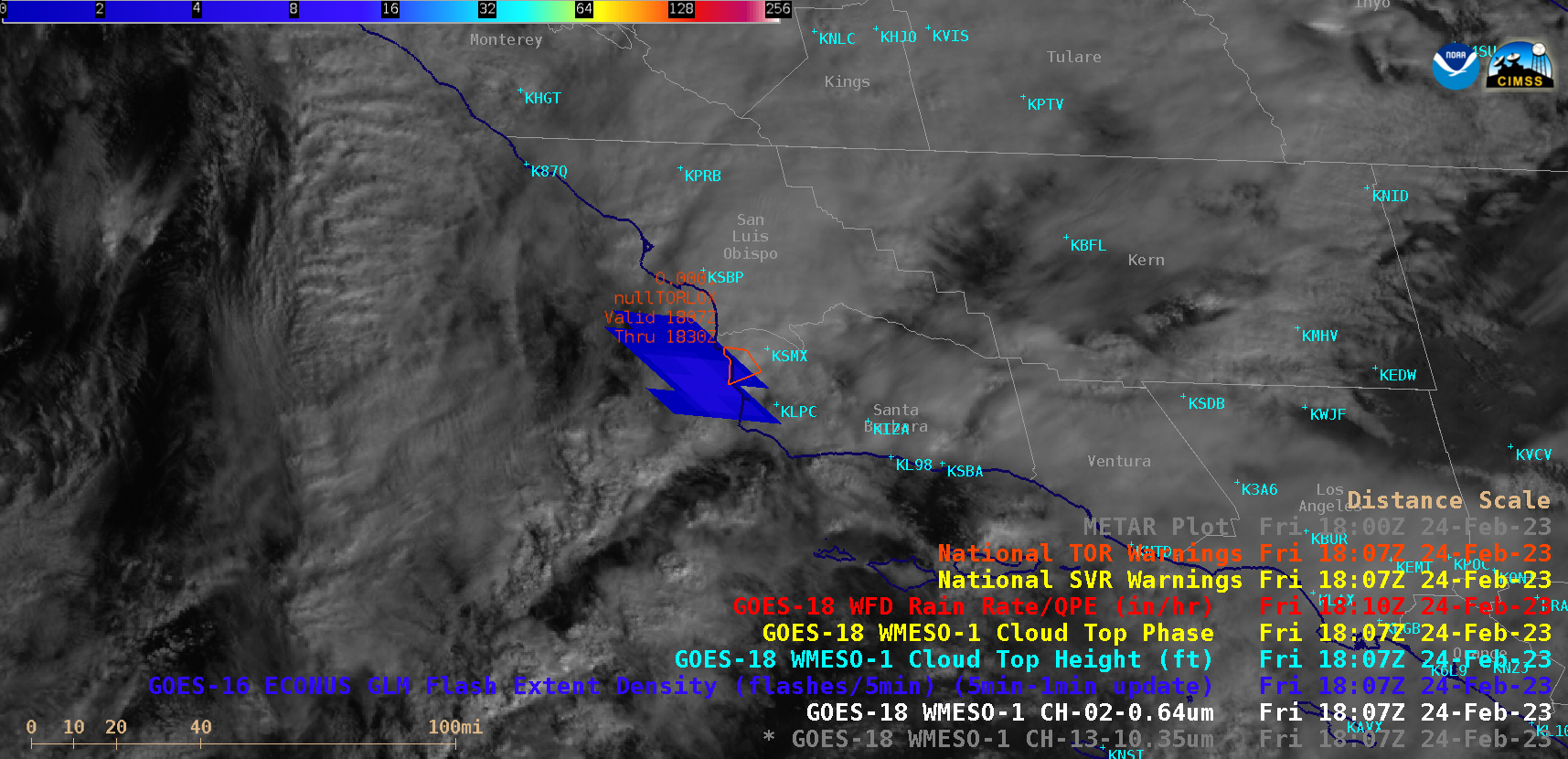
1-minute Mesoscale Domain Sector GOES-18 (GOES-West) “Red” Visible (0.64 µm) and “Clean” Infrared Window (10.3 µm) images (above), with and without an overlay of GLM Flash Extent Density, showed convection moving onshore in Southern California during the late morning hours on 24 February 2023 — which prompted NWS Los Angeles to issue a Tornado Warning at 1807... Read More
GOES-18 “Red” Visible (0.64 µm) and “Clean” Infrared Window (10.3 µm) images, with/without an overlay of GLM Flash Extent Density [click to play animated GIF | MP4]
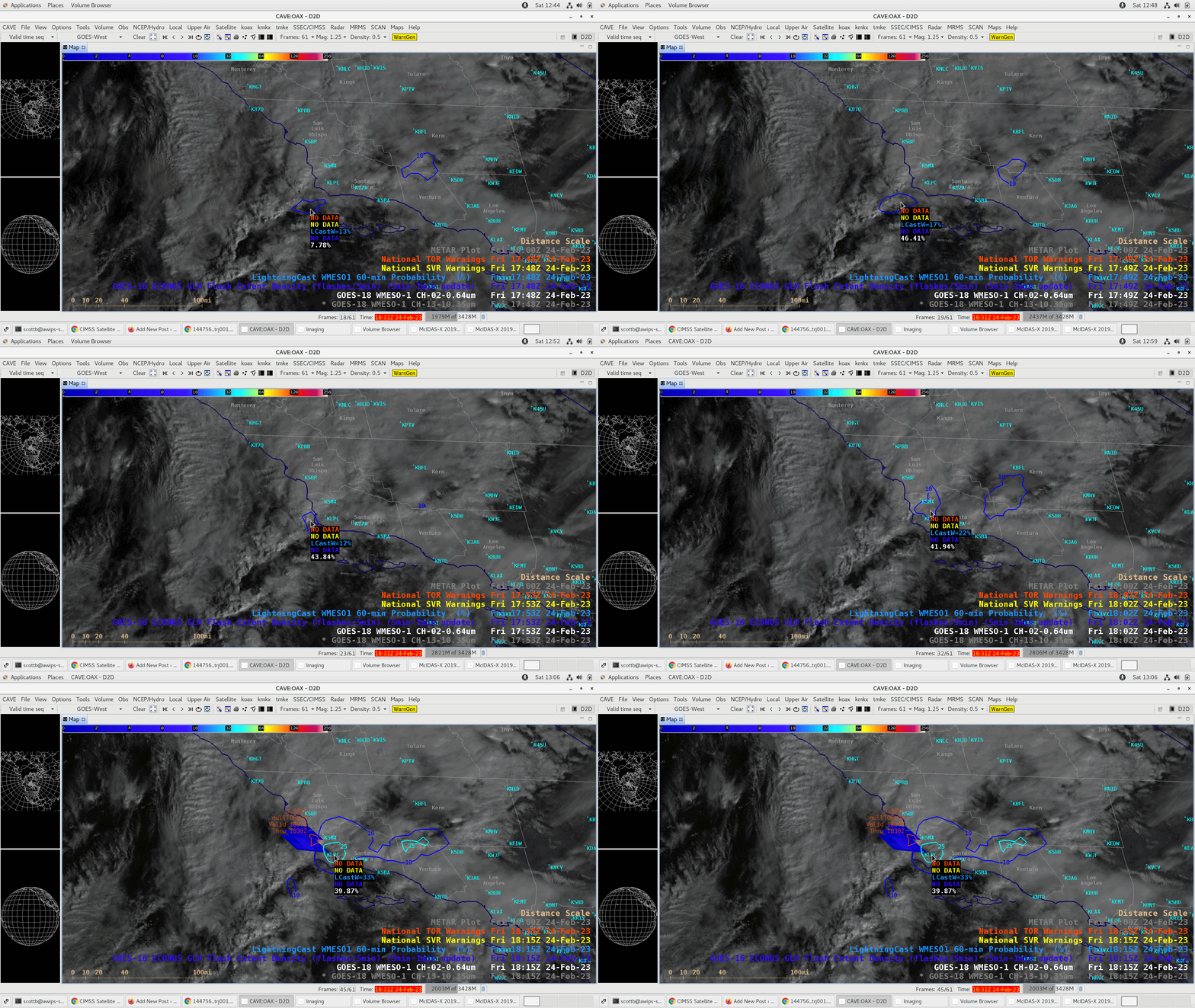
1-minute Mesoscale Domain Sector GOES-18 (GOES-West) “Red” Visible (0.64 µm) and “Clean” Infrared Window (10.3 µm) images (above), with and without an overlay of GLM Flash Extent Density, showed convection moving onshore in Southern California during the late morning hours on 24 February 2023 — which prompted NWS Los Angeles to issue a Tornado Warning at 1807 UTC. There was a notable lightning jump that began at 1803 UTC, 4 minutes prior to the issuance of the Tornado Warning.
GOES-18 “Red” Visible (0.64 µm) images, with an overlay of GLM Flash Extent Density and contours of LightningCast Probability [click to play animated GIF | MP4]
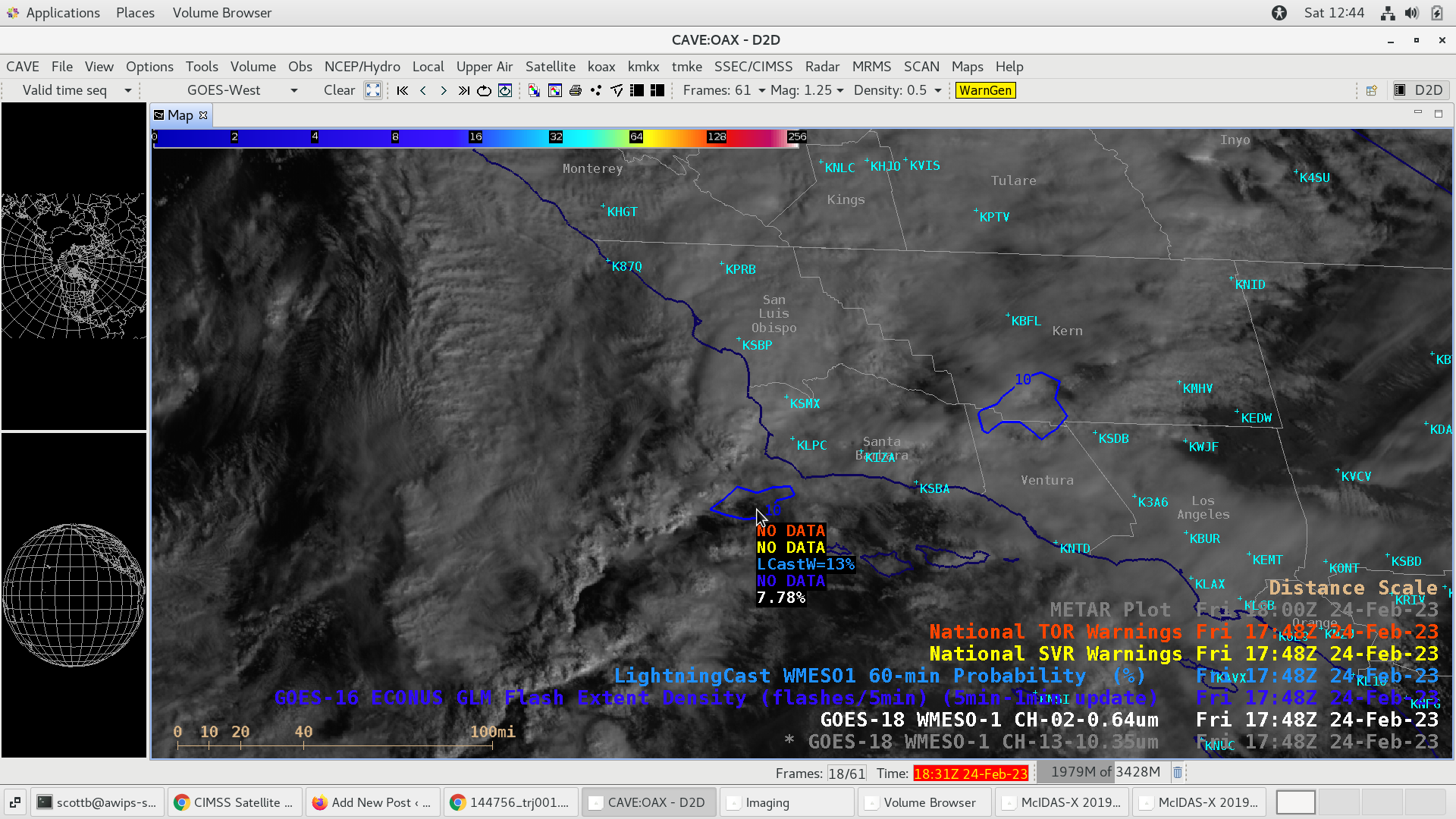
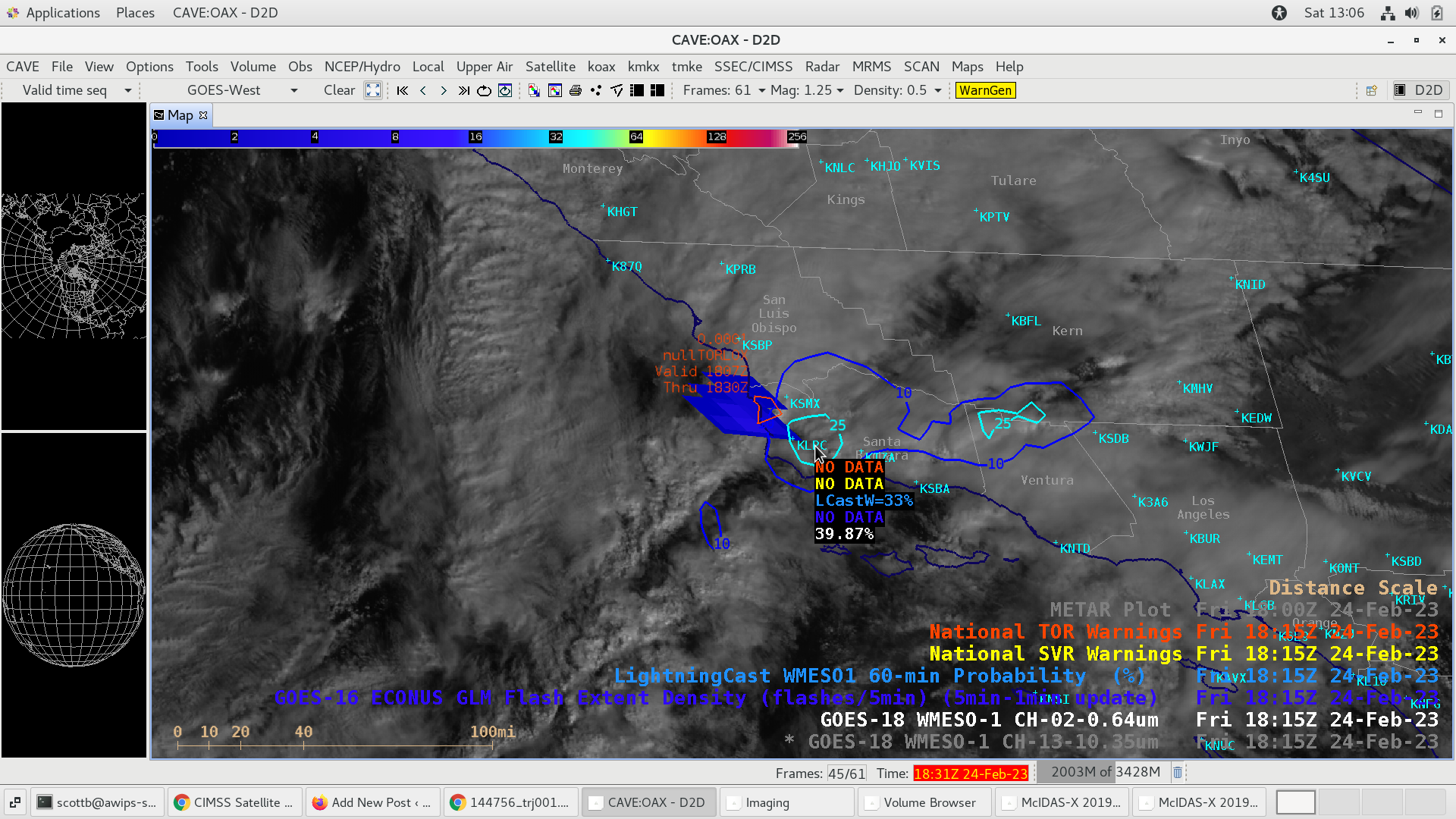
1-minute GOES-18 Visible images (above) include contours of LightningCast Probability. Cursor-sampled maximum values of LightningCast Probability within each contour (below) indicated that while the offshore probability values were fairly low (ranging from 12% to 22%), they did begin to appear as early as 1748 UTC (19 minutes prior to the Tornado Warning) — and probability values increased to a more modest 33% at 1815 UTC as the tornado-warned storm moved farther inland (and the aforementioned lightning jump was still underway).
GOES-18 “Red” Visible (0.64 µm) images, with an overlay of GLM Flash Extent Density — and cursor-sampled values of LightningCast Probability [click to enlarge]
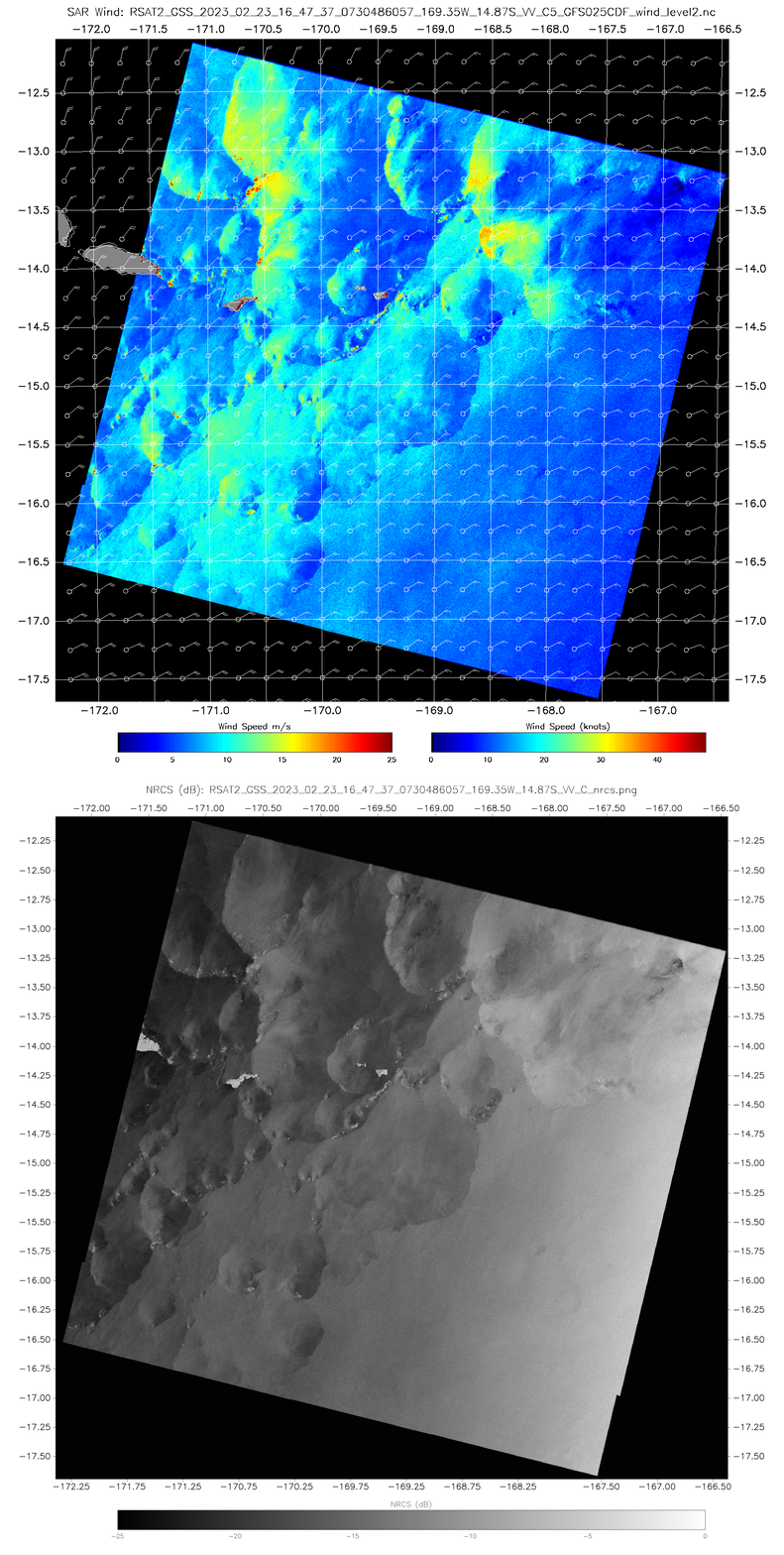
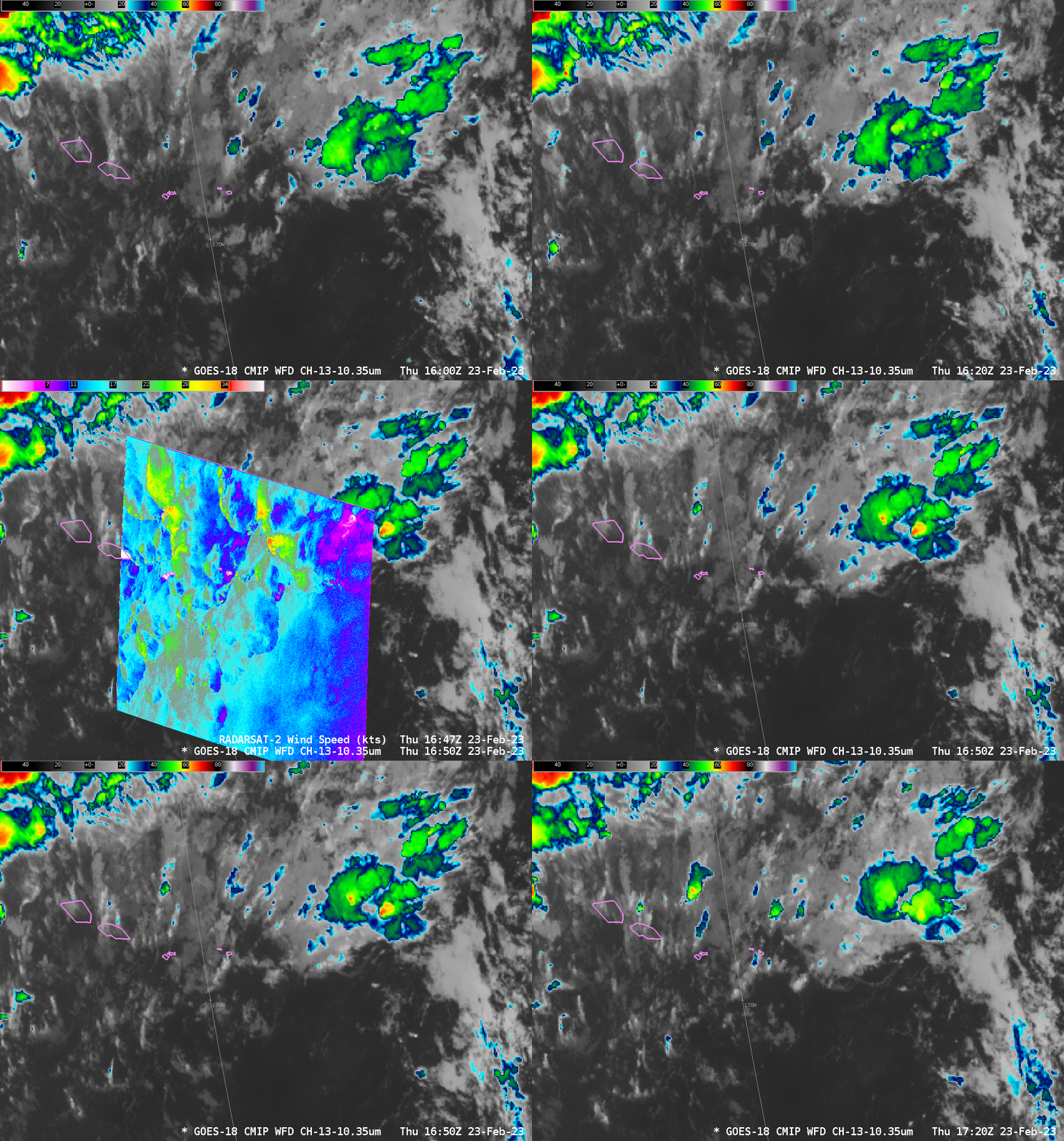
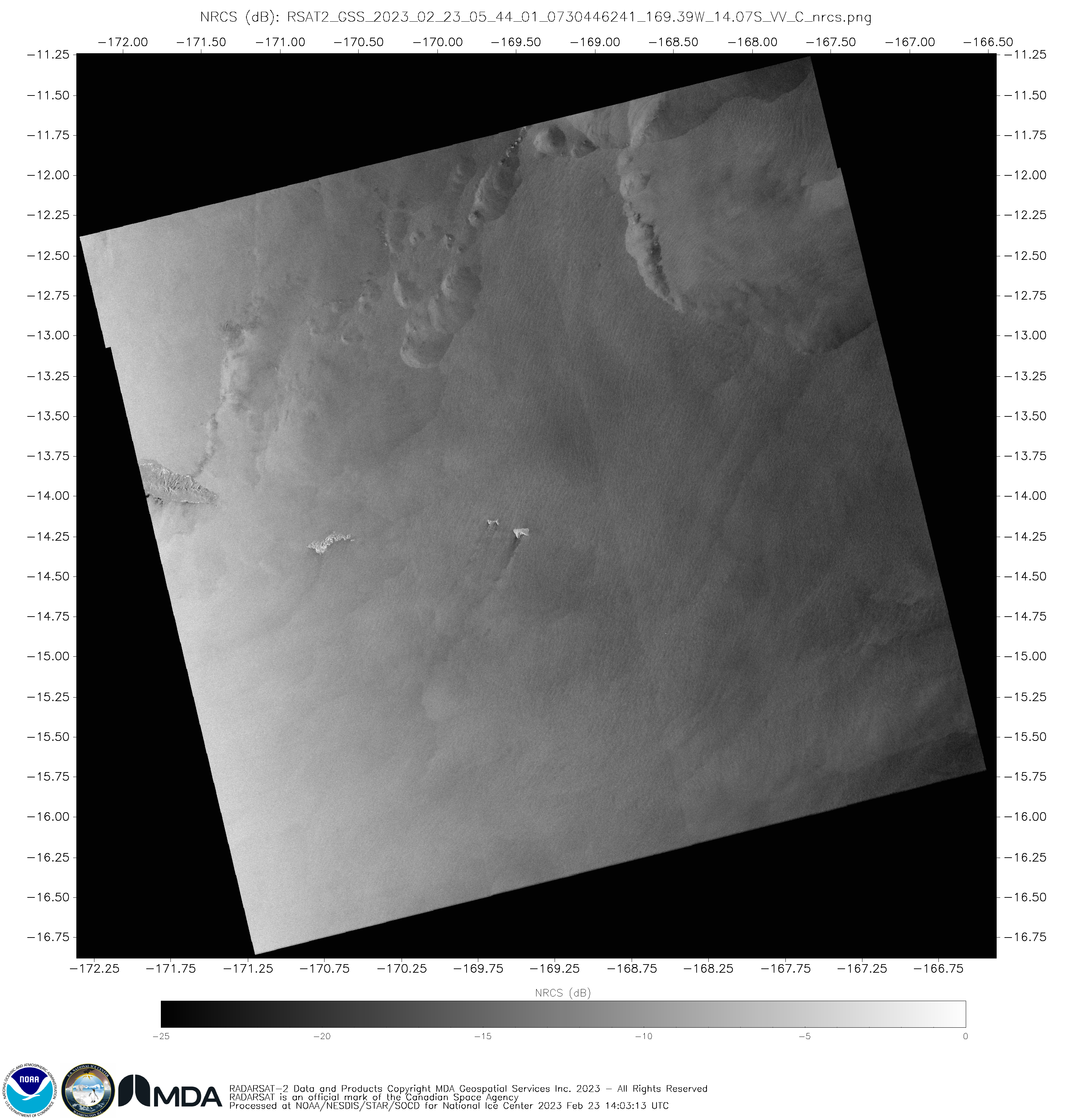
A second pair of SAR observations occurred on 23 February, one at 0544 UTC (above) and one at 1647 UTC (below). The character of the two scenes is quite different. The 0544 UTC wind imagery and NRCS imagery (from this site) shows a mostly quiescent scene with widespread northeasterly winds. One arc of winds... Read More
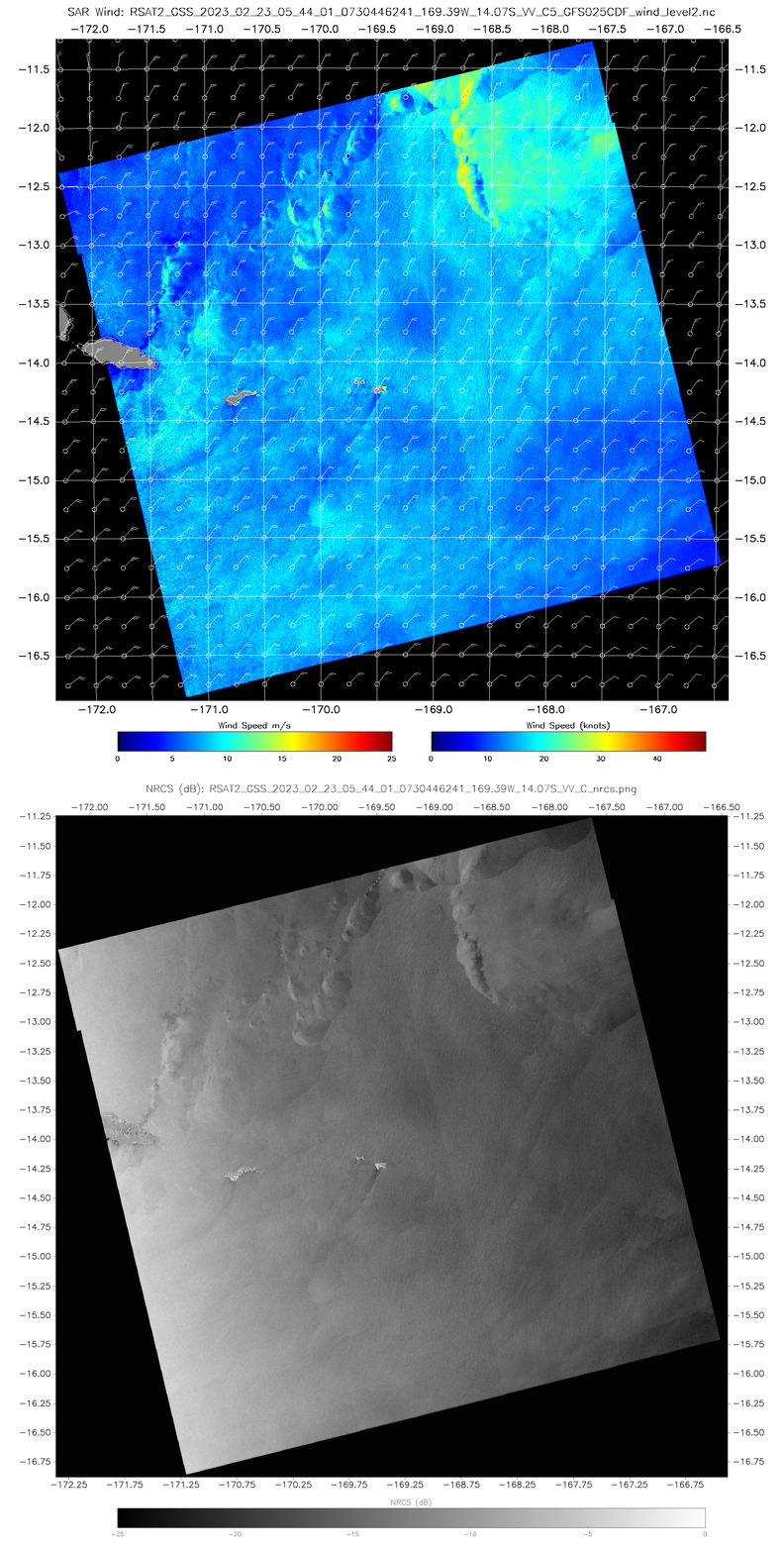
RADARSAT-2 derived SAR Winds and Normalized Radar Cross Section (NRCS), 0544 UTC on 23 February 2023 (Click to enlarge)
A second pair of SAR observations occurred on 23 February, one at 0544 UTC (above) and one at 1647 UTC (below). The character of the two scenes is quite different. The 0544 UTC wind imagery and NRCS imagery (from this site) shows a mostly quiescent scene with widespread northeasterly winds. One arc of winds just west of 12.25oS, 168.5oW is present with peak winds in excess of 40 knots; the NRCS does not show any of the structures that might suggest that high wind observations is influenced by ice within the cloud.
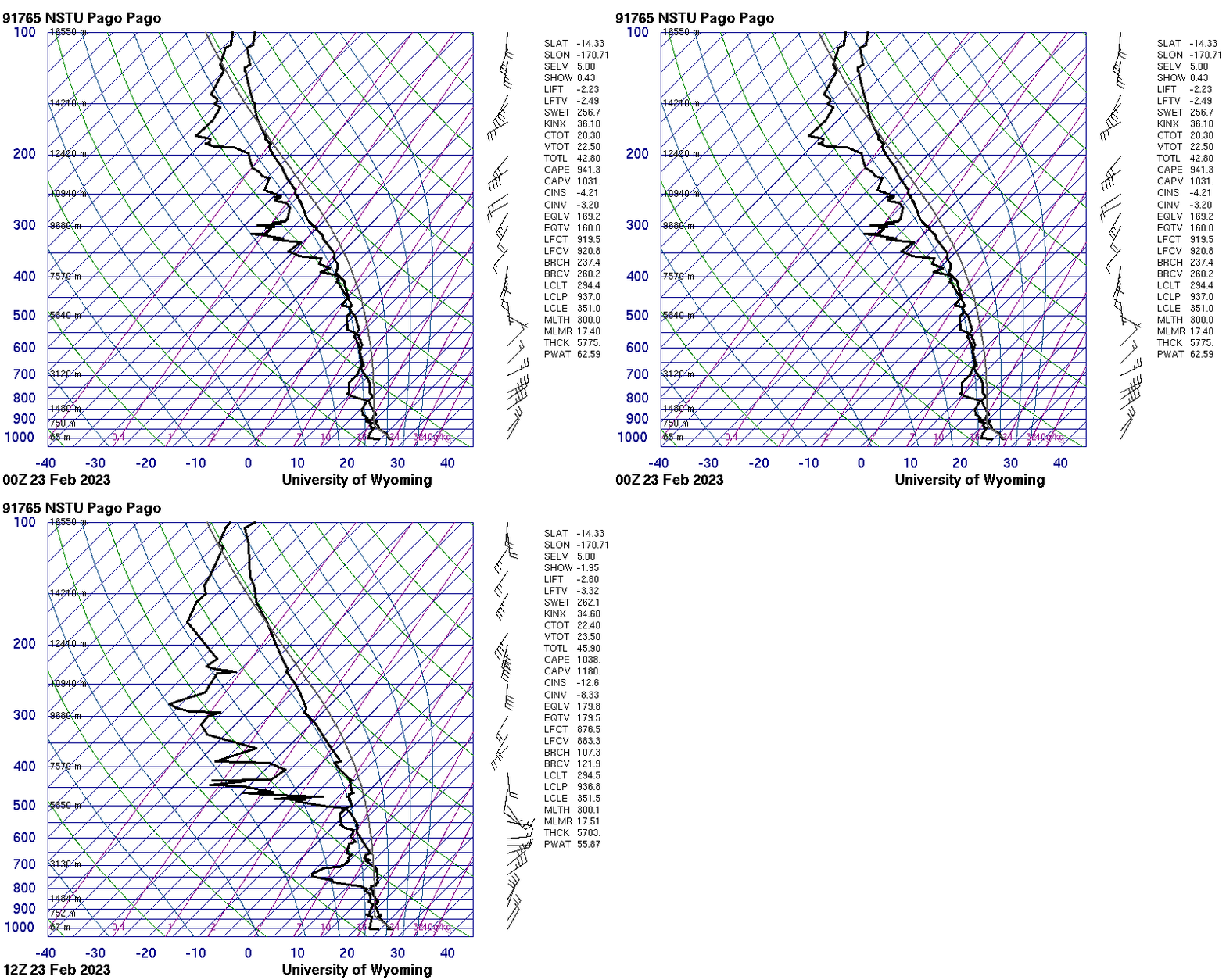
In contrast to previous SAR wind scenes over American Samoa (here, here, here, here, here), the scene above shows a long downstream ‘tail’ to the island influence on the wind from both Tutuila and the Man’ua Islands (Ofu/Olosega and Ta’u). Perhaps this is due to the lack of convection at 0544 UTC. However, the 0000 UTC and 1200 UTC soundings from Pago Pago (from this site), shown below, show a developing low-layer stable layer — between 700-800 mb — that might trap the effect of the wind at lower layers, allowing it to persist.
SkewT/Log P plots from NSTU at 0000 and 1200 UTC on 23 February 2023 (Click to enlarge)
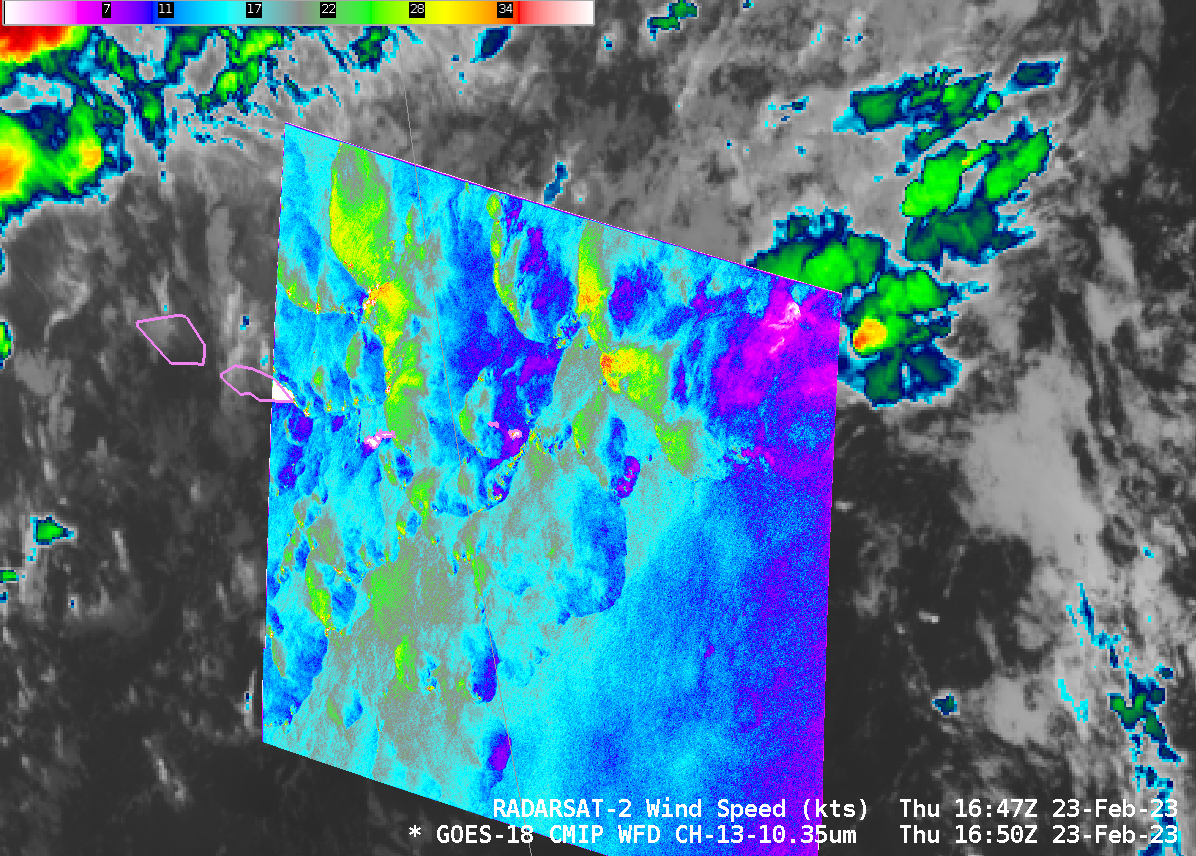
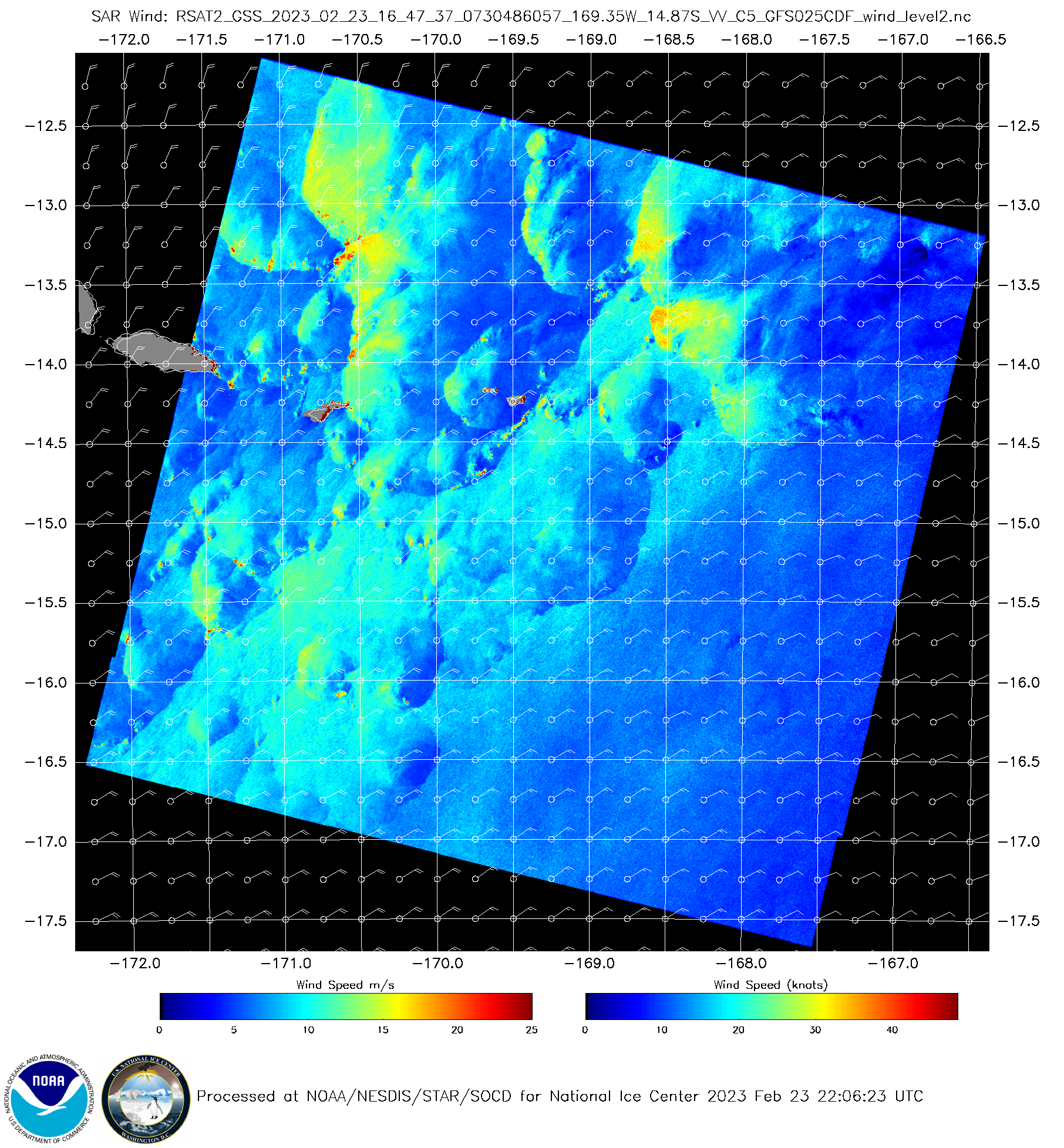
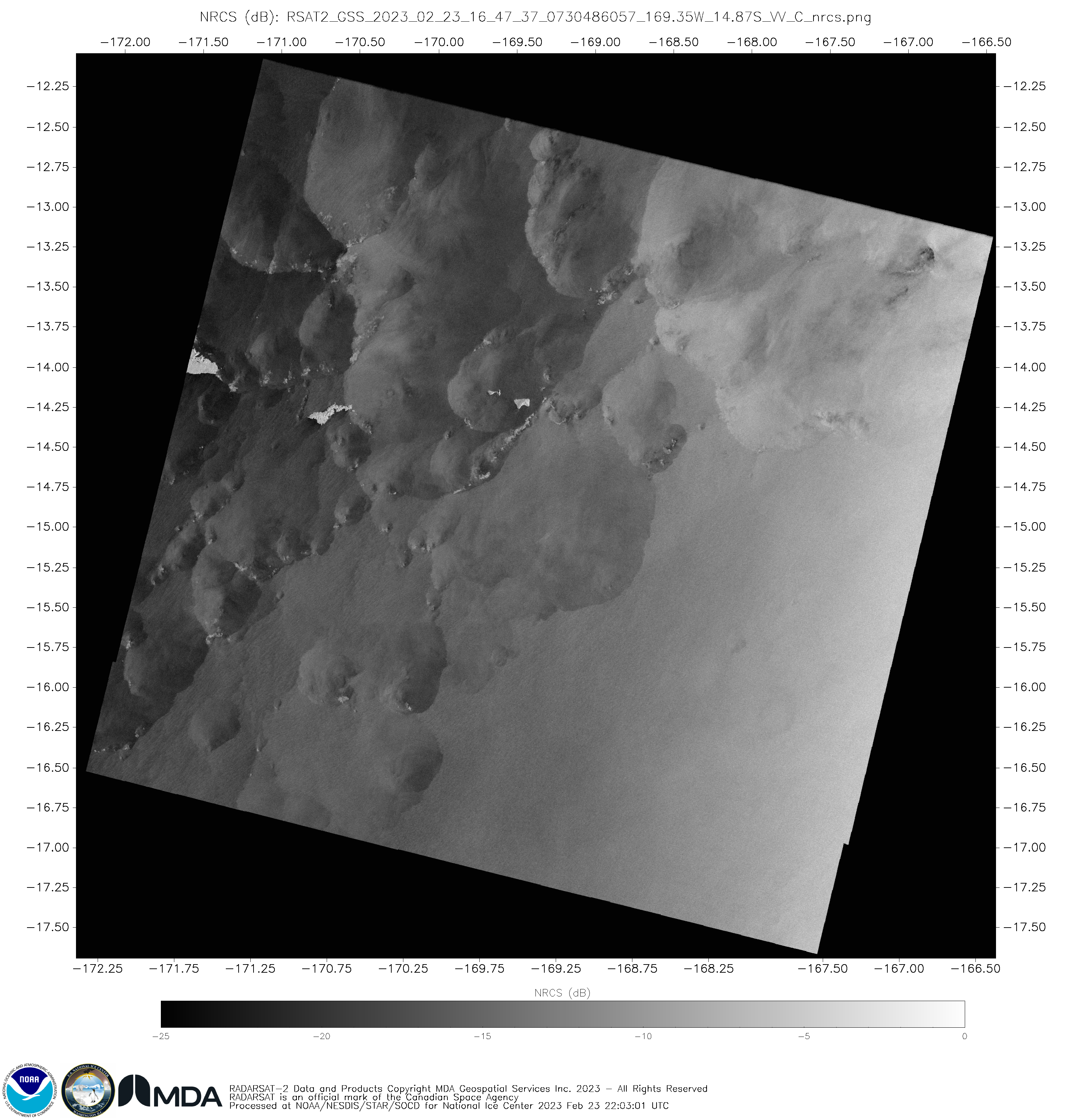
The 1647 UTC SAR winds, below, (both the winds and the NRCS data, both from this site), show a much more chaotic scene suggestive of widespread shower activity. In addition, the NRCS data at this time does include features that suggest ice within clouds (widespread, in fact, near 13.25oS, 170.6oW that will affect derived wind speeds.
RADARSAT-2 derived SAR Winds and Normalized Radar Cross Section (NRCS), 1647 UTC on 23 February 2023 (Click to enlarge)
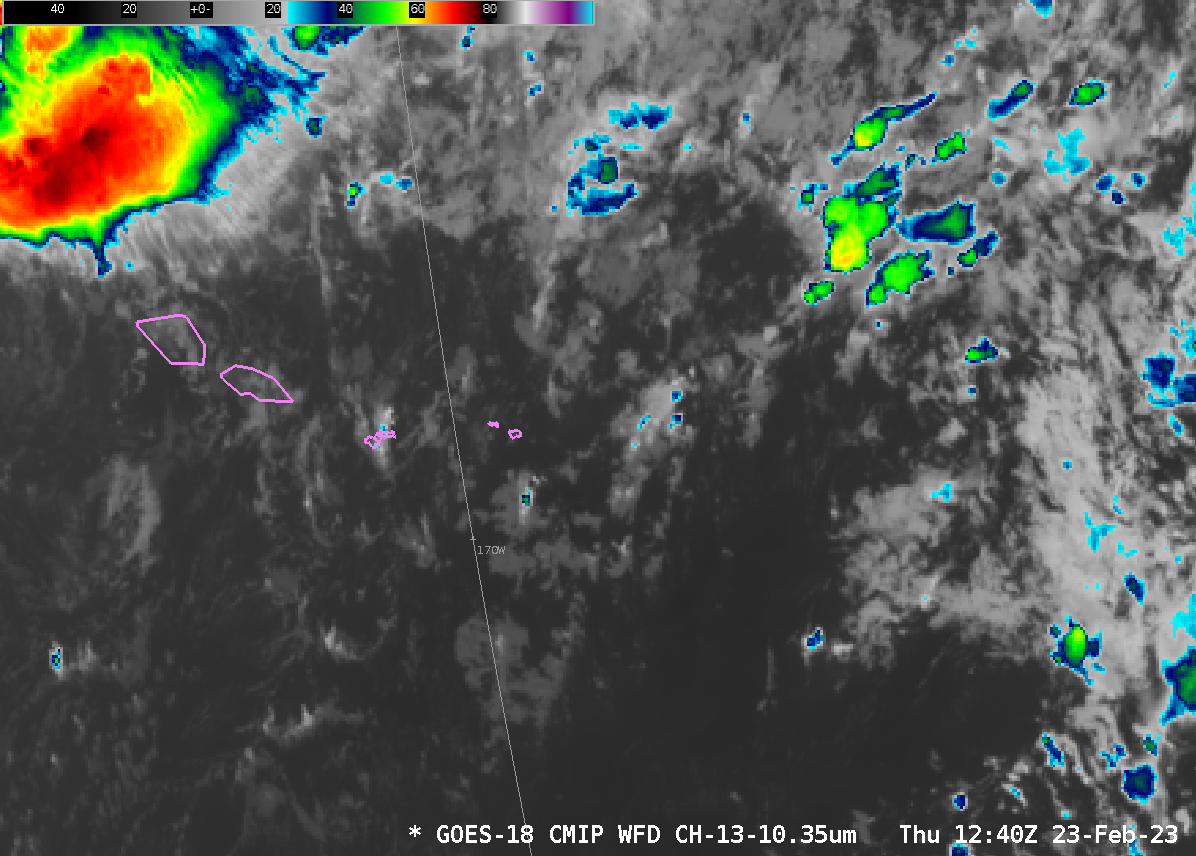
Given the SAR winds above, what do you think the GOES-18 Clean Window infrared (Band 13, 10.3 µm) imagery looks like? The animation below, from 0400 to 1800 UTC on 23 February, including toggles that show the SAR winds (click here for an animation without the SAR wind overlays) spans the two times above. A couple of features stand out, especially an low-level boundary that becomes apparent near 1200 UTC and propagates southwestward to near Ta’u at 1800 UTC. Intermittent convection forms along its leading boundary. Intermittent convection is producing orphan anvils to the south of the Samoan islands during much of the animation.
Added: one might make an argument that the arced feature at 0544 UTC propagates eastward and is assoicated with the north-south band that intersects Tutuila around 1240 UTC and Upolu (the eastern of the two main islands of Western Samoa) around 1530 UTC. In both cases, the line results in convection that is a bit more vigorous.
GOES-18 Band 13 infrared (“Clean Window”, 10.3 µm), 0400-1800 UTC on 23 February 2023, along with SAR wind observations at 0544 and 1647 UTC (click to enlarge)
The orphan anvil features are easily seen in the Night Microphysics RGB, below (using imagery from the CSPP Geosphere site; direct link to the animation), as bright red evanescent features that move northward (in contrast to the southwestward motion of the lower clouds).
Night Microphysics RGB 1200 – 1630 UTC on 23 February 2023
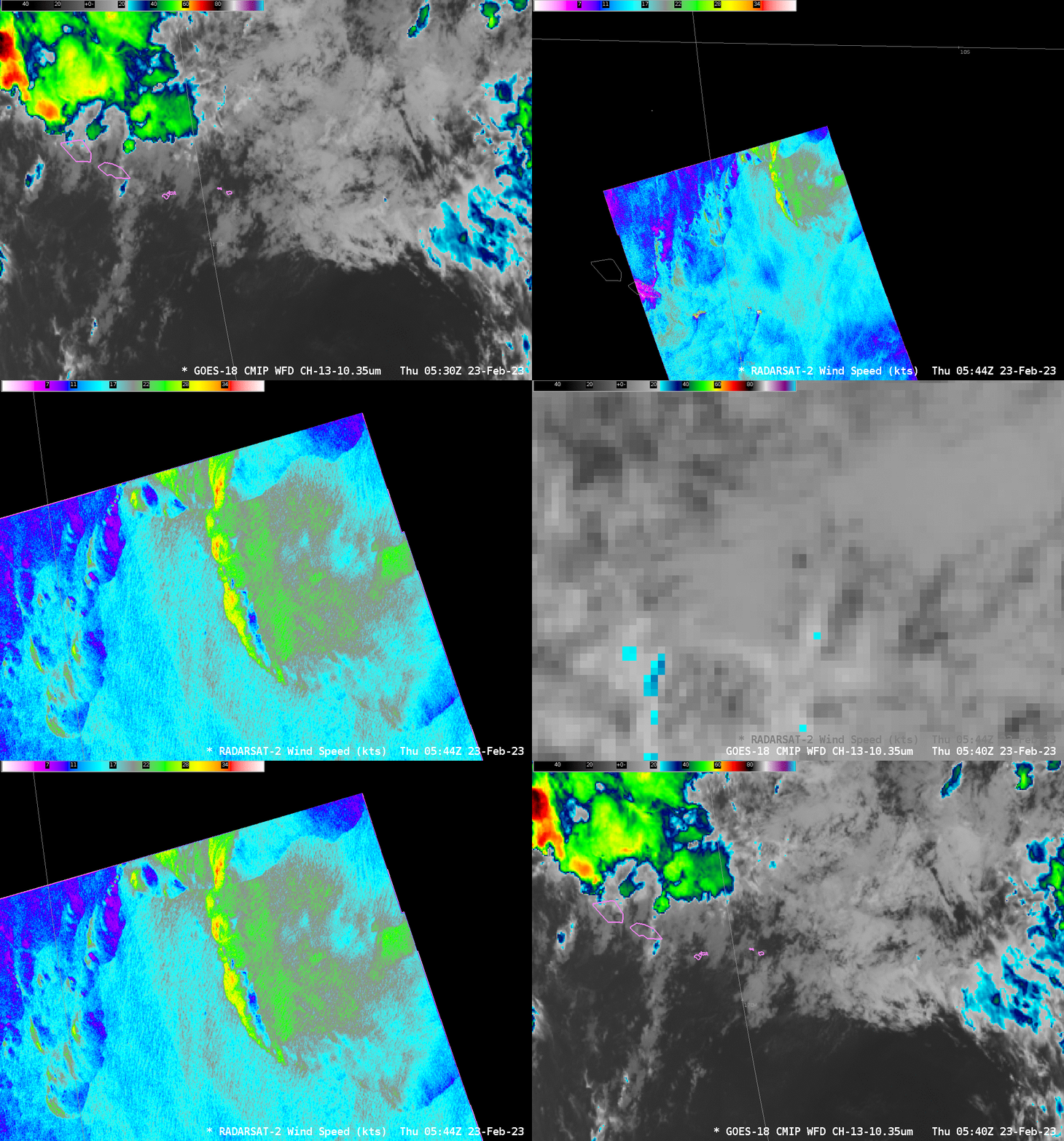
The imagery below compares the GOES-18 clean window infrared imagery to SAR winds. AT 0540 UTC, it is very difficult to relate surface SAR features to infrared imagery.
GOES-18 Clean Window infrared (band 13, 10.3 µm) imagery, 0530 and 0540 UTC as well as SAR winds at 0544 UTC (Click to enlarge)
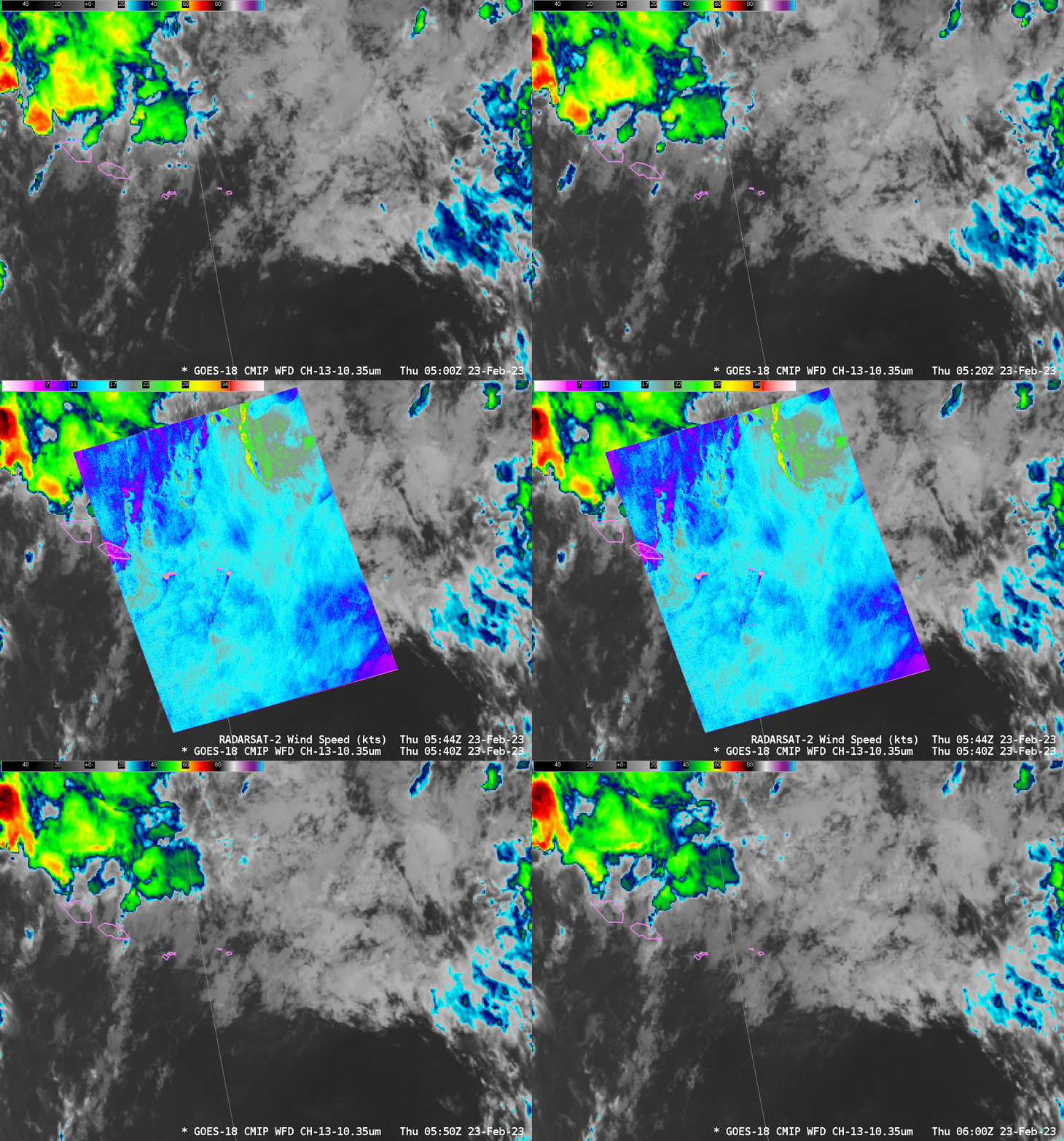
Careful inspection of the Band 13 (10.3 µm) animation between 0500 and 0600 UTC, below, does reveal a cooler cloud top aligned with the northern segment of the arc of stronger SAR winds. It would be difficult indeed to highlight a region of enhanced surface winds with just the GOES-18 data however!
GOES_18 Band 13 Clean Window infrared (10.3 µm), 0500-0600 UTC along with SAR winds at 0544 UTC (Click to enlarge)
There is a better-defined relationship between the GOES and SAR data at 1647 UTC? Wind maxima are linked to features in the GOES-18 imagery. However, not all cloud-top features in the ABI data are linked to SAR wind maxima. The challenge for a forecaster is to learn when the linkage exists.
GOES_18 Band 13 Clean Window infrared (10.3 µm), 1600-1720 UTC along with SAR winds at 1647 UTC (Click to enlarge)
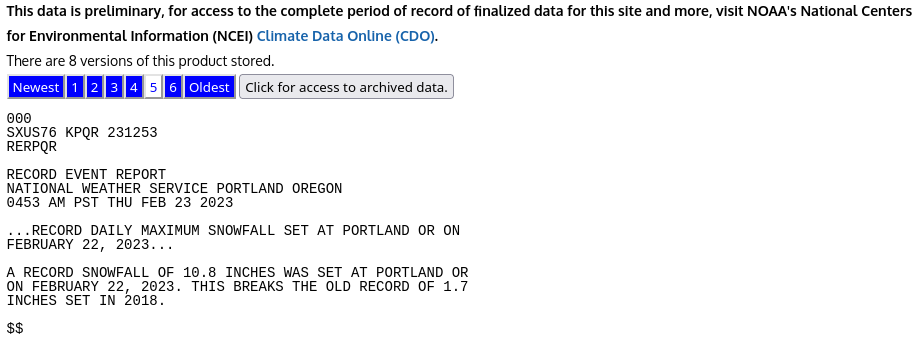
Portland OR had a snowfall of 5.3″ on 22 February 2023, a record for the date. (Update! The snow on 22 February ended up being 10.8″, the second snowiest day of record!) The GOES-18 Clean Window Infrared (10.3) imagery animation, above, taken from the CSPP Geosphere site (direct link to animation) shows the system responsible... Read More
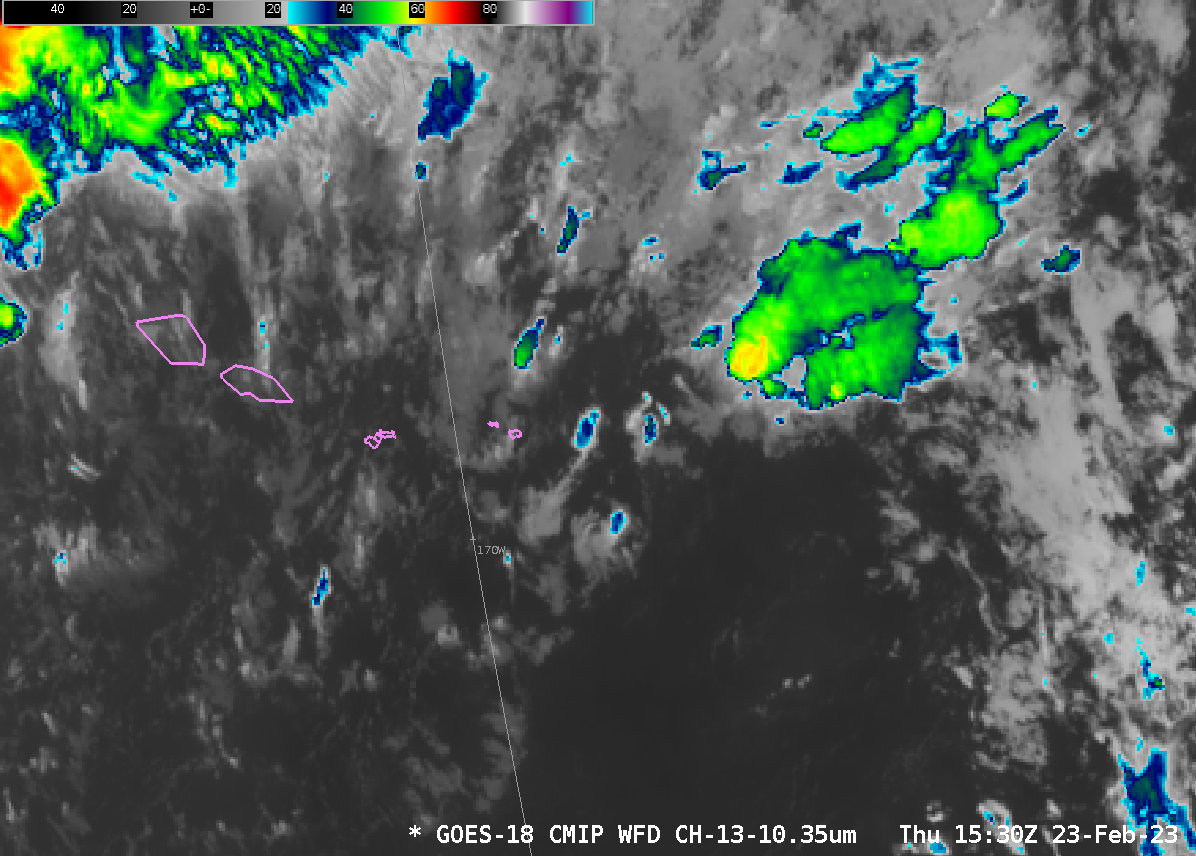
GOES-18 Band 13 (“Clean Window”) infrared (10.3 µm) imagery, 0201 – 0426 UTC on 23 February 2023
Portland OR had a snowfall of 5.3″ on 22 February 2023, a record for the date. (Update! The snow on 22 February ended up being 10.8″, the second snowiest day of record!) The GOES-18 Clean Window Infrared (10.3) imagery animation, above, taken from the CSPP Geosphere site (direct link to animation) shows the system responsible for the precipitation. Colder higher clouds (lighter grey in the enhancement) over western Oregon are moving northward while low clouds (darker grey in the enhancement) over the Pacific are moving southeastward.
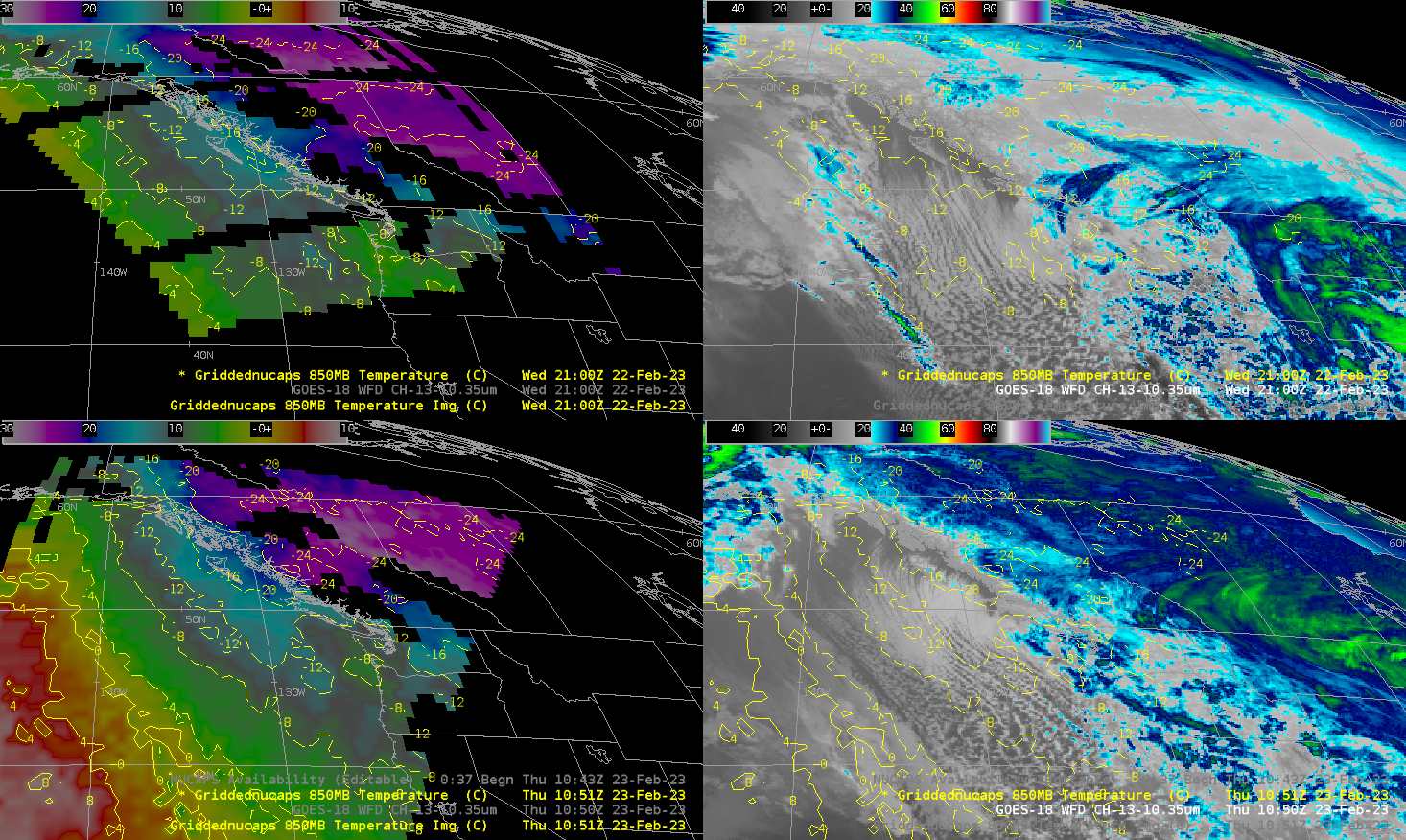
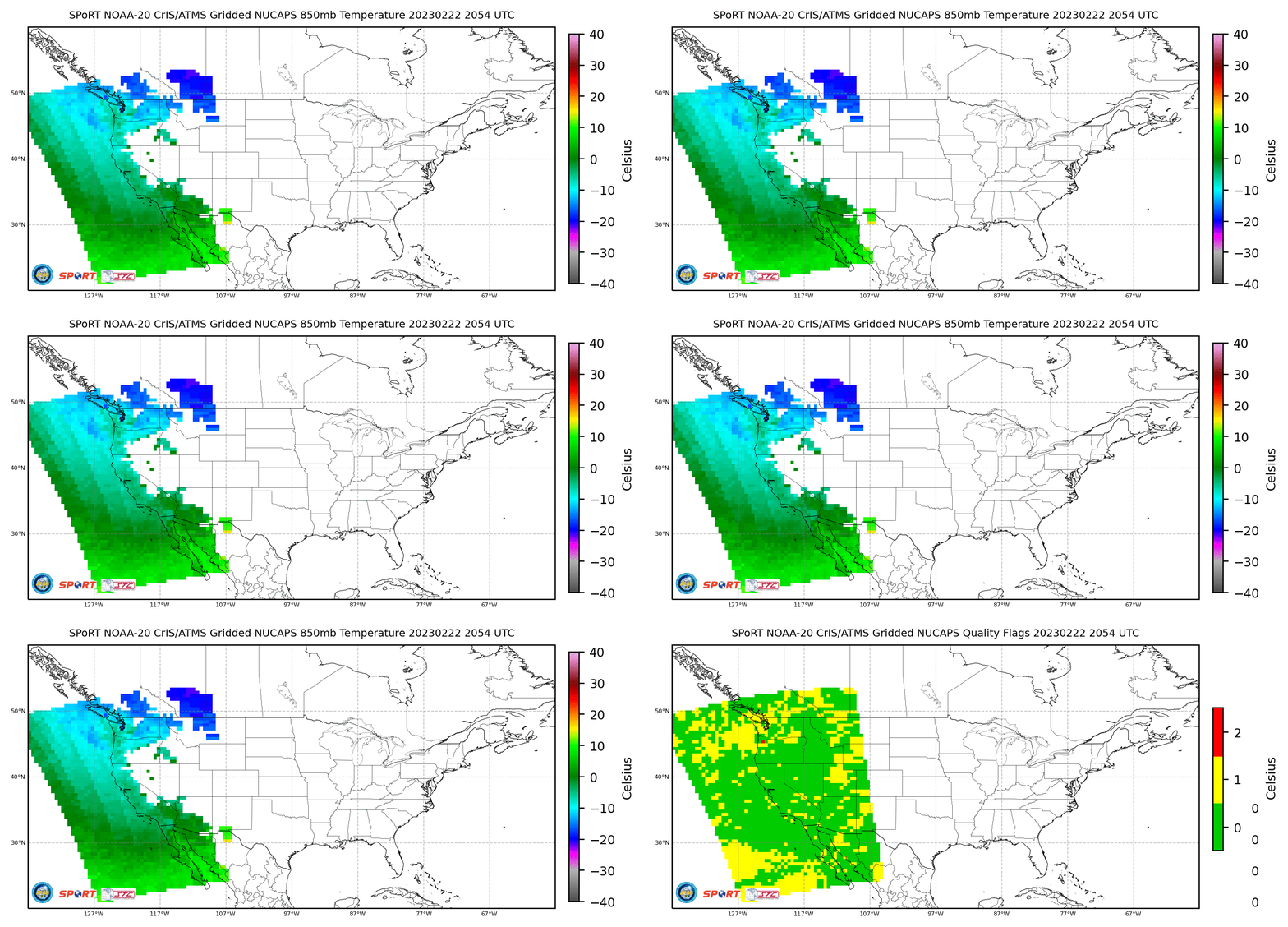
What satellite-based products could be used with this system to monitor the strength of the cold air? The 4-panel below shows gridded NUCAPS 850-mb temperature fields derived from NOAA-20 data from overpasses at 2100 UTC on 22 February and at 1051 UTC on 23 February. GOES-18 Band-13 imagery at the same time are shown. A large region of -10oC air is off the coast of Oregon late on the 22nd, and it persists through the morning of the 23rd. Use of gridded NUCAPS fields can give information about the atmosphere out over oceans where land-based (“conventional”) observations are sparse.
Gridded NUCAPS Temperatures at 850 mb (left) overlain on top of GOES-18 Band 13 imagery (right) at 2100 UTC 22 February 2023 (top) and 1051 UTC 23 February 2023 (bottom)
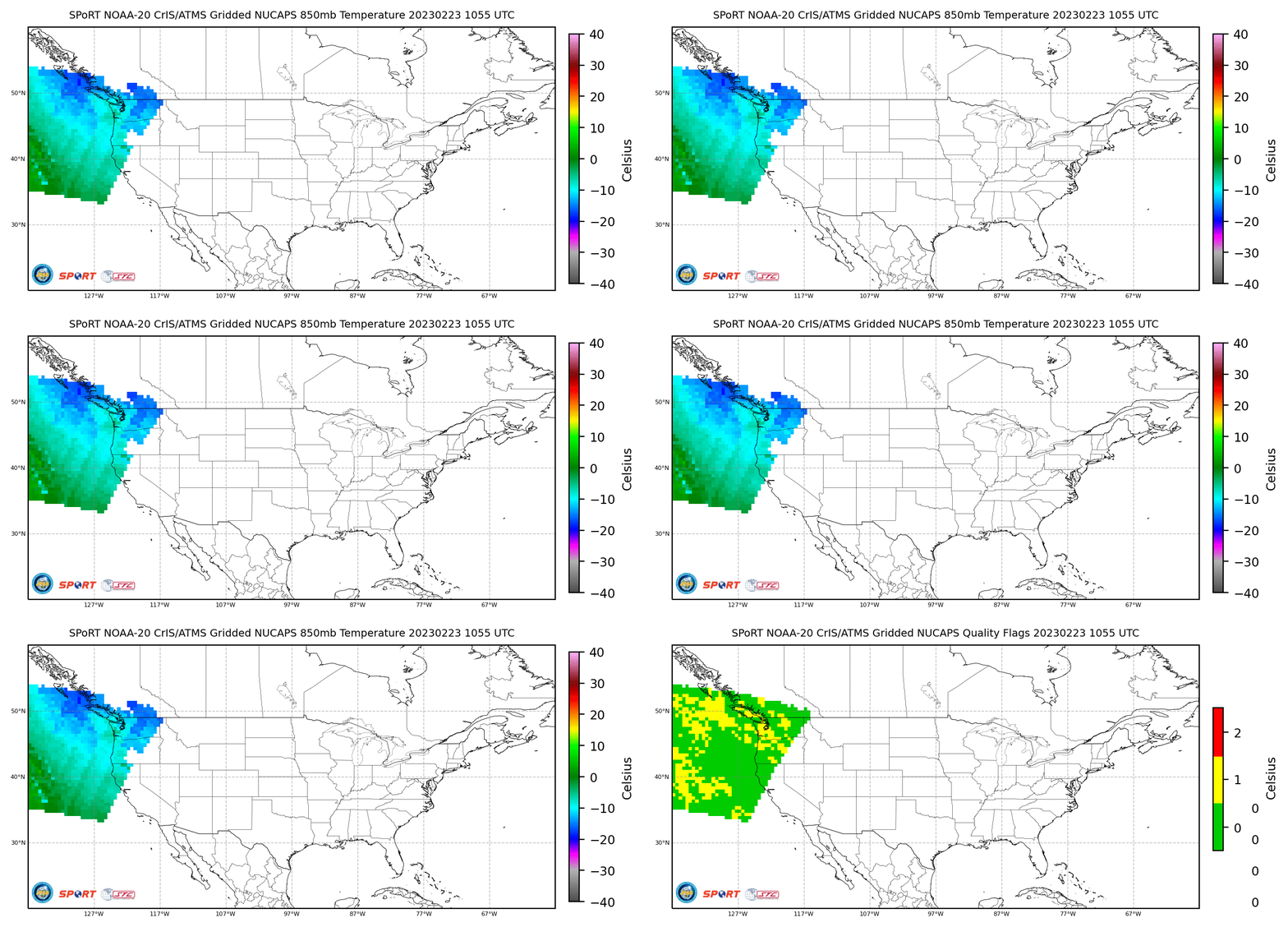
Gridded NUCAPS fields are available online. The toggle below shows the 1055 UTC 23 February 2023 gridded 850-mb Temperatures (along with NUCAPS quality flags), taken from this site. (You can also find gridded NUCAPS fields here). Here is a similar toggle from 2100 UTC on 22 February 2023.
Gridded NUCAPS 850-mb Temperature, 1055 UTC on 23 February 2023, toggled with NUCAPS Quality Flags at the same time (Green: Infrared and Microwave retrievals converged to a solution; Yellow: Infrared retrieval failed, microwave retrieval converged to a solution; Red: Infrared and Microwave retrievals both failed to converge)
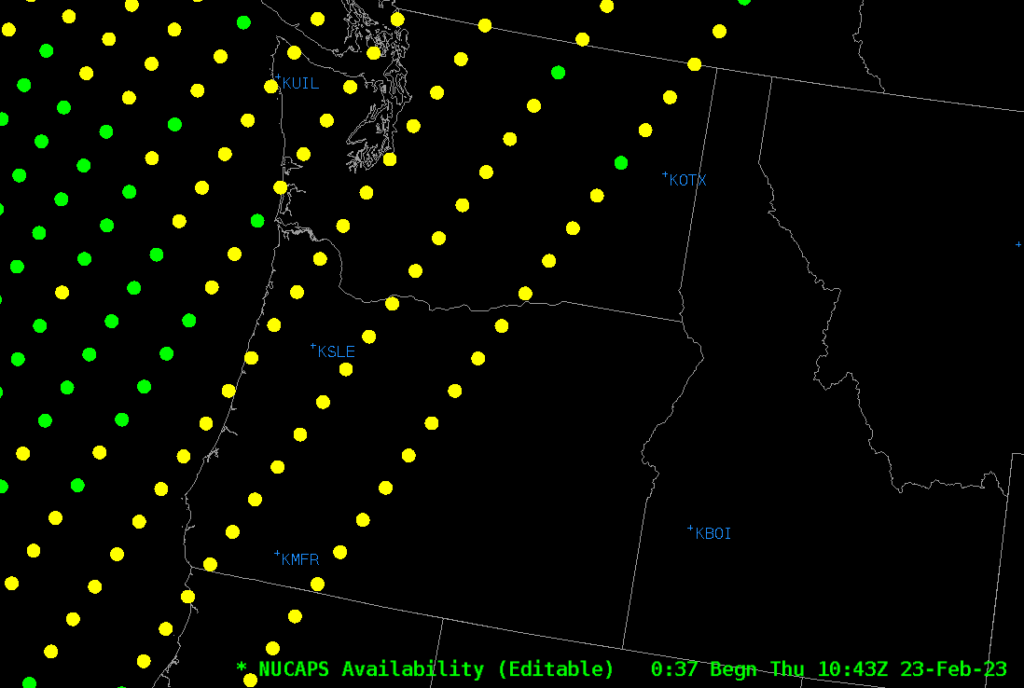
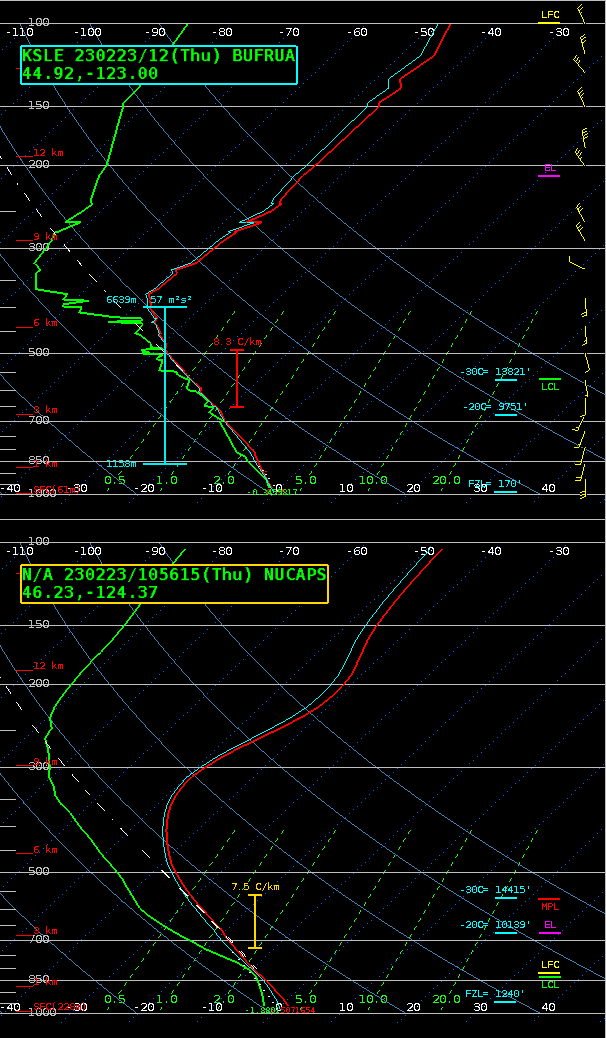
The AWIPS display of NUCAPS Sounding Availability for the morning pass on 23 February is shown below. Note the ‘green’ sounding point just off the coast of Oregon, just west of the mouth of the Columbia River. The toggle below compares the sounding there with the 1200 UTC sounding at Salem (KSLE) (Here’s a toggle of a more complete NSharp sounding window for the two soundings). The overall aspects of the two soundings are very similar, but the NUCAPS profile is smoother.
NUCAPS Sounding Availability plot, 1043 UTC on 23 February 2023 (Click to enlarge)NUCAPS 0156 UTC Sounding just west of the Oregon/Washington border in the Pacific Ocean, and 1200 UTC soundings at Salem OR (Click to enlarge)
Some of the AWIPS imagery in this post was created using the TOWR-S AWIPS Cloud Instance. Thank you!
GOES-18 “Clean” Infrared Window (10.3 µm) images, with plots of 15-minute surface observations (courtesy Scott Bachmeier, CIMSS) [click to play animated GIF | MP4]
GOES-18 “Clean” Infrared Window (10.3 µm) images (above) include plots of 15-minute surface observations — which showed that the surface visibility at both Portland International Airport (KPDX) and Vancouver Pearson Field (KVUO) was restricted to 1/4 mile at times. The highest snowfall totals included 12.0 inches in the Greater Portland area and 16.0 inches in the Greater Vancouver area.
Added, 27 February 2023
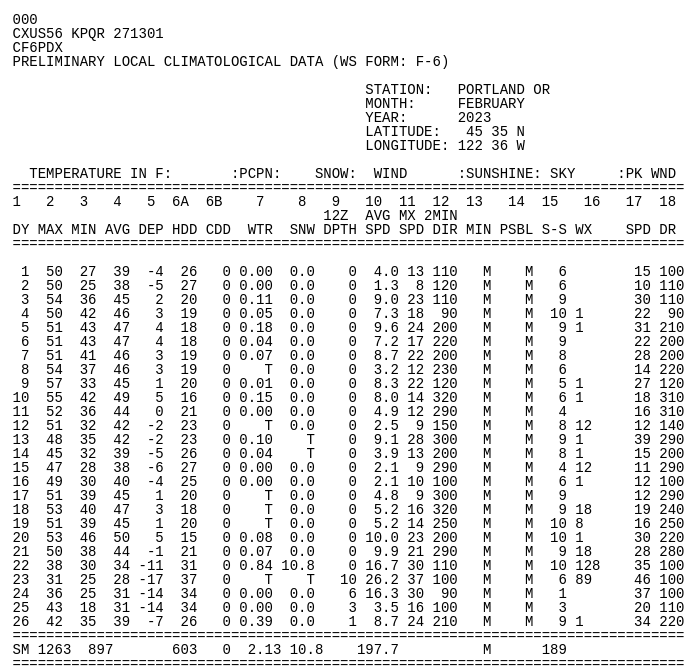
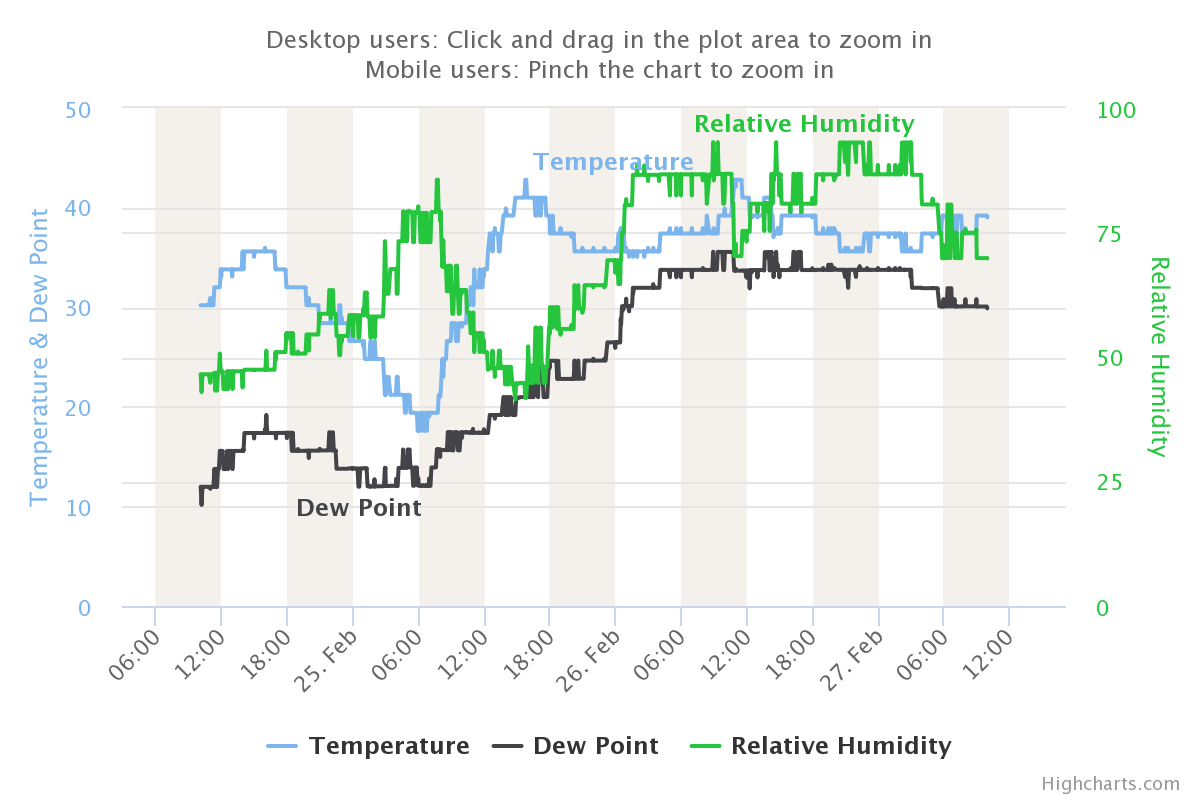
On 25/26 February 2023, another system moved through. This time, however, 850-mb Temperatures were a bit warmer, as shown in the two toggles below (of 850-mb temperature and NUCAPS Quality flags), one from 2138 UTC on 25 February, before the onset of precipitation, and one from 2119 UTC on 26 February, after the cold frontal passage. Note in particular the warmer temperatures on 25 February (green enhancements vs. cyan in the imagery above from early on 23 February!) Instead of snow, Portland had cold rain on the 26th. Here is the Meteorogram that includes 26 February (from this site).
850-mb Temperature and NUCAPS Quality Flags, 2138 UTC on 25 February 2023 (Click to enlarge)850-mb Temperatures and NUCAPS Quality Flags, 2119 UTC on 26 February 2023 (Click to enlarge)