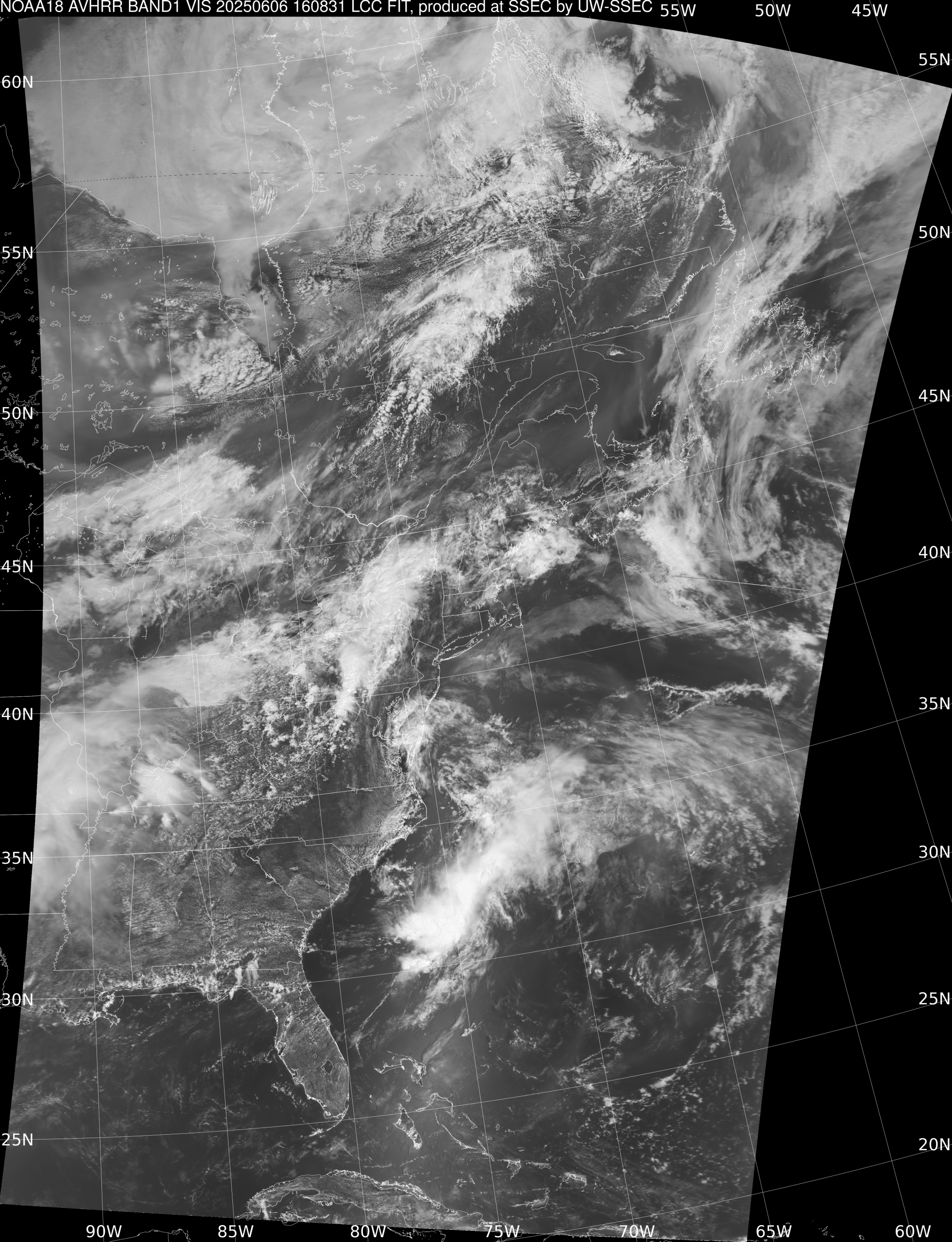

GOES-13 outage

May 22nd, 2013
Last GOES-13 10.7 µm image before outage

Last GOES-13 10.7 µm image before outage

GOES-13 suffered an anomaly overnight: the satellite is no longer pointed towards the Earth for as yet unknown reasons. The anomaly started at 03:40 UTC on 22 May, and at 04:29 UTC, GOES-15 (GOES-West) began a 30-minute full disk scan schedule.

Last GOES-13 10.7 µm images before outage

Last GOES-13 10.7 µm images before outage

Successive images from just before the anomaly (above), at nominal times of 03:15 UTC and 03:32 UTC, are shown. There is a large navigation offset (~200 km) apparent in the right panel, which panel shows the last scanned image from GOES-13 before the major anomaly. The offset is also apparent in the image at the top of the page (Look, for example, at Cuba, or in the northwest corner of the image)

GOES-14, in standby mode at 105.5 W longitude, has been activated; the first images from GOES-14 will be available at 05:00 UTC 23 May. There are no plans now to move GOES-14 from its current position. In the meantime, GOES engineers are working on a solution to GOES-13′s problems. An update from the Environmental Satellite Processing Center (ESPC) is scheduled for around Noon eastern time (see NOAA NESDIS GOES Special Bulletins). Note that GOES-14 data will *not* be relayed via GOES-13 — so ground station users will need to reposition their antennas to receive GOES-14 direct readout data.

In addiion, GOES-12 (GOES-South America) continues to give coverage from its position over 60 W. Full-disk imagery is available every three hours, and routine sampling (both Imager and Sounder) continues and is available here.

– Note to NWS AWIPS Users –

GOES-15 (GOES-West) full-disk coverage

GOES-15 (GOES-West) full-disk coverage

With the temporary loss of GOES-13 (GOES-East), the GOES-15 (GOES-West) satellite has been placed into Full Disk scan mode, which only provides imagery over CONUS every 30 minutes — and the quality of the imagery degrades over the eastern US (above), due to the very large view angle from GOES-15 (which is located at 135 West longitude). Parallax error is also greatly increased.

During such an outage of geostationary satellite data, imagery from polar-orbiting satellite instruments (such as Terra and Aqua MODIS, Suomi NPP VIIRS, and POES AVHRR) can be used when available to help fill in temporal data gaps, and also provide a much more detailed image in terms of spatial resolution (and with a lack of a large parallax error).  The animation below covers the time period from 04:00 UTC to 11:00 UTC, showing the GOES-15 IR imagery at 30 minute intervals with the insertion of IR images from MODIS, VIIRS, and AVHRR when available. You can immediately see the value of the higher spatial resolution provided by the polar-orbiting satellite data.

Animation of GOES-15 IR images, with available polar-orbiter satellite IR images inserted

Animation of GOES-15 IR images, with available polar-orbiter satellite IR images inserted

A direct comparison of GOES-15 and Suomi NPP VIIRS IR imagery around 07:00 UTC (below) again shows the better detail provided by the higher spatial resolution of VIIRS (along with a lack of parallax error) for severe thunderstorms that were producing large hail and damaging winds across parts of the lower Mississippi Valley region.

Comparison of 07:03 UTC Suomi NPP VIIRS IR image and 07:00 UTC GOES-15 IR image

Comparison of 07:03 UTC Suomi NPP VIIRS IR image and 07:00 UTC GOES-15 IR image

In addition, the availability of a Day/Night Band on the VIIRS instrument can provide a “visible image at night”, which can be helpful for locating important  features such as convective overshooting tops and low-level cloud edges (below).

Suomi NPP VIIRS IR and Day/Night Band images

Suomi NPP VIIRS IR and Day/Night Band images

Imagery and products from AVHRR, MODIS, and VIIRS are available in AWIPS via LDM subscription.

GOES-15 Super Rapid Scan Operations (SRSO) imagery

May 19th, 2013
GOES-15 (left) SRSO visible images and GOES-13 (right) RSO visible images (click image to play animation)

GOES-15 (left) SRSO visible images and GOES-13 (right) RSO visible images (click image to play animation)

The GOES-15 (GOES-West) satellite was placed into Super Rapid Scan Operations (SRSO) on 18 May 2013 (to support the IfloodS field experiment), providing bursts of imagery at 1-minute intervals. At the same time, the GOES-13 (GOES-East) satellite had been placed into Rapid Scan Operations (RSO) due to the threat of severe weather over the central US, providing images as frequently as every 5-10 minutes. A comparison of 0.63 µm visible channel GOES-15 SRSO  images with GOES-13 RSO images covering western Kansas, western Oklahoma, and the Texas Panhandle regions (above; click image to play animation; also available as a QuickTime movie) showed interesting views of the convective storm development — both from a perspective of the different satellite viewing geometries, and also the different temporal resolution from the different scanning strategies of the two GOES satellites. One of the more notable tornadoes on this day (SPC storm reports) moved through Rozel, Kansas.

About a half hour prior  to the start of the GOES-15 SRSO period, a sequence of three AWIPS images of 1-km resolution IR data from POES AVHRR (12.0 µm), Suomi NPP VIIRS (11.45 µm), and Aqua MODIS (11.0 µm) showed the rapid cooling of cloud-top IR brightness temperatures (to values of -70 F and colder, black color enhancement), even before any cloud-to-ground lightning strikes were detected (below).

POES AVHRR 12.0 µm IR, Suomi NPP VIIRS 11.45 µm IR, and MODIS 11.0 µm IR images

POES AVHRR 12.0 µm IR, Suomi NPP VIIRS 11.45 µm IR, and MODIS 11.0 µm IR images

A comparison of the 19:43 UTC 1-km resolution Suomi NPP VIIRS 11.45 µm IR image with the corresponding 4.km resolution GOES-13 10.7 µm IR image (below) demonstrated the value of higher spatial resolution for the earlier and more accurate detection of the cold cloud-top IR brightness temperatures values associated with the rapidly-developing convective cells over southwestern Kansas. The actual times that the two satellite were imaging the storms were very close, yet the difference in coldest IR brightness temperature values (-58 C on GOES, compared to -77 C on VIIRS) was quite striking. The northwestward shift in the location of features on the GOES-13 image was due to parallax.

Suomi NPP VIIRS 11.45 µm IR and GOES-13 10.7 µm IR images

Suomi NPP VIIRS 11.45 µm IR and GOES-13 10.7 µm IR images

On the following day (19 May 2013), GOES-15 was again placed into SRSO mode, allowing a similar GOES-15 SRSO vs GOES-13 RSO visible image comparison of the development of severe convection over Oklahoma and Kansas (below; click image to play animation; also available as a QuickTime movie). One of the more notable tornadoes on this day (SPC storm reports) moved through Shawnee, Oklahoma, causing 2 fatalities.

GOES-15 (left) SRSO visible and GOES-13 (right) RSO visible images (click image to play animation)

GOES-15 (left) SRSO visible and GOES-13 (right) RSO visible images (click image to play animation)

Flooding in metropolitan New York City

May 8th, 2013
Morphed Total Precipitable Water (click image to play animation)

Morphed Total Precipitable Water (click image to play animation)

The “cutoff low” system that had been slowly moving across the country for the past week spawned heavy rains which caused flooding in parts of the New York City (NYC) metropolitan area on the morning of 08 May 2013. The image above, of MIMIC Total Precipitable Water, showed a plume of moisture-rich air moving northwestward from the tropical Atlantic towards New York (in advance of the surface frontal system associated with the cutoff low). This region of enhanced precipitable water was seen on the previous day as well. The blended Total Precipitable Water Product (as described here) also showed a plume of higher-than-normal precipitable water air moving over New York City — values of 170+% of normal are over New York City, with a value exceeding 200% (in yellow) sits over the Atlantic Ocean.

GOES-13 6.5 µm water vapor imagery (click image to play animation)

GOES-13 6.5 µm water vapor imagery (click image to play animation)

High values of Total Precipitable Water were being been entrained by the circulation of the upper-level low, as shown in the animation of GOES-13 water vapor channel images above. The cyclonic circulation had drawn the moisture north and west into the NYC metropolitan region, and convection developing in the cyclonic flow was responsible for the heavy rainfall. A Suomi/NPP VIIRS 11.45 µm IR image, below, overlain with model-based 500-mb geopotential height fields, showed the strong convection and the cyclonic flow moving into New York. It is interesting to note that the southern tail end of the convection sat right over the Gulf Stream.

Suomi/NPP VIIRS 11.45 µm imagery

Suomi/NPP VIIRS 11.45 µm imagery

The GOES-13 satellite had been placed into Rapid Scan Operations (RSO) mode, providing images as frequently as every 5-10 minutes. Discrete convective cells with cloud-top IR brightness temperatures colder than -60º C (darker red color enhancement) can be seen developing and moving northwestward over the NYC area on 4-km resolution GOES-13 10.7 µm IR channel images (below).

GOES-13 10.7 µm IR channel images (click image to play animation)

GOES-13 10.7 µm IR channel images (click image to play animation)

A closer view using 1-km resolution POES AVHRR 0.63 µm visible channel and 10.8 µm IR channel images at 10:09 UTC or 6:09 AM local time (below) revealed the texture and shadowing of overshooting tops on the visible image, with cloud-top IR brightness temperature values as cold as -67º C (dark red color enhancement).

POES AVHRR 0.64 µm visible channel and 10.8 µm IR channel images

POES AVHRR 0.64 µm visible channel and 10.8 µm IR channel images

GOES-13 0.63 µm visible channel imagery (below) showed the different bands of convection that developed offshore and moved inland across the NYC metropolitan area.

GOES-13 Visible Imagery (0.63 µm) (click image to play animation)

GOES-13 Visible Imagery (0.63 µm) (click image to play animation)


Thunderstorms producing heavy rain and flash flooding in Puerto Rico

May 7th, 2013
GOES-13 10.7 µm IR channel images (click image to play animation)

GOES-13 10.7 µm IR channel images (click image to play animation)

McIDAS images of 4-km resolution GOES-13 10.7 µm IR channel images (above; click image to play animation) showed the development of large thunderstorms that produced heavy rainfall (including 5.18 inches at San Sebastian) which led to flash flooding over parts of Puerto Rico (Local Storm Report) on 07 May 2013. Since their primary Doppler radar was out of service due to an upgrade to Dual-Polarization technology, the National Weather Service forecast office at San Juan had requested that the GOES-13 (GOES-East) satellite be placed into Rapid Scan Operations (RSO), which provided images as frequently as every 5-10 minutes (instead of the nominal 15-minute image interval). The coldest cloud top IR brightness temperature seen on the GOES-13 IR image sequence above was -69º C at 17:10 UTC.

Due to a full-disk scan at 18:00 UTC, there was a 30-minute gap between the 17:45 UTC and 18:15 UTC GOES-13 images. A timely overpass of the NOAA-19 polar-orbiting satellite at 18:03 UTC provided a 1-km resolution AVHRR 10.8 µm IR image during this 30-minute GOES-13 gap (below), which revealed that a new convective cell had rapidly developed over the northwestern portion of Puerto Rico (exhibiting a cloud-top IR brightness temperature as cold as -79º C).

NOAA-19 AVHRR 10.8 µm IR channel image

NOAA-19 AVHRR 10.8 µm IR channel image

AWIPS images of the MIMIC Total Precipitable Water (TPW) product (below; click image to play animation) showed that an elongated plume of high TPW (50 to 60 mm or 2.0 to 2.4 inches, darker orange color enhancement) was rotating across the Puerto Rico region during this period, providing ample moisture to fuel the development of deep convection and heavy rainfall. Surface analyses suggest that the eastern portion of the TPW  plume was associated with the remnants of a cold frontal boundary, while an impulse over the Caribbean Sea was helping to transport higher TPW values from the south (TJSJ is the station identifier for San Juan, Puerto Rico).

MIMIC Total Precipitable Water product (click image to play animation)

MIMIC Total Precipitable Water product (click image to play animation)