
Mesoscale Convective System in the Gulf of Mexico

April 3rd, 2013
Suomi NPP VIIRS 0.7 µm Day/Night Band and 11 µm IR (Click image to toggle)

Suomi NPP VIIRS 0.7 µm Day/Night Band and 11 µm IR (Click image to toggle)

One of the first strong Mesoscale Convective Systems of the Spring Season traversed the Gulf of Mexico during the day on April 3rd. Suomi/NPP VIIRS imagery of the 0.7 µm Day/Night Band and the 11.45 µm IR channel, from 0722 UTC, above, showed elements that are characteristic of these convective features. For example, the thick convective clouds were able to obscure most of the city lights of southern Louisiana on the Day/Night Band image, and the 11.45 µm IR imagery showed very cold cloud tops — colder than -80 C — over the Gulf of Mexico, along with evidence of cloud-top gravity waves over southern Louisiana (and the adjacent coastal waters) as well as over east Texas.

The active convection was generating considerable lightning activity: there were 1275 negative and 186 positive cloud-to-ground (CG) strikes detected over the region within a 15-minute period. Cloud tops illuminated by lightning were depicted as bright smears of light in the Day/Night Band (DNB) image, indicative of the very fast VIIRS sensor scanning motion. Of particular interest was a pair long black streaks immediately downstream of two large areas of lightning-illuminated cloud tops: one over Louisiana, and another farther south over the Gulf of Mexico (magnified image). These black lines represented a post-saturation “recovery period” after the DNB sensor detected very bright areas associated with intense lightning activity. It is also important to note that there is not always a direct correspondence between DNB image cloud-top lightning signatures and clusters of CG lightning activity — only one positive GC strike was seen close to the bright Louisiana DNB image lightning streak, while numerous negative and positive CG strikes were in the vicinity of the Gulf of Mexico DNB lightning streak.

Suomi NPP VIIRS 11.45 µm IR and GOES-13 10.7 µm IR images (Click image to toggle)

Suomi NPP VIIRS 11.45 µm IR and GOES-13 10.7 µm IR images (Click image to toggle)

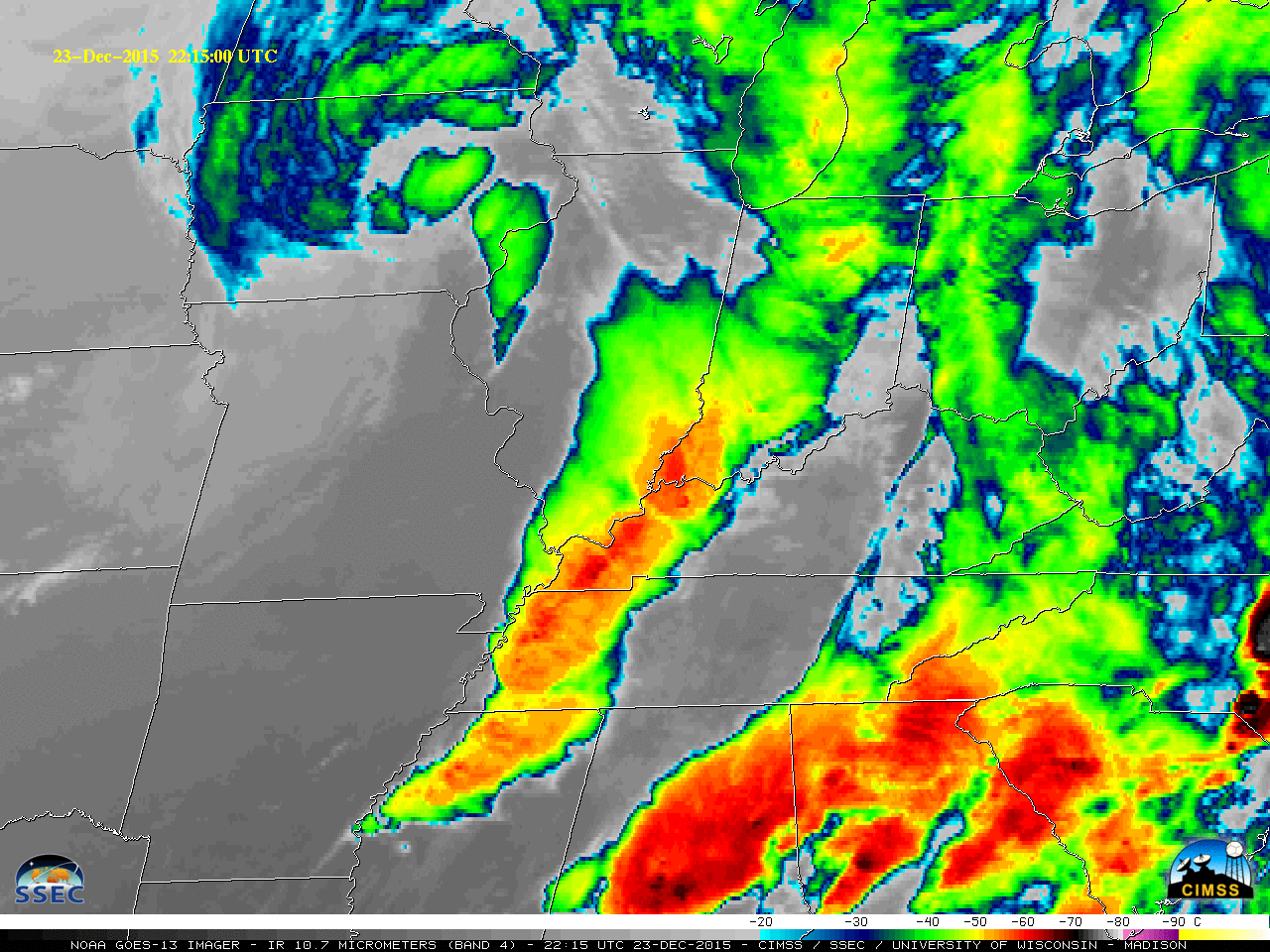
A toggle between the high-resolution (1 km) Suomi/NPP VIIRS 11.45 µm IR imagery and the nominal 4-km imagery of the 10.7 µm IR from the GOES-13 Imager, above, demonstrates the importance of higher spatial resolution in detecting features that are important to aviation. Only the Suomi/NPP VIIRS image cleanly depicts the transverse bands that herald the potential presence of turbulence in the cirrus canopy.

GOES-13 10.7 µm Imagery and auto-detected Overshooting Tops

GOES-13 10.7 µm Imagery and auto-detected Overshooting Tops

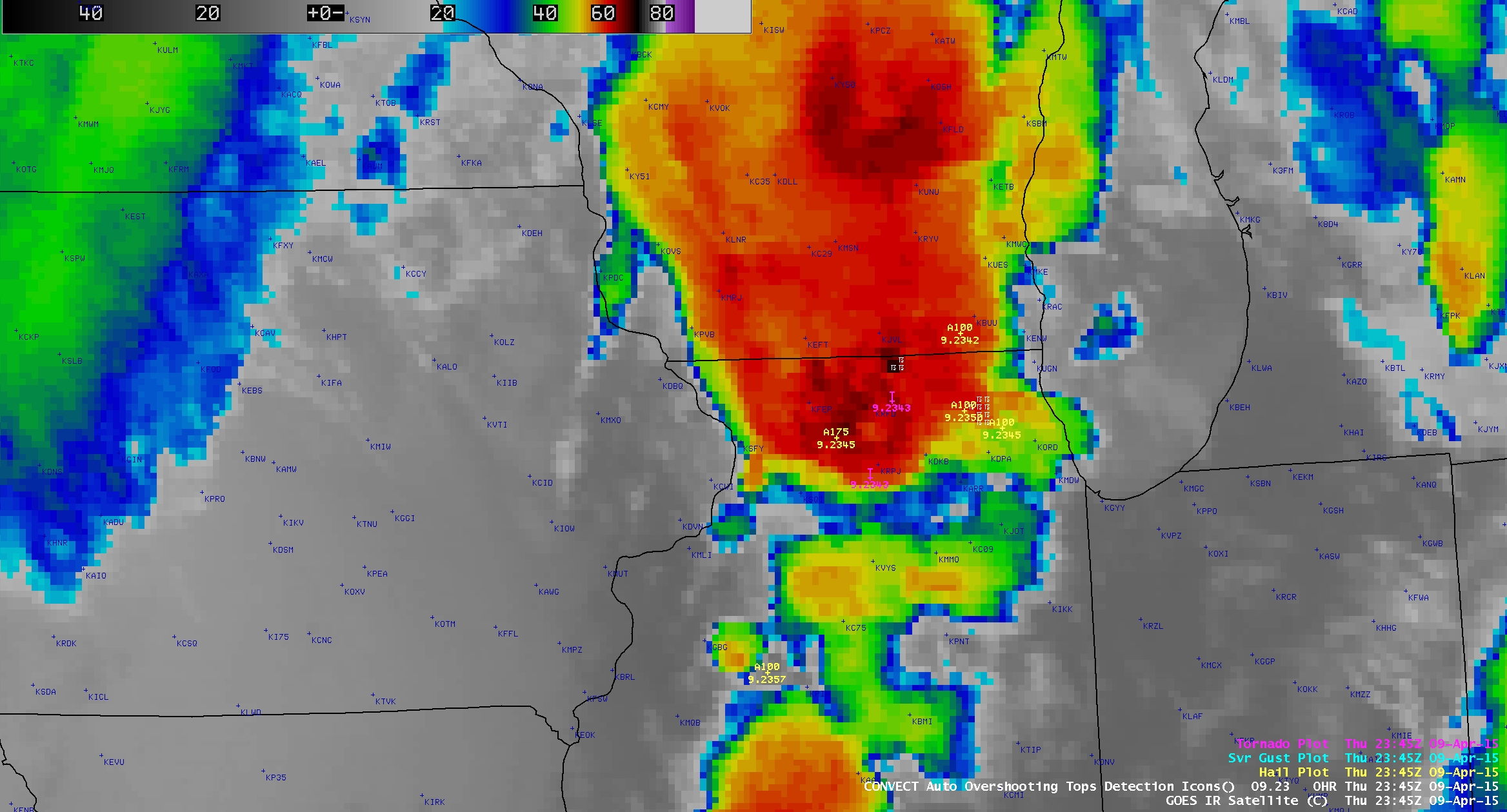
Despite limitations related to resolution, GOES data can be used to automatically detect overshooting tops. The image above shows the GOES 10.7 µm image from AWIPS. Auto-detected overshooting tops are also shown, and they are spread out along the southern flank of this convective system, a region where convective development was ongoing. (Click here to see a toggle between the 10.7 µm image with and without the auto-detected overshooting tops). That persistent convective growth was also shown by the UW Cloud-top Cooling product, shown below, a product that highlights the most rapidly cooling growing convective towers.

GOES-13 10.7 µm Imagery and Computed Cloud-Top Cooling (Click image to animate)

GOES-13 10.7 µm Imagery and Computed Cloud-Top Cooling (Click image to animate)

Four Channels of MODIS imagery from 1841 UTC on 3 April (Click image to animate)

Four Channels of MODIS imagery from 1841 UTC on 3 April (Click image to animate)

The convective system has persisted through the early afternoon on April 3rd, as shown in the loop of different MODIS channels, above (including the visible, water vapor, cirrus channel, and 10.7 µm IR). This system is unusually far south into the Gulf of Mexico for early April.

Mesoscale Convective Vortex in northwestern Arkansas

June 4th, 2012
GOES-13 10.7 µm IR images + 0.63 µm visible images (click image to play animation)

GOES-13 10.7 µm IR images + 0.63 µm visible images (click image to play animation)

A large Mesoscale Convective System (MCS) developed over far northeastern Oklahoma during the pre-dawn hours on 04 June 2012, which eventually produced a Mesoscale Convective Vortex (MCV) that moved into northwestern Arkansas the following morning. AWIPS images of 4-km resolution GOES-13 10.7 µm IR images (at night) followed by 1-km resolution  GOES-13 0.63 µm visible channel images during the day (above) showed the large nocturnal canopy of cold clouds (with cloud-top IR brightness temperatures as cold as -76º C at 05:01 UTC) — then the dissipating convection revealed the cyclonic circulation of the MCV during the late morning hours. As the atmosphere destabilized with daytime heating, new thunderstorms were seen to develop in the vicinity of the MCV as it moved toward Little Rock, Arkansas (station identifier KLIT).

A comparison of a 1-km resolution MODIS 11.0 µm IR image with the corresponding 4-km resolution GOES-13 10.7 µm IR image at 08:15 UTC or 3:15 AM local time (below) demonstrated that finer-scale cloud top details (such as subtle anvil-top gravity waves) were apparent on the higher resolution MODIS image.  Note that the satellite features are displaced slightly to the northwest on the GOES-13 IR images — this is due to parallax error resulting from the large viewing angle from the GOES-East satellite.

MODIS 11.0 µm IR image + GOES-13 10.7 µm IR image

MODIS 11.0 µm IR image + GOES-13 10.7 µm IR image

These anvil-top gravity waves were even more evident on a comparison of 1-km resolution Suomi NPP VIIRS 11.45 µm IR channel and 0.7 µm Day/Night Band (DNB) images at 08:42 UTC or 3:42 AM local time (below). A full moon provided excellent illumination of the thunderstorm cloud top, allowing an very good night-time view of the subtle overshooting top and gravity wave structures (just as they might be seen on a daytime visible image). In addition, note that the city lights of the Wichita, Kansas area could be seen through the thin veil of cloud top cirrus along the northwestern edge of the storm.

Suomi NPP VIIRS 11.45 µm IR channel + 0.7 µm Day/Night Band images

Suomi NPP VIIRS 11.45 µm IR channel + 0.7 µm Day/Night Band images

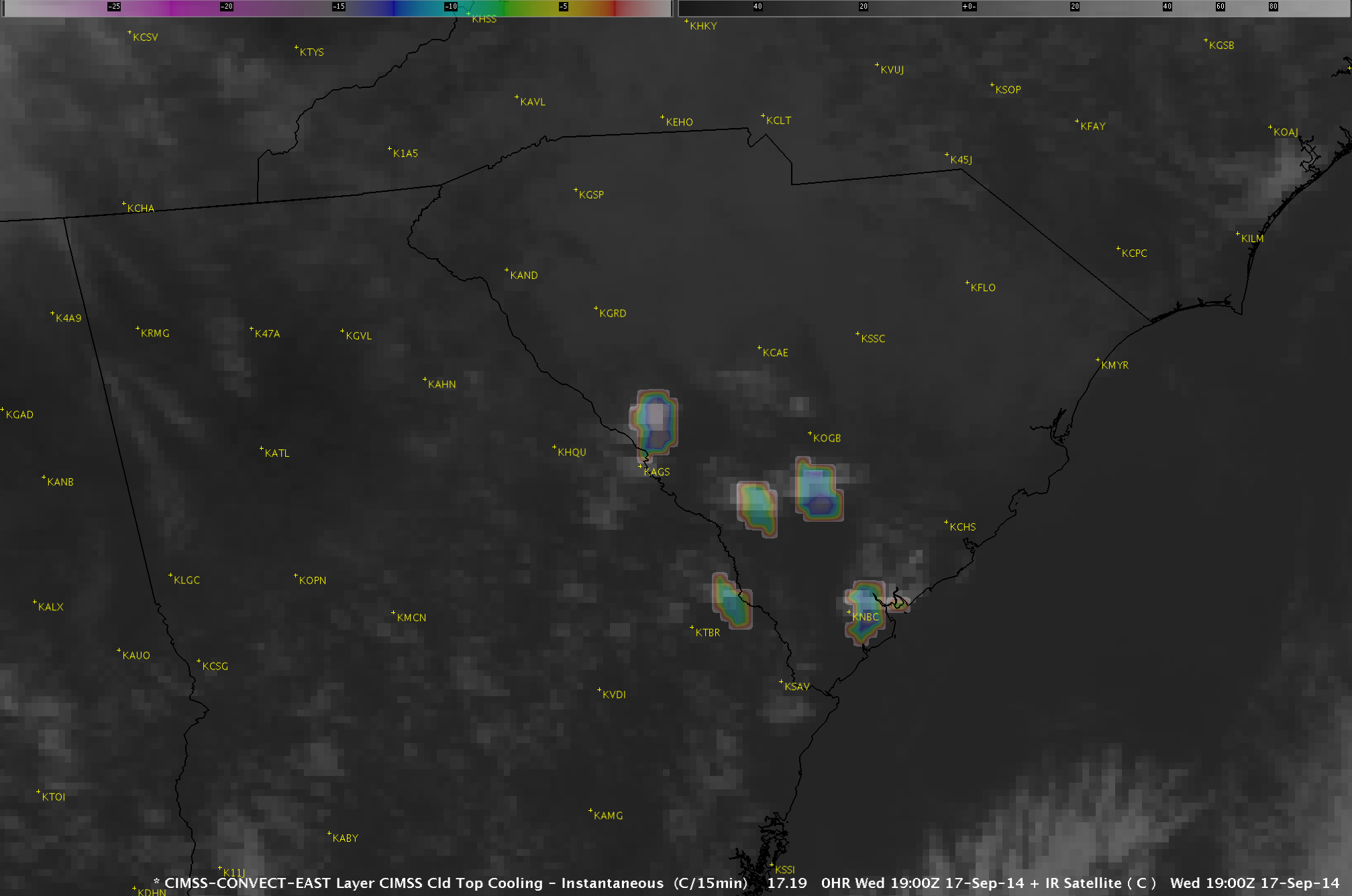
As the MCV was approaching the Little Rock area, the CIMSS Cloud Top Cooling Rate product detected CTC rates in excess of 20º C per 15 minutes, just as the thunderstorms began to produce their first cloud-to-ground lightning strike at 17:45 UTC (below). This cluster of thunderstorms was responsible for a few reports of hail and damaging winds as it continued to move southeastward across Arkansas during the afternoon hours (SPC storm reports).

GOES-13 0.63 µm visible images + Cloud Top Cooling Rate + Cloud-to-ground lightning strikes

GOES-13 0.63 µm visible images + Cloud Top Cooling Rate + Cloud-to-ground lightning strikes

===============================

GOES-13/GOES-15 Sounder DPI Total Precipitable Water (click image to play animation)

GOES-13/GOES-15 Sounder DPI Total Precipitable Water (click image to play animation)

MCVs typically are sustained in regions of low shear and abundant moisture. A plot of 850-500 mb shear from the NAM for 1800 UTC on 4 June show very low values of vertical wind shear in place over Arkansas. GOES Sounder DPI Total Precipitable water (the loop above) shows that the MCV developed in an axis of enhanced moisture. The blended TPW product (a product that blends together GOES Sounder and GPS measurements of precipitable water) shows an axis of values at or above 100% of normal through the mid-south where the MCV formed.

A visible image loop (every half-hour) from June 4 2012 that shows the evolution of the system is below.

GOES-13 0.63 µm Visible Imagery (click image to play animation)

GOES-13 0.63 µm Visible Imagery (click image to play animation)

Cloud-Top Cooling Rate

May 30th, 2012
GOES Sounder DPI Lifted Index 1600 UTC on May 30 2012

GOES Sounder DPI Lifted Index 1600 UTC on May 30 2012

Satellite descriptors of the atmosphere over the central High Plains on May 30th suggested an atmosphere ripe for convection. For example, the GOES Sounder DPI Lifted Index showed an axis of instability from central Oklahoma to northwest Kansas, with widespread values (yellows, reds, purples) at or below -4. (The unstable area overlaps nicely with the slight risk for the day diagnosed for the day by the Storm Prediction Center). The NearCasting product (below, and available on-line here) suggests that convective instability will persist over southern Nebraska and extend southward into Oklahoma for most of the day.

GOES-13 NearCast product (click image to play animation)

GOES-13 NearCast product (click image to play animation)

GOES-13 Visible Imagery and UW Cloud-Top Cooling Rate

GOES-13 Visible Imagery and UW Cloud-Top Cooling Rate (click image to play animation)

Given this type of environment, what can cloud-top cooling rate tell you? The Cloud-Top Cooling Rate is a satellite-based product that diagnoses how quickly the growing convective towers are cooling with time, and strong cooling means rapid vertical convective growth. The strongest cooling is where the strongest convective growth is occurring, and that cooling is well-correlated with the subsequent development of NEXRAD signatures (MESH, maximum VIL, reflectivity at -10 C, etc.) The loop above shows GOES-13 visible imagery with the cloud-top cooling rate superimposed. (Real-time imagery of the cloud-top cooling rate product is available here) The The cloud-top cooling rate product highlights a persistently and quickly growing convective feature near McCook, Nebraska before and shortly after 1700 UTC. By 1800 UTC, that feature is a severe thunderstorm warned for high winds and hail.

The UW Cloud-Top Cooling Rate product is being evaluated at the Hazardous Weather Testbed taking place this month. At the HWT Blog, there are many examples of using the product in concert with knowledge of the synoptic and mesoscale conditions to anticipate strong thunderstorm development.

SPC storm reports show that the system with the strong Cloud-Top Cooling Rate subsequently produced 1-inch hail near Holdrege.