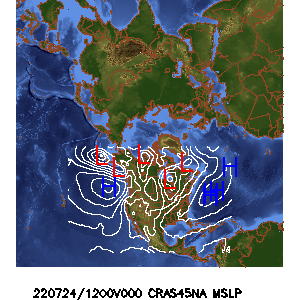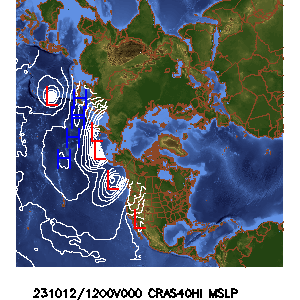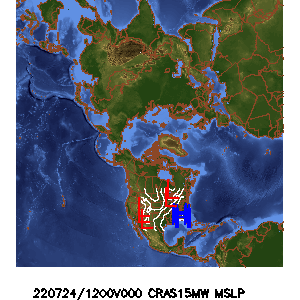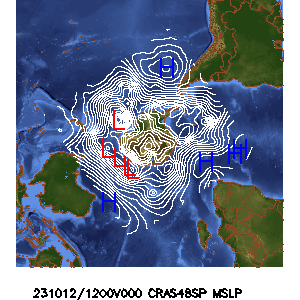
Model Analyses and Forecasts
Last updated:
Wed May 22 02:15:33 UTC 2013
CRAS AUTOMATED ADMINISTRATIVE MESSAGE
COOPERATIVE INSTITUTE FOR METEOROLOGICAL SATELLITE STUDIES MADISON WI
0215 AM UTC WED MAY 22 2013
GEMPAK IMAGE GENERATION FOR THE /12Z CRAS48SP IS NOW COMPLETE.
.END
Google Earth KML Output
CRAS/CRTMA GRIB2 Output
Directory for CRAS45NA GRIB2 Messages on AWIPS 212 Grid
Directory for CRAS45AK GRIB2 Messages on AWIPS 216 Grid
Directory for CRAS40HI GRIB2 Messages on AWIPS 254 Grid Subset
Directory for CRAS20NC GRIB2 Messages on Custom North Central US Grid
Directory for CRTMA5GL GRIB2 Messages on Custom Great Lakes Grid
WRF Transition Experiment Verification
CRAS-WRF Accumulated Precipitation Differences for Recent Runs:
00Z,
12Z
CRAS-WRF Total Precipitable Water Differences for Recent Runs:
00Z,
12Z
CRAS-WRF Total Sky Cover Differences for Recent Runs:
00Z,
12Z
Verification Bootstrap Confidence Intervals for Recent Runs:
00Z,
12Z
WRF Transition Experiment Forecast Skew-T Comparisons
Comparison of 00 UTC radiosonde observation against CRAS/WRF forecasts for:
Int'l Falls, MN,
North Platte, NE,
Springfield, MO
Comparison of 12 UTC radiosonde observation against CRAS/WRF forecasts for:
Int'l Falls, MN,
North Platte, NE,
Springfield, MO
These computer forecasts are
EXPERIMENTAL
and are used by atmospheric scientists
to assess the value of satellite observations in numerical weather prediction.
Although the accuracy of these products is consistently good, forecast errors can
occur due to non-receipt of data, observation errors, and computer problems. The
forecasts are fully automated and are not always closely monitored by CIMSS
scientists. The risk of using the CRAS to plan weather-sensitive activities falls
on the user. Feedback will help us improve deficiencies in the CRAS. Please
forward any comments to the CRASmaster using the
contact form.
About these Forecasts
The purpose of the CRAS is to test the use of satellite observations
in a numerical prediction model. The quality of a numerical forecast
depends on having accurate observations of the environment to define the
forecast model's initial state. Here is a list of the observations that are
currently used in the CRAS 12-hour spin-up forecast:
3-layer precipitable water (mm) from the GOES-13/15 sounders
Cloud-top pressure (hPa) and effective cloud amount (%) from the GOES-13/15 sounders
4-layer thickness (m) from the GOES-13/15 sounders
Cloud-top pressure (hPa) from MODIS
Gridded hourly precipitation amounts from NCEP
Cloud-track and water vapor winds (m/s) from the GOES-13/15 imagers
Cloud-top pressure (hPa) and effective cloud amount (%) from the GOES-13 imager
Surface temperature (C), dew points (C) and winds (m/s)
Sea surface temperature (C) and sea ice coverage (%) from NCEP rtg analysis
Support for the National Weather Service
CRAS GRIB2 Model Output in D-2D
NWS Area Forecast Discussions referencing CRAS
Special Pacific Ocean Sector for Forecast Operations in American Samoa
Archive of Forecast Synthetic IR Window Loops from Select Runs (Animated GIFs)
BUFKIT Forecast Soundings for Select Wisconsin Locations, as well as International Falls, MN, North Platte, NE,
and Springfield, MO, from Recent Runs of: WRF20GFS,
WRF20CRAS, WRF20CIGB
Numerical Weather Prediction Research at CIMSS
61 km CRAS Hurricane Track Prediction Project
60-hour Simulation of the Edmund Fitzgerald Storm
Numerical Weather Prediction Concepts
Land Surface Energy/Water Budget Studies
CIMSS Convective Development Nearcasting Model (CCDNM) — GOES-East
Nowcasting Analysis Project using the GOES sounder
CIMSS Convective Development Nearcasting Model (CCDNM) — GOES-West
Publications referring to CRAS
Please refer questions or comments to the CRASmaster using the
contact form.
|