

Highlights for the week ending August 7, 2026
Data and Information
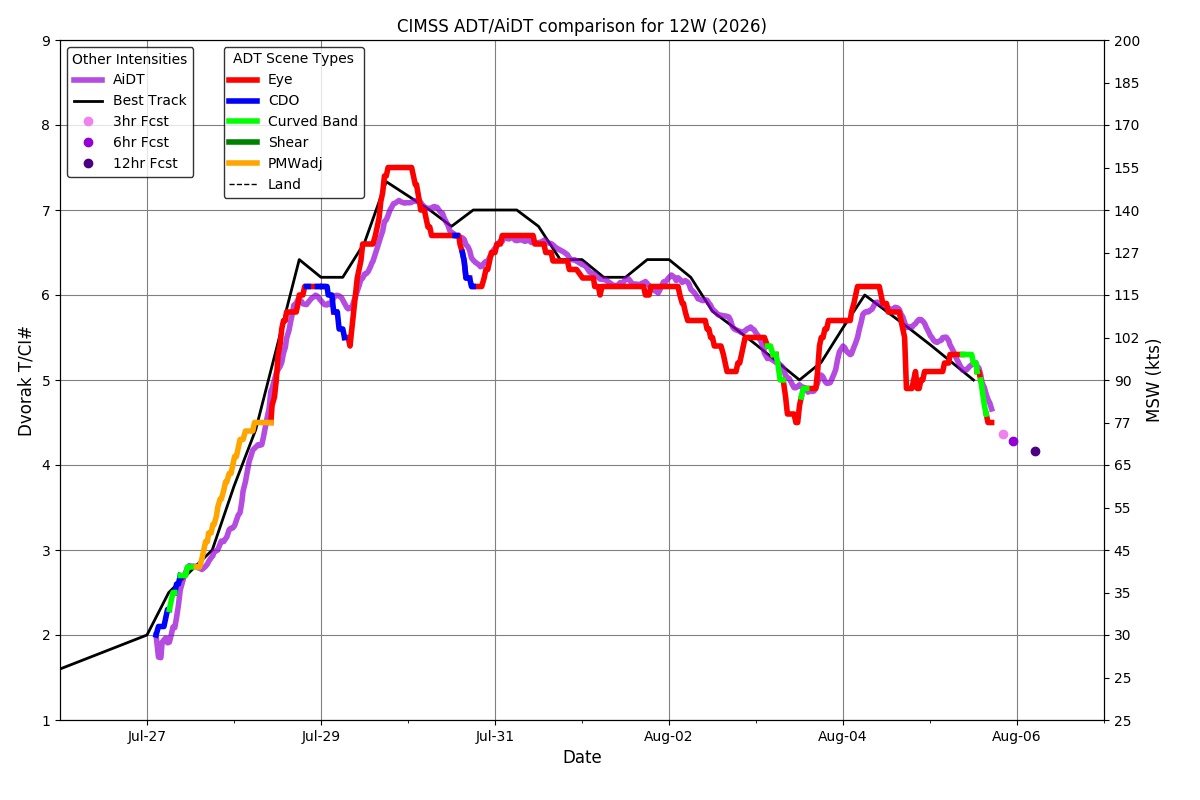
Latest upgrade of CIMSS AiDT launched
- Tim Olander, CIMSS; timo@ssec.wisc.edu
-
 Figure: AiDT estimates of maximum wind speed (MSW) for Super Typhoon Dolphin (12W).
Training and Education
SSEC 2026 10-Week Summer Internship
SSEC’s 2026 Summer Internship program, which started in June, is ending this week. The program involved hiring 13 undergraduate students to work this summer on various SSEC projects. Some interns worked on programming tasks like creating a website for visualizing PATMOS-x data, optimizing existing websites in SSEC, and creating a website used for teaching elementary and high school students about remote sensing. Other interns had more research based projects like using machine learning to determine the importance of a 5.15um band on the GXI instrument, or assessing AIRS and CrIS cloud phase classification continuity, and many more. Interns presented their progress in final presentations last week.
- David Hoese, SSEC; david.hoese@ssec.wisc.edu
- Sam Batzli, SSEC
-
 Figure: Summer interns during their final presentations meeting.

Social Media and Blog Posts
CIMSS Satellite Blog Updates
The Cooperative Institute for Meteorological Satellite Studies (CIMSS) Satellite Blog was updated with the following posts: “Category 5 Super Typhoon Dolphin in the West Pacific” (Jul. 29), “Saharan Dust Plume Streams Over the Atlantic” (Jul. 31), “Eruption of Sheveluch on Russia’s Kamchatka Peninsula” (Jul. 31), “Wind-driven Old Trails Fire burns through parts of the Spokane area, forcing numerous evacuations” (Aug. 1) and “River valley fog in the Upper Midwest” (Aug. 3).
- Tim Wagner, CIMSS; tim.wagner@ssec.wisc.edu
- Scott Bachmeier, CIMSS
-
 Figure: NOAA-21 VIIRS True Color RGB image at 1327 UTC on July 31, 2026 -- showing the hazy signature of Saharan Dust streaming westward over the Atlantic Ocean.
 -
 Figure: GOES-18 Visible image with an overlay of the Fire Mask derived product at 2205 UTC on August 1, 2026 -- showing the large thermal signature (red pixels) and smoke plume associated with the Old Trails Fire as it was approaching the northwestern suburbs of Spokane, Washington.


Publications
Publication on global forecast impact from 3D winds
A manuscript entitled “Observing System Simulation Experiments for Three-Dimensional Wind Fields Generated by Tracking Humidity Features in Hyperspectral Sounder Retrieved Profiles” has been published in the Journal of Atmospheric and Oceanic Technology (JTECH). Key findings indicate that assimilating these 3D winds improves global forecast skill, with the largest impacts seen in wind analyses. The greatest benefits are achieved with a constellation that provides uniform global sampling, while forecast improvements are most pronounced in the Southern Hemisphere due to the limited availability of conventional observations. The publication is available online.
Citation:
- Agnes Lim, CIMSS; alim@ssec.wisc.edu
- Dave Santek, CIMSS