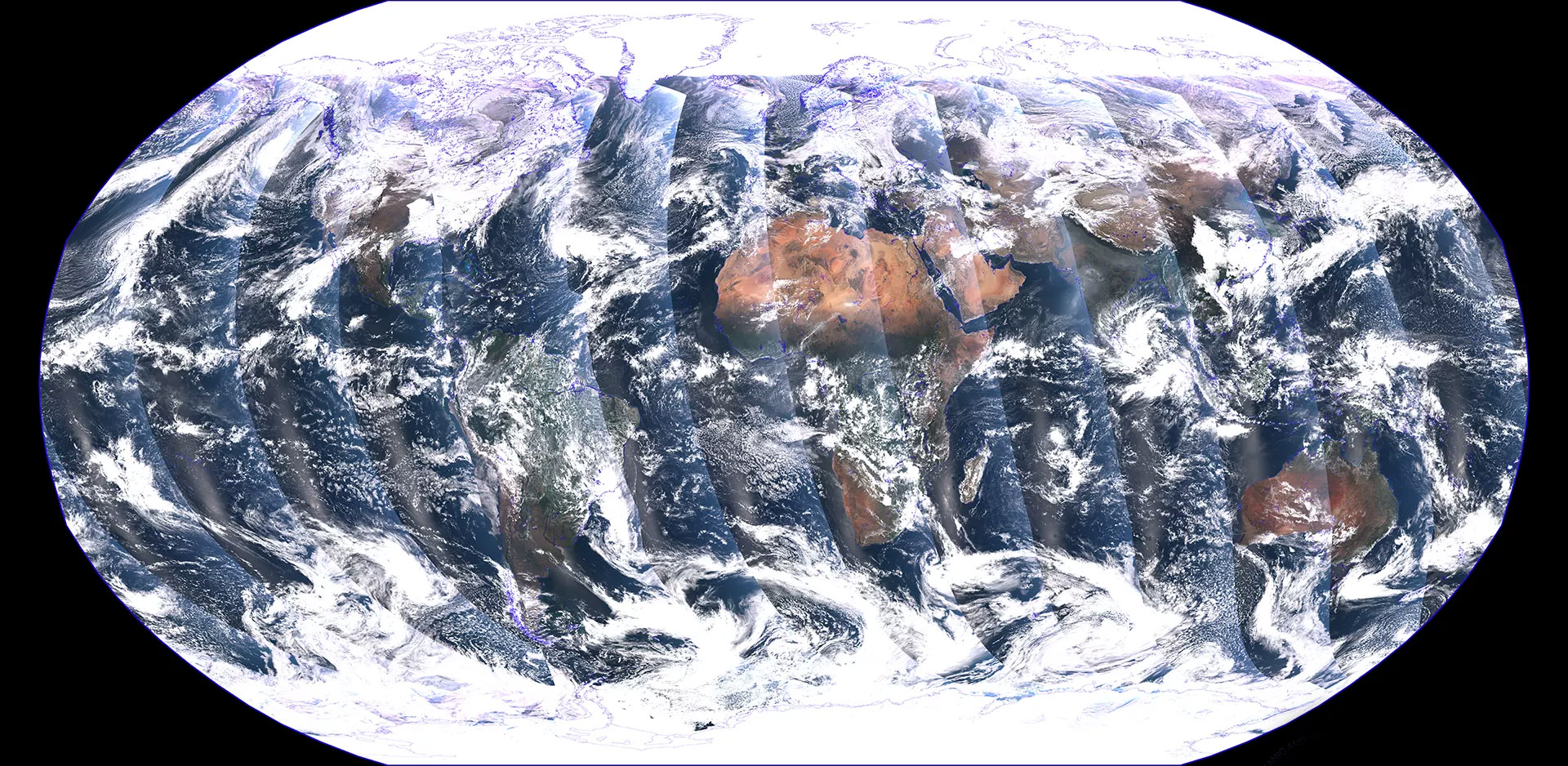
Useful datasets for satellite data processing
The mapping of global parameters such as SST, albedo, terrain types,
surface elevation, emissivity…have been widely produced from polar
satellites, serving as important input parameters for users who are processing
data.
This page provides a list of parameters together with data volumes and
formats, links to documentation and sites from where you can download/request
the datasets.
§ Land surface types and emissivity models
§ Land surface LST/emissivities,
§ SST and albedo, snow cover
§ elevation and type atlas
§ Global atmospheric circulation statistics/analysis
Land surface types and emissivity models
Emissivity models developed by Snyder et al (1998) have been applied to 14 emissivity classes by combining different land cover classes extracted from the International Geosphere-Biosphere Program (IGBP) to generate a range of emissivity spectra for each class. This range is generated by varying the many factors which affect the emissivity for example the viewing angle, water content, vegetation density, growth state…This allow to estimate the mean, maximum and minimum surface emissivities at each wavelength for each of the 14 classes.Snyder et al (1998) ‘Classification-based emissivity for land surface temperature measurement from space’ Int. J. Remote Sensing, 1998, vol 19, no14
IGBP:
19 classes at a 1km resolution. Raster format.
Size (global) Global Ecosystems
compressed 27.5 Mb: uncompressed 694.4 Mb
http://edcdaac.usgs.gov/glcc/glcc.asp
http://edcdaac.usgs.gov/glcc/globdoc2_0.html
http://LPDAAC.usgs.gov/glcc/globe_int.asp
A land classification using MODIS following the IGBP classification scheme is available at http://modis-atmos.gsfc.nasa.gov/ECOSYSTEM/. It is a global static dataset stored on an equal-angle rectangular grid at 1-minute resolution. Data are stored in HDF format and the size is about 1.1GB. The dataset is generated from the official MODIS land ecosystem classification dataset, MOD12Q1 October 15, 2000.
Land surface emissivities
Different emissivity atlas are available through the web.
The ASTER spectral library http://speclib.jpl.nasa.gov/ which is a compilation
of almost 2000 spectra of natural and man made materials, includes data
from three other spectral libraries: the Johns Hopkins University spectral
library made by Salisbury and D’Aria (2004), the Jet Propulsion
Laboratory spectral library, and the United States Geological Survey
spectral library.
The ASTER library is available on CD-ROM at no charge. The Johns Hopkins
University spectral library includes emissivity spectra of about 80 samples
of soils, rocks, different vegetation types and snow/ice within the 2-14
um spectral range at about 2cm-1 resolution;
The MODIS UCSB (University of California) Emissivity Library
http://www.icess.ucsb.edu/modis/EMIS/html/em.html is a collection of
Emissivity laboratory measurements of natural (water, ice, snow, soil,
minerals and vegetation) and manmade materials, from about 3um to 15um.
Data are directly accessible on line for the desired material.
Monthly and routine MODIS land surface LST/emissivities at a 0.05degree
resolution, in HDF format, size of about 625 MB, are distributed by:
http://edcdaac.usgs.gov/modis/dataproducts.asp
Same data are also available at the EOS Data gateway:
http://edcimswww.cr.usgs.gov/pub/imswelcome
P. Francis (2003) has developed an IR land surface emissivity atlas
for NWP applications. See the documentation:
http://www.metoffice.com/research/nwp/publications/papers/technical_reports/sa.html
University of Wisconsin-Madison IR Land Surface Emissivity database: http://cimss.ssec.wisc.edu/iremis/
SST and albedo
Monthly and pentade global SST climatologies with a resolution of 9 km
are available at:http://podaac.jpl.nasa.gov/cgi-bin/dcatalog/fam_summary.pl?sst+clim
Size is about 188MB each file in compressed form. Software to read the data is also available on the site.
Also routine SST products from AVHRR, MODIS,ATSR and GOES instruments
are also available in HDF format on the same site . See
http://podaac.jpl.nasa.gov/cgi-bin/dcatalog/summary.pl?sst
Different temporal and spatial resolution are offered.
Daily, eight-day and monthly albedo and NDVI climatologies are generated
from MODIS observations at a 1 minute resolution, HDF format. See:
http://modis-atmos.gsfc.nasa.gov/ALBEDO/index.html
Snow
Daily operational snow cover analysis is provided by NESDIS at:http://www.ssd.noaa.gov/PS/SNOW/index.html
Elevation and type atlas
The 1km global land cover characterization database, generated from the
1km AVHRR NDVI product, allows to separate land and water surfaces with
a good accuracy.http://edcdaac.usgs.gov/glcc/globdoc1_2.asp#derived
A global digital elevation model 30 arc (approximately 1 kilometer)
topography database
http://edcdaac.usgs.gov/gtopo30/gtopo30.asp , available at no charge
via ftp, is divided in 33 subsets to facilitate the distribution, each
of them with a size of about 50MB.
Coastlines can be extracted at different resolution (0.2, 1, 5, 25 km) using the GMT (Generic Mapping Tools) software developed by scientists at University of Hawaii and NOAA, available at: http://gmt.soest.hawaii.edu/
Also two datasets for the surface type (flag sea/land) and for the surface
elevation at a 1/6*1/6 degrees resolution are part of the IAPP or AAPP
ATOVS pre-processing packages. See:
IAPP: http://cimss.ssec.wisc.edu/opsats/polar/iapp/iapp_info.htm
AAPP: http://www.metoffice.com/research/interproj/nwpsaf/aapp/index.html
Global atmospheric circulation statistics/analysis
Global monthly AVHRR climatology over land from 5 years of GAC data at.
0.15 degree resolution. Climatologies include TOA, surface reflectances,
NDVI, T4, T5, PWI at:
http://www.ngdc.noaa.gov/seg/cdroms/AVHRR97_d1/document/avhrrcli/document.htm
http://www.ngdc.noaa.gov/seg/cdroms/AVHRR97_d1/aareadme.htm
Global atmospheric circulation statistics/analysis from the Geophysical
Fluid Dynamics Laboratory based on 15 years of weather station, ship,
and buoy data at a 5*2.5degrees resolution
http://gcmd.nasa.gov/records/GCMD_NCAR_CIRC.html
http://iridl.ldeo.columbia.edu/SOURCES/.OORT/
http://dss.ucar.edu/datasets/ds217.0/