
Eruption of the Nabro volcano in Eritrea

June 14th, 2011
FY-2E 0.73 µm visible channel images (click image to play animation)

FY-2E 0.73 µm visible channel images (click image to play animation)

The Nabro volcano erupted in the northeast Africa country of Eritrea on 12 June 2011. An oblique view using the Chinese FY-2E satellite (positioned over the Equator at 105º East longitude) 0.73 µm visible channel data (above; click image to play animation) showed the volcanic plume streaming northwestward on 13 June (the Nabro volcano is located near the bottom center of the images. Note that the plume became much brighter on the visible images later in the day, due to forward scattering.

A sequence of EUMETSAT Meteosat-9 7.35 µm “water vapor channel” images (below; click image to play animation) was useful for following the leading edge of the volcanic plume (the volcano summit is circled on the first few images of the animation). The plume moved northward over far northeastern Africa, and eventually curved anticyclonically and passed over the northern Arabian Peninsula on 14 June. It then appeared as if the leading edge of the volcanic plume might have eventually become entrained into a conveyor of isentropic ascent, where moisture began to increase (exhibiting a darker blue color on the water vapor images).

Meteosat-9 7.35 µm water vapor channel images (click image to play animation)

Meteosat-9 7.35 µm water vapor channel images (click image to play animation)

Eruption of the Grímsvötn volcano in Iceland

May 21st, 2011
Meteosat-9 visible channel images

Meteosat-9 visible channel images

Meteosat-9 visible channel images (above) showed the volcanic eruption cloud emanating from the Grímsvötn volcano in Iceland on 21 May 2011 (images courtesy of Dave Santek, SSEC). According to the Icelandic Met Office, at 21:00 UTC the eruption plume had risen to an altitude of over 65,000 ft (~20 km). It is interesting to note that the London VAAC reported

EXTREME LIGHTNING ACTIVITY DETECTED BY ATDNET SYSTEM OF UK METOFFICE, 7000 BETWEEN 1900Z AND 0100Z

The volcanic eruption cloud was even apparent on the very edge of GOES-13 (GOES-East) imagery, as can be seen in an animation of visible channel images (below). The oblique viewing angle from this satellite helped to emphasize the large vertical extent of the eruption cloud.

GOES-13 visible channel images

GOES-13 visible channel images

An animation of Meteosat-9 SEVIRI volcanic ash retrieval product 4-panel images (below) indicated that the initial volcanic cloud was ice-dominated (darker red color enhancement on the false color Red/Green/Blue or RGB images in the upper left panel). Around 22:00 UTC, the signal of an SO2 cloud (green color enhancement) began to appear around the northern and northeastern edges of the eruption cloud — very high values of SO2 were subsequently seen moving northward, using data from the OMI instrument.

A more distinct volcanic ash signal (pink color enhancement on the RGB image) became obvious as time progressed along the southern and southeastern edges of the eruption cloud, and by 06:00 UTC on 22 May the retrieved maximum ash height had reached 7.52 km (with the mean volcanic ash particle effective radius at 11.14 µm). Total volcanic ash mass loading had increased to 44.97 kilotons by 06:00 UTC.

Meteosat-9 volcanic ash retrieval 4-panel images

Meteosat-9 volcanic ash retrieval 4-panel images

CIMSS participation in GOES-R Proving Ground activities includes the generation of these SEVIRI volcanic ash retrievals, which offers a demonstration of the type of products that will be available for volcanic ash monitoring with the ABI instrument on the future GOES-R satellite.

===== 22 MAY UPDATE =====

Meteosat-9 visible channel images (below; click image to play animation) showed that multiple volcanic eruption clouds were still reaching significant vertical heights, with much of this high-altitude material drifting northward. Another lower-altitude hazy volcanic ash cloud could also be seen spreading out just off the southern coast of Iceland. See the US Air Quality blog for MODIS true color images and OMI SO2 images of the volcanic eruption.


Meteosat-9 visible images (click to play animation)

Meteosat-9 visible images (click to play animation)

Earth Day 2011

April 22nd, 2011
Global montage of geostationary satellite images (click to play animation)

Global montage of geostationary satellite images (click to play animation)

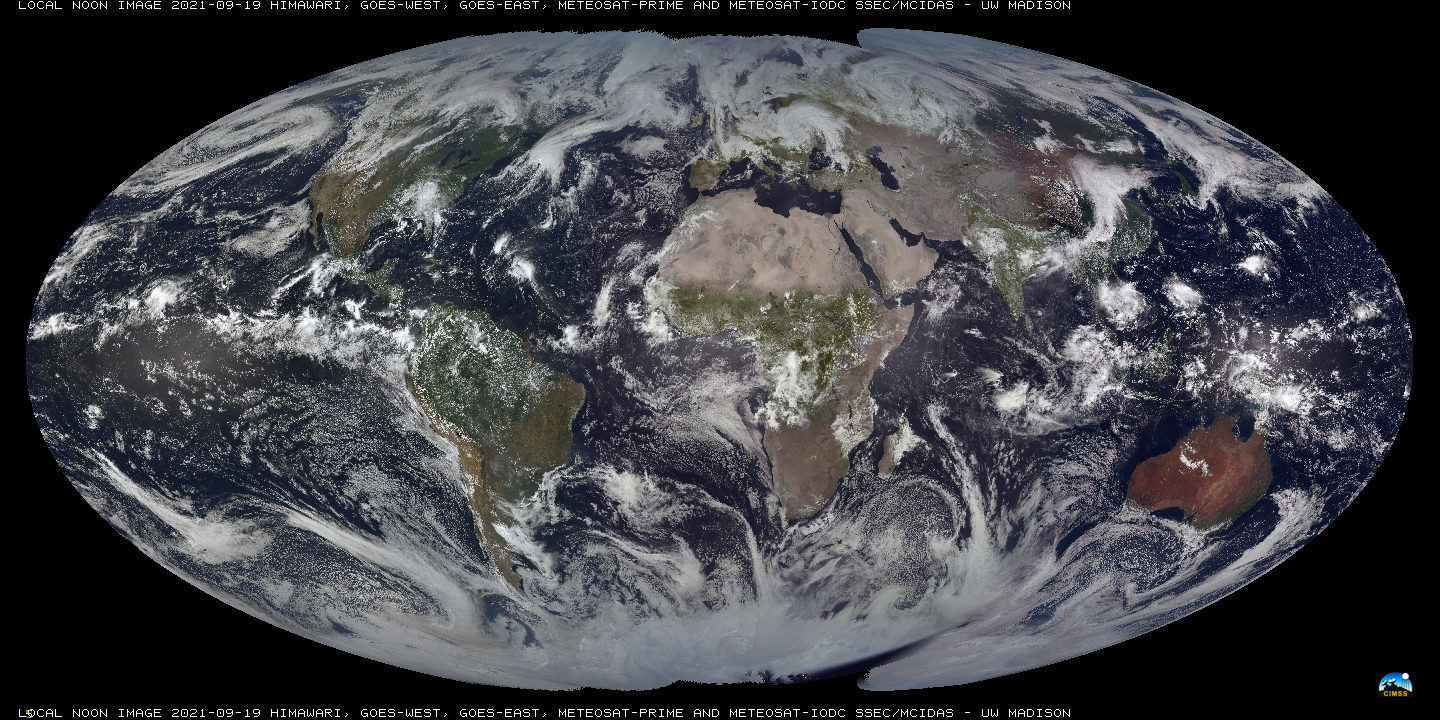
The “spinning globe” satellite image montage (above; click image to play animation) showed the cloud formations around the planet on Earth Day (22 April 2011). This product is created by combining data from 5 of the currently operational geostationary orbiting meteorological satellites (GOES-East at 75º West longitude, GOES-West at 135º West longitude, Meteosat at 0º longitude, Meteosat at 63º East longitude, and MTSAT at 145º East longitude), polar orbiting satellites, and a topographic background map of the Earth. The spinning globe product is created every 3 hours, and is available for either the latest time period or an animation covering the last 3 weeks.

MODIS IR image atmospheric motion vectors over the Arctic region

MODIS IR image atmospheric motion vectors over the Arctic region

Polar-orbiting satellites such as the NASA Terra and Aqua platforms also provide us with valuable information over the polar regions of the Earth (which are not sampled well by geostationary satellites, due to the very large viewing angles). Cloud-tracked winds (or “atmospheric motion vectors”) can be calculated by comparing the location of features on successive images — examples of Terra and Aqua MODIS winds from 22 April 2011 over the Arctic region (above) and the Antarctic region (below) provide valuable input into numerical weather prediction models.

MODIS IR image atmospheric motion vectors over the Antarctic region

MODIS IR image atmospheric motion vectors over the Antarctic region

These are just a few examples of the diverse array of real-time satellite data and products that are available from the Space Science and Engineering Center at the University of Wisconsin – Madison every day.