
Flooding along the Red River in North Dakota

April 11th, 2011
MODIS false color RGB image (displayed using Google Earth)

MODIS false color RGB image (displayed using Google Earth)

A MODIS false color Red/Green/Blue (RGB) image from the SSEC MODIS Today site (above; courtesy of Kathy Strabala, CIMSS) showed the areal extent of the unprecedented overland flooding that was occurring along parts of the Red River in North Dakota on 11 April 2011. Spring snow-melt along with recent heavy rainfall were contributing to the flooding. Interstate 29 north of Fargo was closed on the previous day due to rising floodwater covering the roadway.

AWIPS images of 1-km resolution MODIS 0.65 µm visible channel and 2.1 µm near-IR “snow/ice” channel data (below) was also useful for helping to highlight the location of the flooded areas. Both water and frozen lakes appear as very dark features on the 2.1 µm “snow/ice” channel image — but the frozen lakes are brighter white on the visible image.

MODIS 0.65 µm visible image + MODIS 2.1 µm near-IR "snow/ice" image

MODIS 0.65 µm visible image + MODIS 2.1 µm near-IR "snow/ice" image

A comparison of 250-meter resolution MODIS true color and false color RGB images (below) offered a more detailed view of the flooding in the Fargo and Grand Forks areas. The flooded areas exhibited a “muddy” light brown appearance on the true color image. Farther to the west, the still-frozen Devils Lake (whose water level had reached a new record high level) and portions of northeastern North Dakota that still had snow cover (as much as 6 inches remaining on the ground) could also be seen (snow cover and frozen lakes appeared as lighter blue to cyan features on the false color image).

250-meter resolution MODIS true color and false color RGB images

250-meter resolution MODIS true color and false color RGB images


River flooding due to heavy rains across the Upper Midwest region

September 29th, 2010
MODIS false color images (13 September and 29 September 2010)

MODIS false color images (13 September and 29 September 2010)

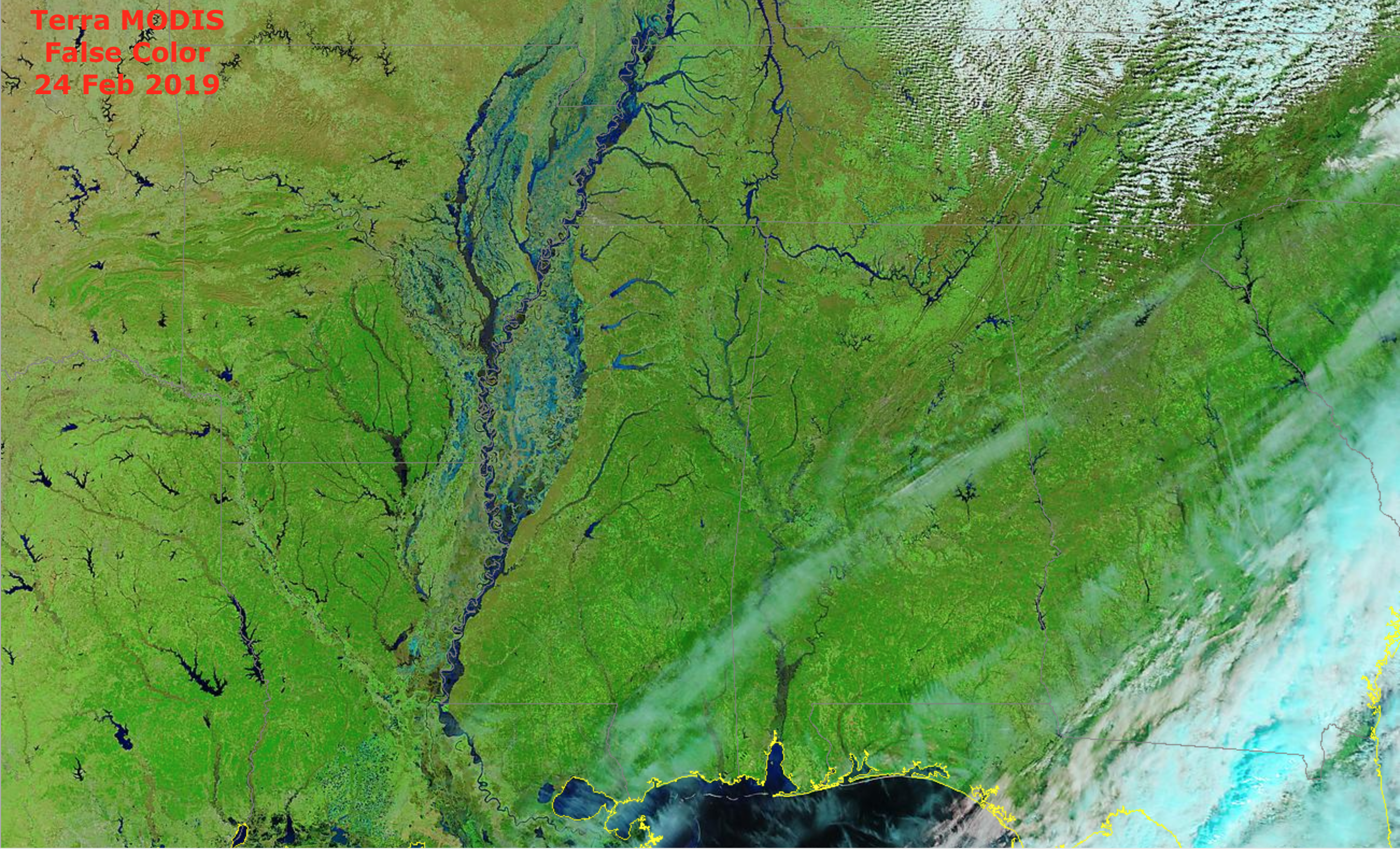
A comparison of 250-meter resolution MODIS false color Red/Green/Blue (RGB) images from the SSEC MODIS Today site (above) show dramatic changes in some of the larger rivers (primarily the Mississippi River and the Wisconsin River) before (13 September 2010) and after (29 September 2010) parts of the Upper Midwest region received very heavy rainfall. Two locations in Wisconsin are highlighted where there were evacuations ordered due to flooding: Arcadia (on 23 September) and Portage (on 27 September).

These false color Red/Green/Blue images are created using MODIS bands 7/2/1 — water shows as the very dark features, allowing the changes in river boundaries  (as well as areas that have experienced significant water inundation) to be easily seen.

Lingering snow cover in the Upper Peninsula of Michigan

April 28th, 2009
MODIS visible, 11.0 µm IR, and Land Surface Temperature images

MODIS visible, 11.0 µm IR, and Land Surface Temperature images

A late-season winter storm dumped as much as 29.0 inches of snow across parts of the Upper Peninsula of Michigan during the 19-21 April 2009 period — in fact, the 20.5 inches that fell at Marquette was their 3rd largest late season 2-day snowfall on record. AWIPS images of the MODIS visible channel, 11.0 µm IR window channel, and the Land Surface Temperature (LST) product (above) showed that a few areas of snow cover still remained on 28 April 2009. MODIS IR brightness temperatures were as cold as +2º to +5º C (darker blue colors) over the patches of snow cover, which still appeared as varying shades of white on the visible image. While there were some MODIS Land Surface Temperature values as cold as the middle 40s F (darker green colors) over the patches of snow cover, the coldest areas showed up as black “NO DATA” pixels in the LST product, due to the product algorithm mistakenly identifying the sharp temperature gradients as cloud features.

Unfortunately, there were no National Weather Service Cooperative Observer locations in the region that reported any snow depth on the morning of 28 April, so the true depth of the remaining snow cover was not known — however, according to an email reply from meteorologist  John Dee (who lives on the Keweenaw Peninsula):

The snow that remains is from the season and is quite variable in depth, with shaded areas in the higher terrain still having a foot or a bit more, but unshaded areas being bare and those that catch some sun and some shade having anywhere in between zero and a foot. I’d say probably 2-6″ still remaining if you took the bare with the other areas with varying depth and averaged things out.

AWIPS examples of a 250-meter resolution MODIS true color image and a 1-kilometer resolution MODIS Sea Surface Temperature (SST) product (below) showed two items of interest: (1) there was a good signal of the runoff of snow-melt water as it flowed northward from the Ontonagon River basin into Lake Superior (note the reddish hue of the water immediately offshore, due to the iron-rich sediment), and (2) the water temperatures in Lake Superior were still quite cold, with MODIS SST values generally in the 35º to 38º F range (darker blue colors).

MODIS true color image + MODIS Sea Surface Temperature

MODIS true color image + MODIS Sea Surface Temperature