
Tehuano wind event following the 02 March 2012 severe weather outbreak

March 4th, 2012
METAR surface reports + tropical surface analyses + ASCAT scatterometer winds

METAR surface reports + tropical surface analyses + ASCAT scatterometer winds

The powerful mid-latitude cyclone that was responsible for the widespread outbreak of severe weather across parts of the eastern US on 02 March 2012 spawned a southward surge of cold air (OPC surface analyses) that traversed the Gulf of Mexico, crossed the mountainous terrain of far southern Mexico, and emerged across the Pacific Ocean as a strong gap wind event known as a Tehuano wind. AWIPS images showing METAR surface reports, Tropical surface analyses, and a pass of ASCAT scatterometer surface winds (above) showed that there was blowing sand reported at Veracruz (station identifier MMVR), with wind gusts to 45 knos at Minatitlan (station identifier MMMT) and 35 knots at Ixtepec (station identifier MMIT).

McIDAS images of GOES-13 0.63 µm visible channel data from 04 March 2012 (below; click image to play animation) showed the cloud arc that marked the leading edge of the Tehuano wind, and also showed the hazy signature of blowing dust that was being lofted southward across the Pacific coast and over the waters of the Gulf of Tehuantepec (hence the name “Tehuantepecer“ given to this type of strong wind event).

GOES-13 0.63 µm visible channel images (click image to play animation)

GOES-13 0.63 µm visible channel images (click image to play animation)

A similar Tehuano wind event was seen on 08 March 2008.

Plume of blowing sand from the White Sands National Monument in New Mexico

February 28th, 2012
GOES-15 (left) and GOES-13 (right) 0.63 µm visible channel images (click image to play animation)

GOES-15 (left) and GOES-13 (right) 0.63 µm visible channel images (click image to play animation)

Strong winds of 50-60 mph (with a peak gust of 74 mph at Fort Stanton, New Mexico) in the wake of a cold frontal passage caused widespread areas of blowing dust from New Mexico to Kansas on 28 February 2012. One notable feture that was apparent on both GOES-15 (GOES-West) and GOES-13 (GOES-East) 0.63 µm visible channel images (above; click image to play animation) was a long plume of blowing sand originating from the White Sands National Monument located in southern New Mexico. Note how the plumes of blowing dust/sand became easier to identify later in the day on the GOES-13 imagery, as the forward scattering angle increased during the afternoon hours.

A 250-meter resolution Aqua MODIS true color Red/Green/Blue (RGB) image from the SSEC MODIS Today site (below; viewed using Google Earth) revealed how the gypsum sand from White Sands appeared white in color (full-resolution view), in contrast to the light brown colored blowing dust that was seen across the Texas and Oklahoma panhandle regions into southwestern Kansas.

MODIS true color Red/Green/Blue (RGB) image (viewed using Google Earth)

MODIS true color Red/Green/Blue (RGB) image (viewed using Google Earth)

The interaction of the strong winds with the terrain could be seen in a comparison of 1-km resolution MODIS 6.7 µm and 4-km resolution GOES-13 6.5 µm water vapor channel images (below), which revealed a complex pattern of mountain waves across the region.

MODIS 6.7 µm and GOES-13 6.5 µm water vapor channel images

MODIS 6.7 µm and GOES-13 6.5 µm water vapor channel images

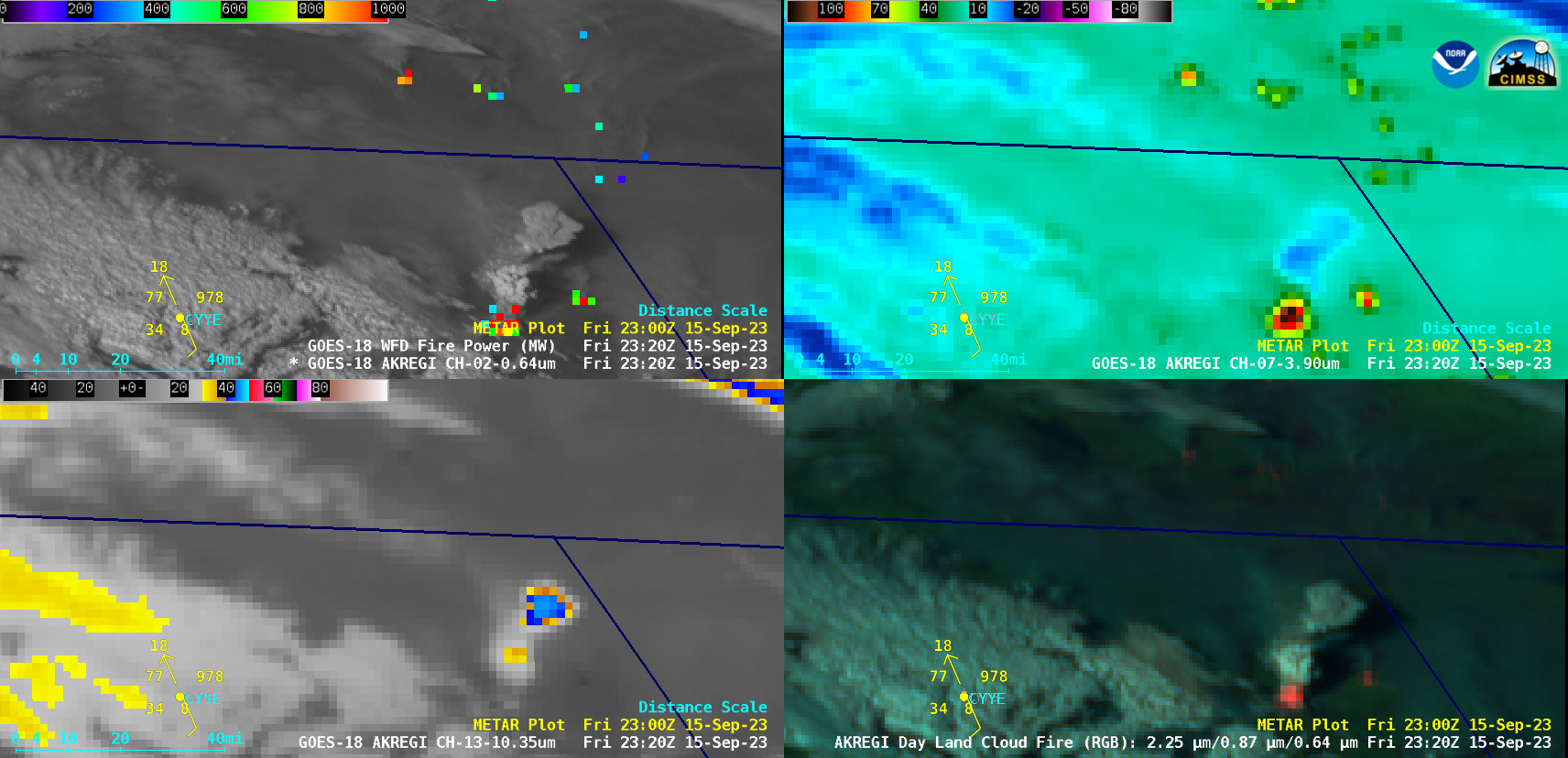
The strong surface winds in tandem with very dry air were creating conditions favorable for wildfire activity — one such fire could be seen in the southern Texas panhandle region in a comparison of 1-km resolution MODIS 3.7 µm and GOES-13 3.9 µm shortwave IR images (below).

MODIS 3.7 µm and GOES-13 3.9 µm shortwave IR images

MODIS 3.7 µm and GOES-13 3.9 µm shortwave IR images

Additional information and imagery from this event can be found on the Wide World of SPoRT blog.

Low cloud over snow cover in the Mid-Atlantic region, and blowing dust in New Mexico and Texas

February 20th, 2012
MODIS 0.65 µm visible image + MODIS Red/Green/Blue (RGB) false color image

MODIS 0.65 µm visible image + MODIS Red/Green/Blue (RGB) false color image

A comparison of AWIPS images of  MODIS 0.65 µm visible channel data with the corresponding MODIS false-color Red/Green/Blue (RGB) image (above) showed a large swath of snow on the ground on 20 February 2012, in the wake of a winter storm that moved across the Mid-Atlantic region the previous day.  The snow cover appears as shades of red on the false-color image, in contrast to the patches of supercooled water droplet clouds that persisted over the western half of the snow swath.

Farther to the west, strong winds (gusting to 60-70 mph) behind a cold front were causing an outbreak of blowing dust across parts of far eastern New Mexico and the Texas Panhandle. A comparison of a MODIS 0.65 µm visible channel image with the corresponding 1.3 µm “cirrus detection channel” image (below) demonstrated how the near-IR cirrus channel can be used to better identify the areal extent of the blowing dust (which might not be apparent on the visible channel imagery). The cirrus detection channel is sensitive to particles that are good scatterers of light, such as ice crystals, dust, volcanic ash, and smoke/haze.

MODIS 0.65 µm visible channel + MODIS 1.3 µm "cirrus detection channel" images

MODIS 0.65 µm visible channel + MODIS 1.3 µm "cirrus detection channel" images

A comparison of the MODIS 0.65 µm visible channel image with the corresponding MODIS 11-12 µm IR difference product (below) demonstrates how 11-12 µm difference values of 1-2 degrees C (yellow color enhancement) highlighted areas where the dust concentration was highest. Airborne dust particles have different emissivities at the 11 µm and 12 µm wavelengths, which allows such an IR difference product to be used to locate and track blowing dust. Recall that the older series of GOES satellites (GOES-8 through GOES-11) had a 12.0 µm IR channel that allowed the creation of a similar IR difference product — but on the latest satellites (GOES-13 through GOES-15) the 12.0 µm IR channel was replaced with a 13.3 µm channel.

MODIS 0.65 µm visible channel image + MODIS 11-12 µm IR difference image

MODIS 0.65 µm visible channel image + MODIS 11-12 µm IR difference image

A closer view of the blowing dust cloud can be seen using 250-meter resolution MODIS true-color RGB images from the SSEC MODIS Today site (below). Some of the primary source regions of the blowing dust (located in New Mexico) can be seen on the earlier Terra image at 17:56 UTC.

Terra and Aqua MODIS true color Red/Green/Blue (RGB) images

Terra and Aqua MODIS true color Red/Green/Blue (RGB) images

In the southeastern Texas Panhandle, a multiple-vehicle accident occurred along Highway 287 around 20:00 UTC (3:00 pm local time), causing a closure of that section of highway between Memphis and Childress (station identifier KCDS). McIDAS images of 1-km resolution GOES-13 0.63 µm visible channel data (below; click image to play animation) showed that an optically thick band of blowing dust was moving through the region between Memphis and Childress around the time of the accident.

GOES-13 0.63 µm visible channel images (click image to play animation)

GOES-13 0.63 µm visible channel images (click image to play animation)